Prevent shelf sag by choosing a stiff material, using enough shelf thickness, shortening the distance between supports, spreading weight evenly, and adding a strong front edge or center support when needed.
In American homes, shelves hold everything from heavy textbooks and kitchen dishes to garage tools, storage bins, and family keepsakes. A shelf may look straight when first installed, yet slowly bend as years of weight press down on its surface. This problem often appears in home offices, bedroom closets, kitchen cabinets, and garage storage systems.
Shelf sag prevention starts before cutting or installing a board. The shelf must match its expected load, material stiffness, depth, thickness, and support spacing. A long shelf made from a thin panel may bend even when its fasteners remain tight. A shorter shelf with a stronger support system can carry the same load with much less movement.
The main goal is to control deflection. Deflection means the amount a shelf bends under weight. Good shelf design keeps this movement small during normal use and limits the chance of permanent bending over time. A strong design also checks the brackets, wall anchors, joints, and cabinet sides instead of focusing only on the shelf board.
Source: quikdrawers.com
What Causes a Shelf to Sag?
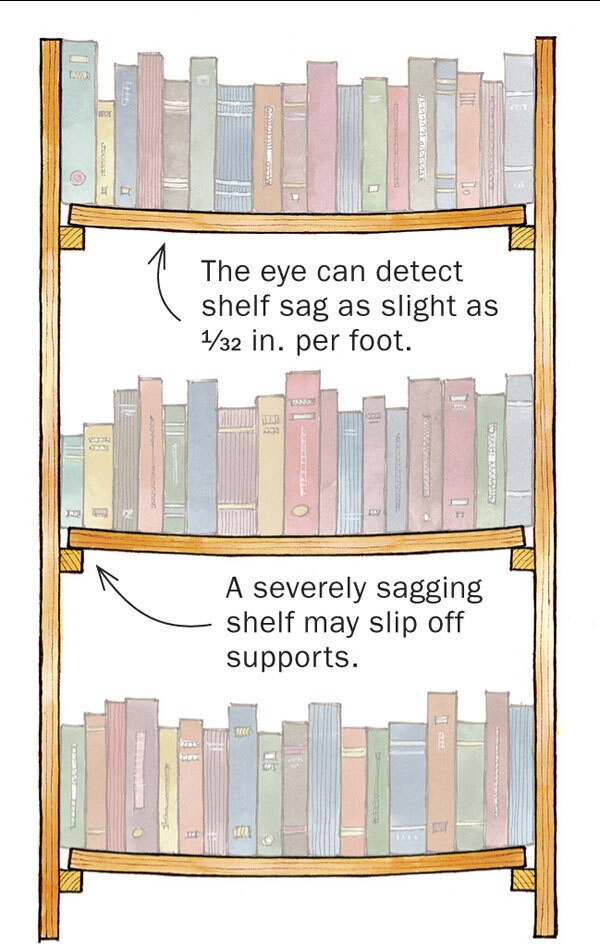
A shelf sags when its material bends under a load. Gravity pulls the contents down, while the supports hold the shelf near its ends or at other support points. The center often moves downward because it has less direct support than the edges.
Wood and wood-based panels behave like flexible beams. They can bend slightly under weight and may return close to their original shape after the load is removed. However, a constant load can cause more movement over time. This gradual increase is known as creep.
Several factors work together to cause shelf sag. A long span, thin board, flexible material, heavy load, weak edge, or poor support system can increase the amount of bending. Moisture changes and material defects can also affect performance.
The problem is not limited to wood. Particleboard, MDF, plywood, glass, and other shelf materials all have different stiffness and strength limits. A shelf that works well for light decorations may not be suitable for heavy books or power tools.
Source: branchingoutwood.com
Long shelf spans
The distance between supports has a major effect on bending. A long unsupported section allows the shelf to move more under the same load.
Insufficient thickness
Thin boards have less resistance to bending. This is a common problem with wide shelves made from standard cabinet panels.
Heavy or uneven loads
Dense books, tools, dishes, and storage boxes can create high loads. Placing most of the weight near the center can make the problem worse.
Weak support connections
Loose shelf pins, weak brackets, poor joints, and inadequate wall anchors can allow movement even when the shelf board itself is stiff.
Long-term material movement
Wood and wood-based panels can develop additional deflection under a constant load. Moisture changes may also affect their dimensions and behavior.
Understanding Shelf Deflection and Creep
Deflection is the downward movement of a shelf under a load. It can be temporary or permanent. A small amount of temporary bending is normal in many shelf designs, but excessive movement can damage joints and make the shelf look uneven.
Creep is the gradual increase in deformation under a sustained load. A shelf may look straight during installation but develop a visible curve after months or years. The effect depends on material, load, moisture, temperature, and support conditions.
This is why a shelf should not be designed only for its appearance on installation day. Leave room for long-term movement and use a design with enough stiffness for the intended storage.
Choose the Right Shelf Material
Choose a shelf material with enough stiffness for its span and expected load. Material stiffness describes how strongly a material resists bending. A stiffer board generally bends less than a more flexible board with the same dimensions under the same conditions.
The best choice depends on the project. Solid hardwood can provide high stiffness and a clean natural edge. Plywood offers layered construction and useful stability. MDF creates a smooth surface for painted furniture, but its stiffness and long-term performance must suit the shelf design. Particleboard can work for light storage when its span and support spacing remain appropriate.
Do not assume that every product in one material category has the same performance. Plywood grade, veneer direction, core construction, board density, wood species, and manufacturing quality all matter. Check the product data when the shelf will carry a large or valuable load.
Source: toolsradar.com
Solid hardwood
Oak, maple, birch, and other hardwoods can provide good stiffness. Actual performance depends on species, grain direction, board quality, knots, and thickness.
Softwood
Pine and fir can work well for shelves when the dimensions and support spacing are suitable. Choose straight boards without major defects in critical areas.
Plywood
Quality plywood has cross-layered veneers that help provide dimensional stability. Check the panel grade, core quality, thickness, and intended use.
MDF
MDF offers a smooth surface and consistent appearance. However, long spans under heavy loads may require thicker panels or extra reinforcement.
Particleboard
Particleboard is common in economical furniture and closet systems. It can be useful for light storage, but long-term loading and moisture exposure require care.
Plywood vs. MDF for Shelf Sag Prevention
Plywood and MDF are both useful shelf materials, but they do not behave in exactly the same way. Plywood uses layers of veneer, while MDF uses compressed wood fibers and resin. Their stiffness depends on product specifications and panel construction.
A good plywood panel may be a practical choice for a long utility shelf or bookcase. MDF can work well for shorter shelves, painted furniture, and cabinet interiors when the load and dimensions are suitable. Neither material should receive an automatic load rating based only on its name.
For a heavy bookshelf, compare published stiffness information or use a suitable shelf calculation. Include the actual panel thickness, clear span, depth, and expected load. If the manufacturer does not provide enough information, use a conservative design with closer supports.
Check panel construction
Look at the core, grade, thickness, and intended application before choosing a sheet product.
Protect exposed edges
Seal or edge-band exposed panel edges as suitable for the product, especially where moisture may enter.
Why Wood Grain and Board Quality Matter
Solid wood does not have identical stiffness throughout every board. Grain direction, knots, slope of grain, moisture, and natural variation can change its bending behavior. A clear, straight-grained board may perform differently from a board with large knots or irregular grain.
The USDA Forest Products Laboratory discusses these variations in its Wood Handbook, including the mechanical properties of wood and wood-based products. Use published average values as design guidance rather than assuming that every piece will match the average.
Use the Correct Shelf Thickness and Span
Shelf thickness and support spacing are two of the strongest design controls for reducing sag. A thicker shelf resists bending more effectively, while a shorter span reduces the distance over which the shelf must carry its load.
The relationship is not linear. For a simple rectangular shelf, the bending stiffness depends strongly on thickness. In basic beam theory, the second moment of area is calculated as I = b × h³ / 12. Here, b represents the shelf depth and h represents its thickness.
This cubic relationship explains why doubling the thickness can make a shelf about eight times as stiff, assuming the same material, depth, span, load pattern, and support conditions. It also explains why a small increase in thickness may produce a useful improvement.
Span has an equally important role. For a simply supported shelf under a uniformly distributed load, deflection is proportional to the fourth power of the span when the load per unit length remains constant. A shorter span can therefore provide a major improvement without changing the material.
Source: storage.googleapis.com
Measure actual thickness
Use the real board thickness rather than its nominal lumber name. A board sold as one-inch lumber may have a smaller finished thickness.
Measure the clear span
Measure the open distance between the supports. Do not use the overall shelf length when part of the board rests on side supports.
Consider shelf depth
A deeper rectangular shelf has more resistance to bending when other factors remain constant, but extra depth also adds material weight and may increase the load placed on supports.
Plan for future use
Allow for heavier contents if the shelf may later hold books, equipment, files, or other dense items.
How to Calculate a Practical Shelf Span
Start with the expected load and the material. Then select a suitable thickness and calculate the likely deflection across the planned span. A shelf sag calculator can help compare different dimensions before you cut the board.
For a simply supported rectangular shelf under an evenly distributed load, a common elastic beam formula is δ = 5WL³ / (384EI). In this form, W is the total distributed load, L is the clear span, E is the material’s modulus of elasticity, and I is the second moment of area. Use consistent units throughout the calculation.
This formula estimates shelf bending under stated assumptions. It does not automatically check the strength of brackets, fasteners, wall anchors, joints, or the surrounding cabinet. It also does not fully capture material variation, complex support conditions, or long-term creep.
Example calculation
Consider a hypothetical 36-inch shelf carrying 50 pounds spread evenly across its length. The shelf is 10 inches deep and 0.75 inch thick. If it is made from eastern white pine with an assumed stiffness of 1.24 million psi, the simple beam estimate is about 0.07 inch of initial deflection. This is an illustration, not a load rating or a guarantee of real-world performance.
Use a conservative target
A commonly used woodworking guideline is to aim for initial sag around 0.02 inch per foot of span or less. Treat this as a design guideline, not a building code requirement or a universal safety limit.
Check long-term movement
Consider creep and material variation when selecting the final design. A calculation of initial deflection alone may understate the movement that develops during years of use.
Why Adding a Center Support Works
A center support divides one long shelf into two shorter spans. This can greatly reduce deflection because span has a powerful effect on bending. Under the simplified uniform-load beam model, halving the span can reduce calculated deflection substantially.
The support must transfer the load into a strong structure. A loose divider, weak shelf pin, or poorly attached bracket may not provide the intended benefit. Secure the center support to the cabinet frame or another suitable structural member.
Reinforce the Front Edge and Underside
A strong front edge can make a shelf much more resistant to sagging. This method works by increasing the effective depth of the shelf’s cross-section. A vertical strip attached along the front edge acts like a small beam and helps resist downward bending.
Woodworkers often call this strip a nosing, edging strip, or front apron. It can be made from solid wood and attached with a suitable glue joint, screws, or both. The connection must be strong enough to transfer forces between the shelf and the added strip.
A front strip can also improve the shelf’s appearance. It hides the edge of plywood or particleboard and creates a thicker visual profile. This is useful in bookcases, built-in cabinets, home offices, and custom storage furniture.
Source: pinterest.com
Add a vertical front nosing
Attach a solid wood strip to the front edge with its height oriented vertically. This arrangement increases the effective depth of the shelf section.
Install an underside cleat
A straight wood cleat fixed beneath the shelf can add stiffness. Make sure its size, material, and attachment suit the load.
Use a rear support rail
A rail along the rear edge can reduce movement and provide another support path when connected firmly to the cabinet structure.
Support both front and rear edges
For some wide shelves, reinforcement at both edges can improve performance. The complete assembly must be designed as a connected system.
How to Install a Front Shelf Nosing
First, measure the shelf width and select a straight strip of suitable wood. The strip should run along the full front edge and fit without gaps. A taller strip generally adds more stiffness than a shallow strip, provided the joint and overall design can transfer the load.
Prepare the mating surfaces so they are clean and flat. Apply a suitable woodworking adhesive when the materials and joint permit it. Clamp the strip in place and use appropriate screws or other mechanical fasteners when required by the design.
Keep the strip aligned while the adhesive cures according to its instructions. Do not load the shelf until the joint has reached the required cure time. Check for gaps, loose fasteners, and twisting before installation.
Use sound wood
Avoid a reinforcement strip with large knots, splits, or severe grain defects.
Make a full-length connection
A continuous, well-bonded strip is generally more useful than several small pieces with weak gaps between them.
Check material compatibility
Select an adhesive and fastening method suitable for the shelf material and the intended service conditions.
When an Underside Cleat Is Better
An underside cleat is useful when the front edge must remain visually clean or when an existing shelf needs reinforcement. It can also work when the shelf has enough clearance beneath it for the added wood.
Attach the cleat securely and keep it straight along the shelf. Screws should have suitable length and placement, and the shelf material must have enough holding strength. Thin or damaged particleboard may not provide a dependable screw connection without a different reinforcement design.
Do not assume that adding a strip automatically makes the shelf safe for any load. The shelf supports and surrounding structure still need to carry the total weight.
Install Strong Shelf Supports and Brackets
A shelf is only as dependable as its support system. Even a thick hardwood board can fail if the brackets bend, the fasteners loosen, or the wall anchors pull out. Check the complete load path from the shelf surface to the cabinet frame, wall studs, or other supporting structure.
For wall shelves, choose brackets that suit the shelf depth and expected load. Their published ratings may depend on the wall material, spacing, fasteners, and installation method. A bracket rating alone does not prove that the complete installation can carry the same load.
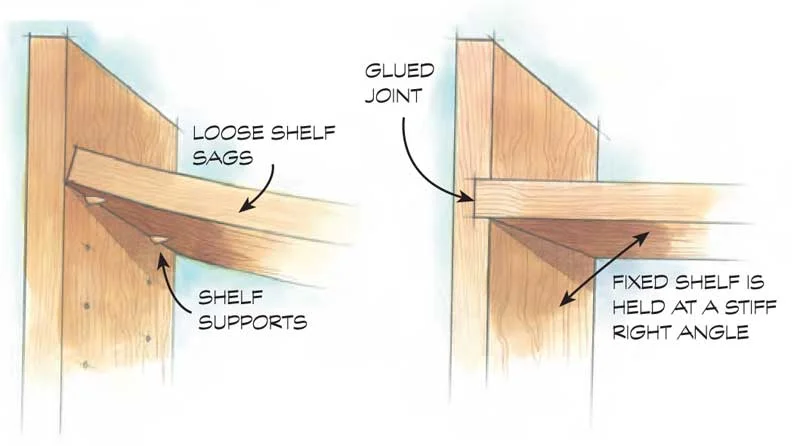
For built-in shelves, use strong side panels, fixed dividers, dados, cleats, or suitable shelf hardware. A fixed shelf joined to the cabinet sides may provide a different level of support from a removable shelf resting on small pins.
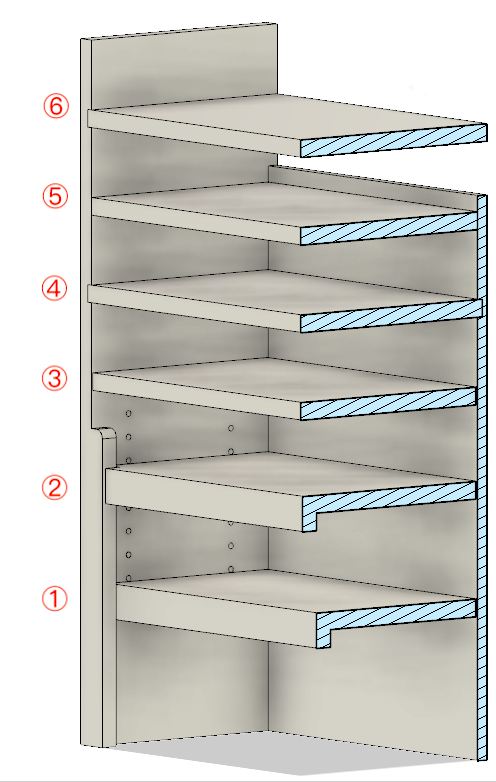
For adjustable shelving, place shelf pins in matching holes and check that every pin sits fully in place. Use enough supports for the span and load. If the shelf is wide or heavily loaded, a center divider or additional support rail may be needed.
Locate wall studs
For heavy wall shelving, fasten into suitable structural framing where possible. Do not assume ordinary drywall alone can carry a heavy shelf.
Use compatible fasteners
Select screws, anchors, and mounting hardware for the wall or cabinet material. Follow the hardware manufacturer’s installation instructions.
Check bracket depth
The bracket should support the shelf appropriately from front to back. Excessive front overhang can increase leverage on the bracket and its fasteners.
Keep supports level
Misaligned supports can twist the shelf and concentrate weight on only a few contact points.
Inspect shelf pins
Check their diameter, material, fit, seating, and published capacity. Replace bent or damaged pins.
Fixed Shelves vs. Adjustable Shelves
Fixed shelves are attached to the cabinet structure through joints, screws, or support cleats. This connection can help resist movement, depending on the joint design and cabinet construction. A well-fitted dado joint is one common option for a fixed shelf.
Adjustable shelves offer flexibility because their height can change. However, their performance depends on the pins, holes, shelf dimensions, and support spacing. A removable shelf may have less restraint than a properly secured fixed shelf.
For heavy storage, fixed shelves or adjustable systems with suitable support hardware may be better choices. The right option depends on how often the shelf must move and how much weight it will carry.
Why the Cabinet Back Matters
The cabinet back can help prevent the whole unit from shifting or leaning sideways. This movement is called racking. A cabinet that racks can change the way its shelves sit on their supports and may cause joints to loosen.
A properly fitted plywood back, fixed into the cabinet structure, can help resist racking. The panel must be attached in a suitable pattern and the cabinet must be assembled square. A thin decorative back that is loosely attached may provide little structural benefit.
Distribute Shelf Weight Correctly
Even weight distribution helps limit bending and reduces stress on local support points. A shelf carrying books should have the books spread across the available length rather than piled into one heavy stack at the center.
The load type matters as much as the total weight. A uniformly distributed load behaves differently from one heavy object placed at the center. A point load can create higher local stress and a different deflection pattern.
Think about the shelf’s real use before installing it. A kitchen shelf may carry dishes, cookware, and food containers. A garage shelf may hold power tools, paint cans, or heavy storage bins. A bookshelf may carry many pounds of books over a long period.
Place heavy items near supports
Where practical, store heavier objects closer to side supports or structural dividers instead of concentrating them at the center.
Avoid narrow heavy stacks
Spread dense objects across the shelf instead of creating one concentrated pile.
Use lower shelves for heavy storage
Lower storage can reduce the risk of injury if an item falls and may make heavy objects easier to access.
Do not exceed stated limits
Follow the published capacity of the weakest component in the system, while accounting for the actual installation conditions.
Estimate the Weight of Books and Stored Items
Books can weigh more than they appear to. Large hardcover books, textbooks, and tightly packed reference books may create a substantial load across a shelf. Do not estimate capacity by counting books alone.
A practical method is to weigh a representative group of items and calculate their combined weight. If a group of ten books weighs 30 pounds, two similar groups would weigh about 60 pounds. Add the weight of the shelf itself when making a complete support assessment.
For storage bins, tools, and kitchen items, check the actual weight when possible. A shelf designed for lightweight decorations should not be assumed to carry a row of heavy tools.
Measure the full load
Include all items that may remain on the shelf, not just the objects placed there during installation.
Consider uneven loading
Account for heavy objects that may be placed in the middle or at one end.
How to Prevent Shelf Sag During Construction
A reliable construction process starts with a clear load estimate and a support plan. Choose the shelf dimensions before cutting the material, and confirm that the complete design can carry the expected contents without excessive movement.
Use accurate measurements and inspect every board before assembly. A shelf that is cut too short may have poor support at its ends, while an uneven board can create a poor fit even when the dimensions appear correct.
Source: branchingoutwood.com
Step 1: Define the intended use
Decide whether the shelf will hold decorations, books, dishes, garage supplies, or heavy equipment. Estimate the total weight and how it will be distributed.
Step 2: Measure the support spacing
Record the clear distance between the supports, the shelf depth, and the actual material thickness.
Step 3: Select the material
Choose solid wood or a suitable panel product with enough stiffness for the intended design. Check available manufacturer information.
Step 4: Calculate expected deflection
Use a shelf sag calculator or an appropriate engineering method to compare different thicknesses, materials, and spans.
Step 5: Add reinforcement
Install a front nosing, underside cleat, rear rail, center divider, or additional bracket when the design requires more stiffness.
Step 6: Assemble the support structure
Use suitable joints, adhesive, screws, brackets, and anchors. Confirm that each connection is compatible with the materials.
Step 7: Check alignment
Use a level and a straightedge to confirm that the supports are aligned and the shelf sits flat without rocking.
Step 8: Load the shelf gradually
Add the intended contents in a controlled way. Watch for unexpected movement, noise, loose connections, or visible bending.
Tools and Materials for Shelf Construction
Most basic shelf projects require a tape measure, pencil, level, square, drill, suitable drill bits, and a saw. Clamps help hold reinforcement strips in place while the adhesive cures.
The exact material list depends on the project. You may need plywood, solid wood edging, shelf pins, brackets, screws, adhesive, wall anchors, and a stud finder. Choose tools and fasteners that match the shelf material and installation surface.
Measuring tools
Use a tape measure, square, level, and straightedge to check the shelf dimensions and support alignment.
Cutting and drilling tools
Choose suitable saw blades and drill bits for the material. Follow the tool manufacturer’s safety instructions.
Clamping tools
Use clamps to hold edging strips and cleats in position during assembly.
Protective equipment
Wear suitable eye and hearing protection. Use dust control and respiratory protection appropriate for cutting MDF, plywood, and other wood products.
How to Know the Shelf Is Working Properly
A properly constructed shelf should sit evenly on its supports and show no unexpected movement during normal loading. Its joints should remain tight, and the brackets or pins should stay in position.
Use a straightedge or a consistent measurement method to record the shelf’s center height before and after loading. This can help identify changes that may be difficult to notice by eye. Check again after the shelf has been in use for some time.
Stop loading the shelf if you notice growing sag, cracks, loose brackets, pulling fasteners, or damaged support panels. Remove the load carefully before making repairs.
How to Fix an Existing Sagging Shelf
The best repair depends on why the shelf is sagging. A shelf may be bending because its board is too thin, its span is too long, its supports are loose, or its material has suffered permanent deformation. Identify the cause before choosing a repair.
Start by removing the contents. Do not try to straighten a heavily loaded shelf while it remains in place. Inspect the board, brackets, shelf pins, cabinet sides, fasteners, and wall connections for damage.
Source: storage.googleapis.com
Loose supports
Tighten or replace suitable fasteners and damaged hardware. Check the supporting material before reusing the same screw holes.
Excessive span
Add a suitable center support or divider to reduce the unsupported distance.
Insufficient stiffness
Add a properly attached front nosing or underside cleat when the shelf material remains sound.
Permanent board deformation
Replace the shelf if the board has developed a severe permanent bend, cracks, or damaged connections.
Repairing a Sagging Floating Shelf
Floating shelves often use hidden rods, brackets, or a concealed mounting frame. Their appearance can make it difficult to see how the load transfers into the wall. A shelf may sag because the board has bent, the hidden bracket has moved, or the wall connection has weakened.
Remove the stored items and inspect the shelf mounting system. Check whether the hidden support remains secure and whether the shelf has separated from its mounting plate. Do not simply add more weight or tighten a loose fastener without checking the wall structure.
If the mounting system is damaged or poorly anchored, repair or replace it with a suitable support arrangement. For a heavy floating shelf, use hardware designed for the shelf dimensions, wall type, and intended load. Seek professional help if the wall or concealed structure is damaged.
Repairing a Sagging Adjustable Shelf
For an adjustable shelf, check whether the pins are bent, loose, or placed at different heights. Replace damaged pins with compatible hardware and confirm that all support points sit firmly in their holes.
If the shelf itself has a permanent curve, stronger pins alone will not solve the problem. Shorten the span with a center support, add a suitable reinforcement strip, or replace the board with a stiffer panel.
Check the cabinet sides as well. Damaged particleboard holes may no longer hold shelf pins securely. A suitable repair may require a new support location, a structural insert, or replacement of the damaged panel.
When to Replace Rather Than Reinforce
Replace a shelf when it has split, broken, delaminated, or suffered severe permanent deformation. A reinforcement strip cannot restore damaged material to its original condition in every case.
Replacement is also a sensible option when the existing shelf is too weak for the intended load and there is not enough room for a suitable support. Choose a new design with a shorter span or a stronger support system rather than repeating the original problem.
Common Shelf Sag Prevention Mistakes
Many shelf problems begin with small design choices that seem harmless during construction. A board may look strong enough when empty, but its actual performance depends on the complete shelf system. Avoid these common mistakes before installation.
Choosing a board by thickness alone
A thick panel may still be too flexible for a long span or heavy load. Consider material stiffness, grain direction, support spacing, and actual dimensions.
Ignoring the shelf’s own weight
The board contributes to the total load. This matters more for long, deep, and heavy shelves.
Using decorative edging as structural reinforcement
A thin veneer or decorative edge band does not provide the same reinforcement as a properly designed solid wood nosing or structural cleat.
Using weak wall anchors
A strong bracket can still fail if the anchor or wall material cannot carry the load. Match the entire mounting system to the installation.
Placing heavy objects in the center
Concentrated loads can create more bending than a similar weight spread across the shelf.
Assuming all plywood is the same
Different grades, cores, veneer arrangements, and panel thicknesses can produce different results.
Ignoring moisture exposure
Water can damage wood-based panels and weaken joints. Use suitable materials and finishes for kitchens, laundry areas, garages, and other damp locations.
Skipping long-term inspections
A shelf can develop more sag after months of continuous loading. Inspect it periodically, especially when it holds heavy items.
Avoid Using a Sag Calculator as a Load Rating
A shelf calculator estimates bending under stated assumptions. It does not automatically calculate breaking strength, screw withdrawal, bracket failure, wall anchor capacity, or the strength of the cabinet structure.
Some calculators assume a simple rectangular board with supports at both ends. Real shelves may have fixed joints, multiple supports, uneven loads, or reinforcement strips. These differences can change the actual result.
For shelves that support heavy equipment, expensive materials, or objects that could cause injury if they fall, use a suitable engineered design. Ask a qualified professional to assess uncertain or high-consequence installations.
Research-Based Design Guidance and Practical Limits
Published woodworking guidance supports the use of material stiffness, shelf dimensions, support conditions, and expected loads when estimating deflection. The USDA Forest Service Wood Handbook provides technical information on wood properties, moisture behavior, mechanical properties, and structural analysis.
The Sagulator, developed for woodworking shelf design, uses published beam-deflection methods and material stiffness information to estimate bending. Its guidance highlights the value of shorter spans, thicker shelves, and reinforcing edging. Its results are estimates, not guarantees.
WoodBin also reports physical shelf measurements using different materials, depths, loads, and reinforcement methods. Those measurements show why real shelf assemblies may behave differently from simple calculations. Support movement, material variation, and actual connections can affect the result.
These findings support one practical rule: use calculations to compare design choices, but leave a margin for real-world variation. Do not treat one material value or one maximum-span table as suitable for every shelf.
DOCUMENTED
The USDA Forest Service Wood Handbook covers wood stiffness, mechanical properties, moisture relations, and wood-based composite materials.
REPORTED BY OTHERS
WoodBin describes workshop measurements of shelves made from MDF, plywood, and several solid woods under different loads and support arrangements.
ANALYSIS
Beam-deflection relationships show that reducing span and increasing thickness can greatly reduce shelf movement when other conditions remain constant.
NOT ESTABLISHED
No single shelf thickness, material, or support spacing is safe for every project. A universal load rating cannot be established without the full design and installation details.
Reviewed Research and Practical References
The following references support the technical principles used in this guide. They provide material information, design methods, and practical shelf measurements rather than a universal approval for any particular shelf.
A technical reference covering wood mechanics, wood-based composite products, moisture relations, fastenings, and structural analysis.
Fine Woodworking, Engineer Shelves With the Sagulator
A woodworking design guide explaining the main variables that affect shelf deflection and ways to improve shelf stiffness.
WoodBin, The Sagulator
A shelf deflection calculator that considers material, load, dimensions, support conditions, and optional edge reinforcement.
WoodBin, Shelf Sag Measurements
A workshop measurement project comparing shelf materials, support methods, and load levels. It also discusses differences between calculated and measured deflection.
Questions That Need More Project-Specific Research
The most useful next questions depend on the type of shelf. For an adjustable closet shelf, pin spacing and panel quality may matter most. For a floating shelf, hidden bracket design and wall connections deserve more attention. For a heavy bookshelf, span, stiffness, and long-term loading should guide the design.
The references reviewed provide general design methods and practical measurements. They do not establish a universal capacity for every adjustable shelf, floating shelf, or garage storage system. Those decisions require the exact material specifications and mounting details.
What is the maximum safe span for my shelf?
Reader stage: planning. Basis: inferred next need. Reviewed coverage: answered with general calculations, but a project-specific result requires material stiffness, dimensions, load, and support details.
Can I reinforce a sagging adjustable closet shelf?
Reader stage: repair. Basis: inferred next need. Reviewed coverage: answered with general repair methods, but exact shelf-pin and panel compatibility depends on the closet system.
Why does my floating shelf sag near the wall?
Reader stage: troubleshooting. Basis: inferred next need. Reviewed coverage: answered with mounting and support checks, but concealed bracket dimensions and wall conditions require inspection.
How much weight can shelf pins hold?
Reader stage: installation. Basis: inferred next need. Reviewed coverage: not established as a universal value. The exact hardware specification, hole condition, panel material, and load arrangement are required.
Frequently Asked Questions
Q
How do I stop a shelf from sagging?
Use a stiffer material, increase shelf thickness, shorten the span, and spread the load evenly. You can also add a center support, front wood nosing, or underside cleat. Check that the brackets, pins, fasteners, and cabinet structure can carry the load.
Q
Does a thicker shelf prevent sagging?
Yes, increasing thickness can greatly reduce bending. For the same material and other conditions, doubling the thickness can reduce calculated deflection to about one-eighth. However, material stiffness, span, depth, and load still matter.
Q
Is plywood better than MDF for preventing shelf sag?
Suitable plywood can provide good shelf stiffness and dimensional stability. MDF can also work for shelves when the dimensions and load are appropriate. Compare the actual panel specifications rather than assuming every plywood or MDF product performs the same.
Q
Does adding a center support stop shelf sag?
A properly installed center support can greatly reduce bending by dividing one long span into shorter sections. The support must connect to a strong cabinet or structural member and must have enough strength to carry the transferred load.
Q
Can a sagging shelf become straight again?
A shelf with temporary elastic bending may return close to its original shape after the load is removed. A shelf with permanent deformation, damaged material, or weakened joints may not straighten. Reinforce or replace damaged shelves rather than relying on them to recover.
✦ Wrapping Up
Conclusion
Good shelf sag prevention begins with the right design. Choose a suitable material, measure the clear span, select enough thickness, and estimate the load before building. These steps help prevent the slow downward curve that often appears in bookshelves, closets, cabinets, and garage storage.
Use reinforcement when the shelf needs extra stiffness. A solid front nosing, underside cleat, center divider, or properly installed bracket can improve support. Also check the entire structure, because a strong shelf board cannot compensate for weak pins, loose joints, or poor wall anchors.
Remember that calculations are estimates. Real materials and support systems can behave differently from simplified models. For heavy or safety-critical storage, use suitable engineering guidance and verify the capacity of every part of the installation.
💡 Key Takeaway
Before building or repairing a shelf, measure its clear span, depth, and actual thickness. Estimate the full load, choose a suitable material, and check the expected deflection. If the shelf needs more stiffness, shorten the span or add properly attached reinforcement. Inspect the complete support system before loading it.