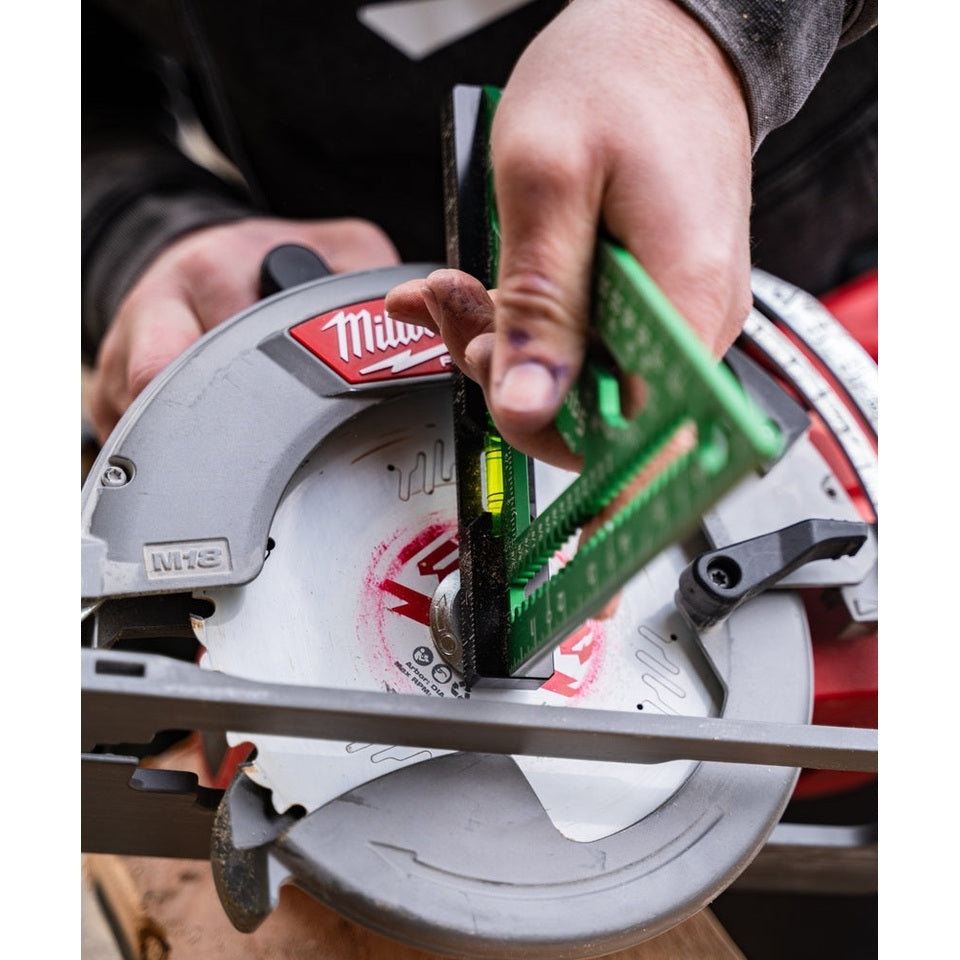
Circular saw accuracy depends on blade condition, saw alignment, measurement, workpiece support, and how consistently the saw is guided. For the most repeatable cuts, use a straight guide or track, verify the blade and shoe are properly aligned, support the material fully, and make a test cut before cutting expensive stock.
For homeowners, remodelers, and woodworkers in the United States, a circular saw can produce much more precise cuts than its reputation as a rough framing tool suggests. The key is to control the variables that make the blade wander, including an unstable workpiece, an inaccurate guide, a dull or unsuitable blade, incorrect measurement, and excessive side pressure.
Circular saw accuracy is not one fixed specification. A saw can be accurate enough for framing lumber while still requiring a guide system for cabinet panels or furniture parts. The required precision changes with the job. A framing cut may only need to meet a layout mark, while a plywood panel intended for a tight cabinet joint may require a much more controlled cut.
The most reliable approach is to build accuracy into the process rather than relying entirely on hand control. A properly positioned guide, stable support surface, suitable blade, correct depth, and controlled feed rate can greatly reduce wandering and tearout.
Source: images.ctfassets.net
What Determines Circular Saw Accuracy?
Circular saw accuracy comes from the relationship between the blade, saw shoe, guide, workpiece, measurement system, and operator. A problem in any one of these areas can make an otherwise capable saw produce an inaccurate cut.
The blade establishes the actual cutting path. The shoe controls how the saw moves across the material. A guide provides a physical reference that limits wandering. The workpiece must remain stable throughout the cut. Finally, the operator must maintain a controlled feed without forcing the saw sideways.
For that reason, buying a more powerful saw does not automatically make cuts more accurate. A rigid shoe and reliable guide system can have a greater practical effect on straightness than additional motor power.
Source: abclive1.s3.amazonaws.com
Blade condition
A dull, damaged, dirty, or inappropriate blade can increase resistance and make the saw harder to control. The blade should match the material and the desired finish.
Blade alignment
The blade needs to run properly relative to the saw shoe and arbor. A misaligned blade can make the saw pull away from the intended path.
Shoe stability
The shoe should sit flat on the material without excessive play. A bent or damaged shoe can change the blade position as the saw moves.
Workpiece support
Panels and boards need enough support to prevent movement and sagging. Material that closes against the blade can increase resistance and affect the cut.
Guidance
A straightedge, edge guide, speed square, crosscut guide, or track can provide a repeatable reference and reduce dependence on hand control.
Accuracy Versus Cut Quality
A cut can be straight but still have poor surface quality. Straightness describes whether the cut follows the intended path, while cut quality includes tearout, splintering, burn marks, rough edges, and blade deflection. Blade selection and workpiece support affect both characteristics.
A fine-tooth blade can improve the edge on plywood and finished panels, but tooth count alone does not guarantee accuracy. The saw still needs a stable reference and controlled movement.
How to Set Up a Circular Saw for Accurate Cuts
Start with the saw disconnected from power and inspect it before making adjustments. For a cordless model, remove the battery according to the manufacturer’s instructions. Check the blade, shoe, depth adjustment, bevel mechanism, lower guard, and guide accessories.
Do not begin by compensating for an inaccurate setup with hand pressure. First remove the mechanical and measurement problems that can cause the saw to leave the intended path.
Source: woodsmith.com
1. Inspect the blade
Check for damaged, bent, cracked, excessively dull, or contaminated teeth. Replace a blade that is not suitable for the material or operation.
2. Confirm the blade is installed correctly
Follow the saw manufacturer’s instructions for blade direction, arbor hardware, and tightening. An incorrectly installed blade can create unsafe operation and poor cutting performance.
3. Check the shoe
Place the saw on a known-flat surface and verify that the shoe sits evenly. Inspect for visible bends, damage, or looseness around the adjustment mechanisms.
4. Verify the bevel setting
For a 90-degree cut, make sure the bevel adjustment is actually at its intended zero-degree position rather than relying only on the printed scale.
5. Set the cutting depth
Adjust the blade depth according to the material and the saw manufacturer’s instructions. Avoid unnecessarily deep blade exposure because it can increase the amount of exposed blade and may affect control.
6. Check the cutting reference
Decide whether you are following the shoe’s cutline indicator, a speed square, a straightedge, or a guide rail. Use one clear reference rather than switching between references during the cut.
How to Check Blade and Shoe Alignment
With the saw disconnected from power, inspect the relationship between the blade and the shoe using an appropriate square or alignment method. The measuring tool should contact the blade plate rather than the cutting teeth. Do not rotate or manipulate the blade in a way that creates a contact hazard.
If the blade appears significantly out of alignment with the shoe, consult the saw’s manual before attempting a correction. Some models have adjustable components, while others require service if the shoe, arbor, or related parts are damaged.
A useful practical check is to make a test cut in scrap material. Measure the resulting cut and compare it with the intended line. A repeatable error points toward setup or alignment; an inconsistent error is more likely to involve technique, support, or guide movement.
Use a Guide for Better Circular Saw Accuracy
A guide is one of the simplest ways to improve circular saw accuracy because it gives the shoe a physical reference. Instead of trying to keep the blade perfectly aligned by sight throughout a long cut, you guide the saw shoe against a straight surface or run the saw in a dedicated track.
For short crosscuts, a speed square or crosscut guide can be effective. For long rip cuts in plywood or other sheet goods, a straightedge or track is usually easier to control. A properly fitted track system can provide a zero-clearance reference at the blade edge, reducing the need to calculate a separate shoe-to-blade offset.
Source: kaizencasesandinserts.com
Straightedge guide
A straight board, factory edge, or purpose-built guide can be clamped to the workpiece. Position the guide using the measured distance between the saw blade and the shoe edge.
Track guide
A track or guide rail constrains the saw along a defined path. Some systems use a saw sled or compatible shoe that rides directly on the rail.
Speed square
A sturdy speed square can guide the shoe for accurate short crosscuts and can also help establish common angles.
Shop-made guide
A simple plywood or hardboard guide can be cut with the same saw it will guide. Trimming the guide to the saw creates a reference edge that corresponds closely to the blade path.
How to Account for the Shoe-to-Blade Offset
When using a conventional straightedge, the guide is usually not placed directly on the desired cutline. The saw shoe rides against the guide while the blade is offset from the shoe edge. Measure the distance from the reference edge of the shoe to the blade on the side you will use, then position the guide accordingly.
For example, if the blade is 1 1/2 inches from the shoe edge that will contact the guide, and the desired cutline is 20 inches from the reference edge of the panel, the guide would be positioned 18 1/2 inches from that edge when the geometry requires the guide to sit on the outside of the blade path. Always verify the direction of the offset before cutting.
A zero-clearance track or shop-made guide changes this process because its trimmed edge is designed to correspond with the blade path. Even then, make a test cut when dimensional accuracy matters.
How to Keep a Guide from Moving
Clamp a conventional straightedge when movement could affect the cut. Before starting, check that the guide is straight, fully supported, and not sitting on debris. Some commercial tracks use anti-slip material, but clamping can still be appropriate when the cut is long, the material is slick, or the operation involves a bevel.
For long sheet cuts, make sure the entire path of the saw shoe remains supported. A guide cannot compensate for a panel that sags enough to lift or tilt the saw.
How to Make Accurate Crosscuts, Rip Cuts, and Bevel Cuts
Different circular saw cuts create different accuracy challenges. Crosscuts are generally easier because the cutting distance is short. Rip cuts require control over a longer path, while bevel cuts introduce another variable because the shoe is no longer flat relative to the material.
Source: overhalfsale.com
Accurate crosscuts
Mark the cutline clearly, place a square or crosscut guide against the workpiece, and keep the shoe firmly against the guide. Clamp the guide when the workpiece is large or the cut requires greater repeatability.
Accurate rip cuts
Use a long straightedge or track whenever the cut must remain straight over a substantial distance. Support the sheet on a stable sacrificial surface and prevent the cutoff from interfering with the blade.
Accurate bevel cuts
Set the bevel using the saw’s adjustment mechanism, then verify the actual angle on scrap material. Keep the shoe fully supported and avoid forcing the saw sideways against the guide.
Repeat cuts
Use a fixed guide, stop block, or jig where appropriate so each piece references the same surface. Measure the first piece before cutting the rest.
Making a Straight Rip Cut
Lay the material on a stable cutting surface and mark both ends of the desired cut. Calculate the guide position if using a conventional straightedge. Place the guide so its reference edge produces the intended blade path, then clamp it securely.
Set the blade depth and confirm the saw’s bevel is at the required angle. Start the saw before the blade enters the material, allow the blade to reach normal operating speed, and guide the shoe smoothly against the reference surface.
Do not force the saw if resistance increases. A blade that is binding, dull, incorrectly selected, or entering unsupported material can make the saw harder to control. Stop safely and determine the cause before continuing.
Making a Square Crosscut
For a short board, place a speed square or crosscut guide at the layout line and keep the saw shoe against the guide. For wider stock, clamp the guide so both hands can remain on the saw when appropriate.
After the cut, check the end with a reliable square. If the cut is consistently out of square, verify the saw’s bevel setting and the relationship between the blade and shoe before changing the guide position.
Making Accurate Bevel Cuts
Bevel cutting is more sensitive to support because tilting the shoe changes how the saw contacts the material and guide. Set the bevel angle according to the saw’s scale, but verify the resulting angle on scrap when the fit matters.
Keep the saw’s shoe fully supported by the material and maintain controlled pressure against the guide. If the saw tends to lift, tip, or leave the guide, stop and improve the support or clamping arrangement rather than forcing the cut.
Troubleshooting Inaccurate Circular Saw Cuts
When a circular saw produces inaccurate cuts, diagnose the symptom before changing several variables at once. The shape of the error often points toward the cause. A consistent angle error suggests setup or alignment, while a wandering line over a long cut often points to guidance or support.
Source: cdn.fixami.com
The cut is straight but consistently off the measurement
Check the guide offset, blade kerf, measurement reference, and whether you marked the blade path or the shoe position.
The cut wanders during a long rip
Check for guide movement, inadequate workpiece support, excessive feed pressure, and whether the saw shoe is actually staying against the guide.
The cut is consistently out of square
Check the bevel setting, shoe alignment, and the angle of the guide. Make a test cut in scrap and measure the result.
The blade seems to pull to one side
Check the blade condition, blade installation, material support, and possible binding. Do not continue forcing a saw that is behaving unexpectedly.
The cut has heavy tearout
Use a blade suited to the material, support the workpiece properly, and consider a zero-clearance guide or sacrificial backing surface where appropriate.
Repeated cuts differ from one another
Use a fixed guide or jig, improve clamping, and measure the first completed piece before continuing with a batch.
A Simple Accuracy Test
Use a piece of scrap material similar to the stock used for the project. Mark a straight reference line, set the saw for a 90-degree cut, and make a controlled cut using the same guide method intended for the project.
Measure the result at several points. If the width is consistent but the edge is not straight, investigate guidance. If the edge is straight but the angle is wrong, investigate bevel or alignment. If the measurement changes along the length, investigate movement, sagging, blade deflection, or guide placement.
Repeat the test after making one adjustment. Changing several variables simultaneously makes it difficult to identify which change solved the problem.
When the Saw Should Come Out of Service
Do not continue using a circular saw with a cracked or damaged blade, defective guard, damaged shoe, excessive arbor play, or another mechanical problem that affects safe operation. A saw that cannot maintain proper control should be inspected or repaired before further use.
For workplace operations, follow applicable OSHA requirements and the tool manufacturer’s instructions. Portable circular saws are required to have appropriate guards under OSHA’s portable powered tool rules, and woodworking equipment must be maintained in safe working condition.
Accuracy Limits, Safety, and When to Use Another Saw
A circular saw can make highly controlled cuts, but it has practical limits. It is still a handheld tool unless it is paired with a guide, track, jig, or other control system. The longer and more demanding the cut, the more valuable a rigid reference and stable support become.
For simple construction cuts, a circular saw is often appropriate. For repeated production work, extremely tight joinery, or operations where the workpiece must be held in a highly controlled position, a table saw, miter saw, track saw, or other purpose-built machine may provide a more suitable setup.
Source: upload.wikimedia.org
Use a circular saw for
Breaking down plywood, dimensional lumber, framing material, general construction cuts, long panel cuts, and many shop projects where a guide can provide the required control.
Consider a track saw for
Frequent sheet-good work where repeatable straight cuts, a zero-clearance edge, and guided operation are important.
Consider a miter saw for
Repeated crosscuts and angled cuts on manageable lengths of stock when the machine’s capacity matches the workpiece.
Consider a table saw for
Repeated rip cuts, controlled stock sizing, and operations where a stable table and fence provide a better reference.
Safety Practices That Protect Accuracy and the Operator
Accuracy and safety are closely connected because a shifting workpiece or binding blade can affect both the cut and the operator’s control. Keep the blade guard functional, keep hands away from the blade path, and use appropriate eye and hearing protection.
Support the material so it cannot unexpectedly fall, move, or pinch the blade. Keep the saw’s base supported throughout the cut and avoid reaching underneath the workpiece while the blade is moving.
OSHA identifies blade contact, kickback, and flying particles among the hazards associated with circular saw operations. OSHA also requires guards on applicable portable circular saws and emphasizes maintaining blades and equipment in proper working condition.
Never bypass a defective guard
If the lower guard does not operate correctly, stop using the saw until the problem is corrected according to the manufacturer’s instructions.
Keep the cut path clear
Know where the blade will travel and make sure supports, clamps, cords, and hands are outside the blade path.
Avoid forcing the saw
Excessive side pressure can reduce control and may contribute to binding or deflection. Let the appropriate blade and feed rate do the cutting.
Use stable support
Do not rely on a small contact area when cutting large panels. Support the workpiece sufficiently to keep the saw shoe and material stable.
Frequently Asked Questions
Q
How accurate can a circular saw be?
A circular saw can produce very straight and repeatable cuts when it is paired with a suitable blade, stable workpiece support, and an accurate guide or track. The practical accuracy depends on the saw, blade, material, guide system, and operator. A freehand cut generally offers less repeatability than a properly fitted guide.
Q
Why does my circular saw cut at an angle?
A cut that is consistently angled can result from an incorrect bevel setting, shoe or blade misalignment, a guide that is not square, or a workpiece that moves during cutting. Make a test cut in scrap, check the actual angle with a square, and inspect the saw’s setup before continuing.
Q
How do I make a circular saw cut perfectly straight?
Use a straightedge, guide rail, or track instead of relying only on freehand steering. Position the guide according to the saw’s blade-to-shoe offset unless the system uses a zero-clearance reference edge. Keep the shoe against the guide and maintain stable support throughout the cut.
Q
Does a better blade make a circular saw more accurate?
A suitable, sharp blade can improve cutting behavior and edge quality, but it does not replace accurate guidance. Choose a blade appropriate for the material and cut type. A dull or unsuitable blade can increase resistance and make controlled cutting more difficult.
Q
Should I use a track saw instead of a circular saw for precision work?
A track saw can be useful when you regularly make long, repeatable cuts in sheet goods because the guide track establishes the cutting reference. A standard circular saw can also make accurate cuts when paired with a properly designed guide. The better tool depends on the type, frequency, and required repeatability of the work.
✦ Wrapping Up
Conclusion
Improving circular saw accuracy is mainly a matter of controlling the cutting process. Start with a suitable blade and properly functioning saw, verify the bevel and alignment, support the material, measure from the correct reference point, and use a guide whenever straightness matters.
For occasional construction work, a speed square or simple straightedge may provide all the control you need. For long plywood cuts or repeated precision work, a track or custom guide can make the process more consistent. Always make a test cut when the dimensions matter and investigate unexpected saw behavior rather than forcing the tool through the material.
💡 Key Takeaway
Before your next precision cut, inspect the blade and shoe, set the correct depth and bevel, support the workpiece, position a reliable guide, make one test cut in scrap, and verify the result before cutting the final material.