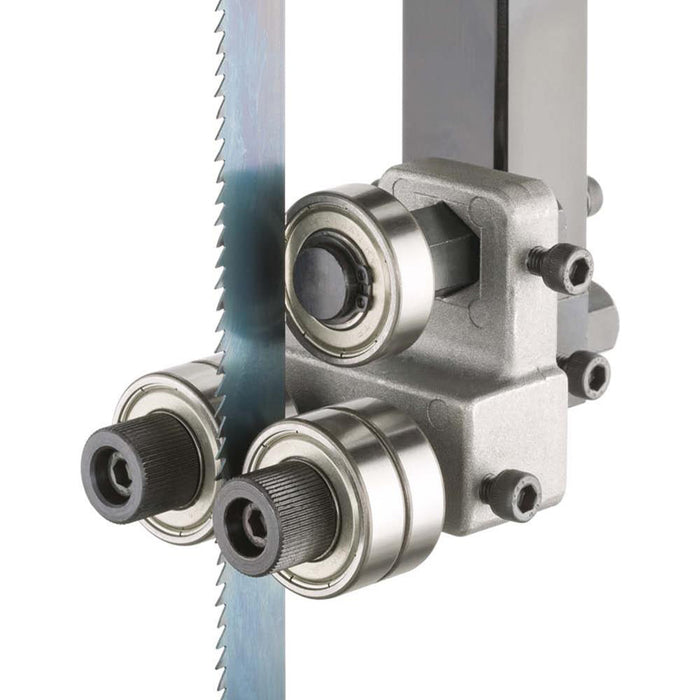
A band saw thrust bearing supports the back edge of the blade when cutting pressure pushes the blade rearward. It should normally sit very close to the blade without creating continuous contact while the saw runs unloaded.
For woodworkers using band saws in U.S. home shops, professional woodworking shops, school shops, and production environments, the thrust bearing is a small component with a major effect on blade control. It works with the two side guide bearings to keep the blade positioned correctly as it passes through the upper and lower guide assemblies.
The exact adjustment varies by band saw design, blade width, and the manufacturer’s instructions. Many U.S.-market machines use small clearances measured in thousandths of an inch, while some manufacturers specify approximately 1/64 inch or similar spacing. The manufacturer’s manual should take priority over a generic measurement. A properly adjusted thrust bearing should support the blade when cutting forces push it backward without unnecessarily rubbing the blade during unloaded operation.
Source: finewoodworking.com
What Is a Band Saw Thrust Bearing?
A band saw thrust bearing is the rear bearing in the blade guide assembly. Its job is to resist the blade’s backward movement when the workpiece creates cutting pressure. The blade normally travels vertically through the guide assembly, while the thrust bearing is positioned behind the blade to provide support when the blade deflects rearward.
A typical upper or lower guide assembly can contain three bearing positions: two side guide bearings and one rear thrust bearing. The side bearings limit lateral movement, while the thrust bearing limits front-to-back deflection. Together, these components help keep the blade stable during a cut.
The thrust bearing does not replace correct blade tension, tracking, or blade selection. It is a support component that works after those basic adjustments are correct. If the blade is improperly tensioned or tracking incorrectly, moving the thrust bearing closer is not a substitute for correcting the underlying problem.
Source: popularwoodworking.com
Rear support
The thrust bearing supports the back edge of the blade when cutting forces push the blade toward the rear of the machine.
Upper and lower locations
Many band saws have a thrust bearing in both the upper and lower blade guide assemblies.
Rotating contact
On bearing-style guides, the bearing can rotate when the blade contacts it under cutting load, reducing sliding friction compared with a stationary support surface.
Thrust Bearing vs. Side Guide Bearings
The three bearings in a common roller-style guide assembly have different jobs. The two side bearings support the blade from its sides, while the rear thrust bearing supports the blade from behind. Confusing these functions can lead to incorrect adjustment.
The side bearings should be positioned near the blade gullets without allowing the bearing to contact the teeth. The thrust bearing is positioned behind the blade rather than alongside the blade. Both systems need enough clearance to avoid unnecessary continuous contact when the machine is running without a workpiece.
Thrust bearing
Controls rearward blade deflection during cutting.
Side guide bearings
Control lateral blade movement and help prevent twisting.
How Band Saw Thrust Bearings Work During a Cut
During a free-running condition, the blade should generally pass the thrust bearing without significant continuous pressure. When a workpiece is pushed into the blade, cutting forces can deflect the blade toward the rear of the machine. The thrust bearing then provides a controlled support surface that limits this movement.
This support becomes particularly important during demanding operations such as resawing thick hardwood, making long rip cuts, or feeding material at a rate that creates substantial cutting force. The bearing does not hold the blade rigidly in one position; instead, it limits excessive rearward movement while allowing the blade to continue traveling around the wheels.
The bearing’s effectiveness depends on its alignment with the blade. If it sits too far away, the blade can move farther backward before receiving support. If it is adjusted too tightly, the bearing can remain in contact with the blade during unloaded operation, increasing friction and potentially contributing to unnecessary wear or heat.
Source: factoryauthorizedoutlet.com
Correct clearance
The required gap depends on the machine and manufacturer. Common instructions range from very small thousandths-of-an-inch clearances to approximately 1/64 inch.
Cutting load matters
The bearing is primarily intended to support the blade when cutting forces cause rearward deflection.
Blade position matters
The thrust bearing should be centered behind the blade’s back edge and aligned with the blade path.
Why the Bearing Should Not Be Overtightened
A thrust bearing that is forced against the blade can rotate continuously even when the saw is not cutting. Continuous unnecessary contact creates additional friction and can accelerate wear in the bearing or blade. Some manufacturers specifically instruct users to leave a small clearance so the bearing contacts the blade primarily when cutting pressure causes rearward movement.
The correct gap is machine-specific. A clearance that works on one band saw should not automatically be transferred to another model. Use the owner’s manual whenever it provides a measurement or adjustment procedure.
Too close
May cause continuous contact, friction, noise, heat, or accelerated wear.
Too far away
Allows excessive rearward blade movement before the bearing provides support.
How to Adjust a Band Saw Thrust Bearing
Adjust the thrust bearing only after the blade is correctly installed, tensioned, and tracking properly. The general procedure is similar across many machines, but the exact hardware and clearance vary by model.
Before starting, disconnect the band saw from its power source. Do not rely only on the power switch. Remove or open the necessary guards only as specified by the manufacturer’s service instructions, and reinstall all guards before operating the machine.
Source: marsonequipment.com
1. Install the correct blade
Make sure the blade is appropriate for the machine and the intended cut, then install it according to the manufacturer’s procedure.
2. Set blade tension
Adjust blade tension according to the machine and blade manufacturer’s instructions.
3. Set blade tracking
Confirm that the blade tracks correctly on the wheels before adjusting the guide bearings.
4. Center the thrust bearing
Move the thrust bearing laterally if the design allows it so the bearing is directly behind the blade.
5. Set the rear clearance
Move the bearing toward the blade until the manufacturer’s specified clearance is reached. Do not automatically use a generic measurement when the manual specifies another value.
6. Lock the adjustment
Tighten the appropriate locking screw, knob, or fastener without allowing the bearing to shift from the selected position.
7. Hand-check the blade path
With the machine disconnected from power, rotate the wheel by hand and confirm that the blade moves freely without unwanted continuous contact.
8. Repeat for the lower guide
If the machine has a lower thrust bearing, adjust it using the same model-specific procedure.
Typical Clearance Measurements
There is no universal thrust-bearing gap for every band saw. Manufacturer instructions reviewed for different machines specify values such as approximately 0.5 mm, approximately 0.4 mm, or approximately 1/64 inch. Other woodworking guidance recommends setting the bearing only a few thousandths of an inch behind the blade. These differences reflect different guide designs and adjustment methods.
For that reason, the manufacturer’s measurement should be treated as the controlling specification. If no manual is available, a conservative approach is to position the bearing close enough to provide prompt rear support while ensuring the blade does not continuously rub the bearing during unloaded hand rotation.
0.5 mm
Some band saw manuals specify approximately 0.5 mm between the thrust bearing and the blade.
1/64 inch
Some U.S.-market woodworking band saw manuals specify approximately 1/64 inch, or about 0.4 mm.
A few thousandths
Some woodworking setup guidance recommends a very small gap rather than a fixed universal measurement.
A Simple Adjustment Check
After adjustment, rotate the band saw wheel by hand while watching the relationship between the blade and thrust bearing. The blade should travel freely and the bearing should not be forced into continuous contact by an incorrectly positioned guide assembly.
If the bearing starts rotating continuously during unloaded hand rotation, move it back slightly and recheck the manufacturer’s specified clearance. If the bearing never supports the blade during a controlled test cut, inspect the blade tracking, guide alignment, and bearing position rather than simply moving the bearing closer.
Signs of a good adjustment
The blade travels smoothly, the bearing is aligned behind the blade, and there is no unnecessary continuous rubbing when the saw is unloaded.
Signs of a poor adjustment
The bearing is constantly spinning, the blade visibly moves excessively backward, or the bearing is misaligned with the blade.
How to Tell When a Thrust Bearing Needs Replacement
A thrust bearing should be inspected when it becomes noisy, rough, loose, visibly damaged, or difficult to rotate. Bearing condition matters because the blade can repeatedly contact the bearing under cutting load, making a damaged bearing part of the blade-control system.
A quick inspection should start with the machine disconnected from power. Look for visible scoring, excessive play, contamination, damaged seals, or a bearing that does not rotate smoothly when appropriate for its design. Do not assume that every noise comes from the thrust bearing; wheel bearings, blade guides, tires, belts, and other components can produce similar symptoms.
Source: thewoodwhisperer.com
Grinding or rough rotation
A bearing that feels gritty or catches during manual inspection may have internal wear or contamination.
Excessive side-to-side play
Unusual looseness can indicate bearing wear, a worn shaft, or a loose mounting component.
Visible damage
Cracks, damaged seals, severe scoring, corrosion, or deformation are reasons for closer inspection and possible replacement.
Persistent abnormal noise
A new squeal, grinding sound, or repetitive clicking near the guide assembly can justify inspection of the bearing and its mounting hardware.
Thrust Bearing Problems vs. Blade Problems
A poor cut does not automatically mean the thrust bearing is defective. Blade drift, uneven teeth, incorrect tension, incorrect tracking, a dull blade, excessive feed pressure, and misaligned guide bearings can all affect cutting performance.
If the blade is wandering or producing an inconsistent cut, first verify the blade condition, tension, tracking, and complete guide setup. If those settings are correct but the bearing remains rough, loose, noisy, or visibly damaged, replacement becomes more appropriate.
Uneven blade wear
Can result from incorrect guide adjustment, blade contact, tracking problems, or other alignment issues.
Crooked cuts
Can have multiple causes and should not be attributed to the thrust bearing without checking the complete setup.
Bearing noise
More directly points toward a bearing or mounting problem, especially when the sound changes with bearing contact.
Should You Lubricate a Thrust Bearing?
Do not automatically add oil or grease to a sealed band saw thrust bearing. Many modern guide bearings are sealed and designed to operate with factory-applied lubrication. Adding lubricant where the manufacturer does not specify it can attract dust or contaminate components.
Use the maintenance instructions for the exact bearing and band saw. If the bearing is sealed and rough or noisy, lubrication is generally not a substitute for replacement.
Sealed bearing
Follow the manufacturer’s maintenance instructions rather than adding lubricant by default.
Serviceable bearing
Lubricate only when the manufacturer specifically provides a lubrication procedure and lubricant specification.
Common Band Saw Thrust Bearing Adjustment Mistakes
Most thrust-bearing problems come from treating the bearing as a device that should clamp the blade in place. It is better understood as a rear support that limits deflection when cutting pressure is applied.
Correct adjustment also requires the entire guide assembly to be considered. Changing the blade, tracking, tension, or guide position can change the relationship between the blade and bearings, which is why many manufacturers instruct users to recheck the guides after those adjustments.
Source: paulsellers.com
Setting the bearing tightly against the blade
This can create unnecessary continuous contact and friction instead of allowing the bearing to engage primarily under cutting load.
Ignoring the lower thrust bearing
If the machine has both upper and lower guide assemblies, both should be checked and adjusted.
Adjusting guides before tracking
Guide settings should be made after the blade is properly tensioned and tracking correctly.
Letting the teeth contact the guides
Side guide bearings should be positioned relative to the blade gullets so the teeth do not strike the bearing.
Using the wrong generic measurement
A clearance specified for one band saw may not apply to another machine with a different bearing arrangement.
Checking adjustments with power connected
Blade guide work should be performed with the machine disconnected from its power source.
What to Check When the Adjustment Does Not Work
If the blade still moves excessively after the thrust bearing is adjusted, stop changing the bearing position and check the rest of the blade system. Confirm that the blade is tensioned correctly, tracks correctly on the wheels, and is appropriate for the machine and cut.
Next inspect the side guide bearings. They should be correctly positioned behind the blade gullets and close enough to provide lateral support without forcing the blade sideways. Also inspect the bearing mounting screws, shafts, and guide bracket for looseness or damage.
If the problem remains after these checks, inspect the blade itself and the wheel tires. A damaged blade, poor weld, worn tire, tracking problem, or wheel alignment issue can produce symptoms that look like a guide-bearing problem.
First check
Blade installation, tension, and tracking.
Second check
Upper and lower guide bearing positions and mounting hardware.
Third check
Blade condition, wheel tires, wheel alignment, and other machine components.
Frequently Asked Questions
Q
What does a thrust bearing do on a band saw?
A thrust bearing supports the rear edge of the band saw blade when cutting forces push the blade backward. It works with the side guide bearings to control blade movement during cutting.
Q
Should a band saw thrust bearing touch the blade?
It should not normally be forced against the blade during unloaded operation. Many manufacturers specify a small clearance, while some adjustment methods use a very close setting that allows the bearing to engage when cutting pressure deflects the blade. Follow the exact clearance specified for your machine.
Q
How often should band saw thrust bearings be adjusted?
Check the thrust bearing whenever you install a different blade and after changes to blade tension or tracking. Routine inspection is also appropriate when cutting performance changes, unusual noise develops, or the guide assembly has been disturbed.
Q
Why does my band saw thrust bearing keep spinning?
Continuous rotation while the saw is running without a workpiece can indicate that the bearing is too close to the blade or that the blade is not traveling in the expected position. Check the manufacturer’s specified clearance and verify blade tracking and guide alignment before changing the setting.
Q
Can a worn thrust bearing cause crooked cuts?
It can contribute to poor blade support, but crooked cuts have many possible causes. Blade condition, tension, tracking, side guide adjustment, feed pressure, wheel condition, and blade selection should all be checked before identifying the thrust bearing as the cause.
Q
Can I use any replacement bearing as a band saw thrust bearing?
No. The replacement must match the machine’s dimensions, mounting method, bearing configuration, and operating requirements. Consult the band saw parts list or manufacturer’s manual before purchasing a replacement.
✦ Wrapping Up
Conclusion
Band saw thrust bearings provide rear support for the blade and help limit backward deflection during cutting. Their job is closely connected to the two side guide bearings, blade tension, tracking, blade selection, and overall machine alignment.
The most reliable approach is to adjust the thrust bearing only after the blade is correctly installed, tensioned, and tracking properly. Use the exact clearance specified by the band saw manufacturer, keep the bearing aligned with the blade, and verify the blade moves freely before returning the machine to service.
When a bearing becomes rough, noisy, loose, damaged, or seized, inspect the complete guide assembly rather than simply tightening the bearing against the blade. Correct diagnosis prevents a small bearing problem from being confused with a blade, tracking, or alignment problem.
💡 Key Takeaway
Disconnect the band saw from power, verify blade tension and tracking, inspect the upper and lower thrust bearings, adjust each bearing to the manufacturer’s specified clearance, hand-rotate the wheel to confirm free blade movement, and reinstall all guards before operating the saw.