Band saw wheel alignment means positioning the upper and lower wheels so their working surfaces are properly aligned with each other. On most conventional band saws, check the wheels with a straightedge, correct any vertical or lateral misalignment using the machine’s designed adjustments or shims, then set blade tracking and tension again. Always disconnect the saw from power before opening the wheel covers or making alignment adjustments.
For woodworkers in the United States, a band saw that pulls the blade toward one edge, wanders during a resaw cut, or shows uneven tire wear should be checked in a logical order rather than immediately blaming the blade. Blade condition, tension, tracking, guide setup, tire condition, and wheel alignment can all affect the cut. Wheel alignment is specifically concerned with the relationship between the upper and lower wheels, while blade tracking describes where the blade rides on those wheels.
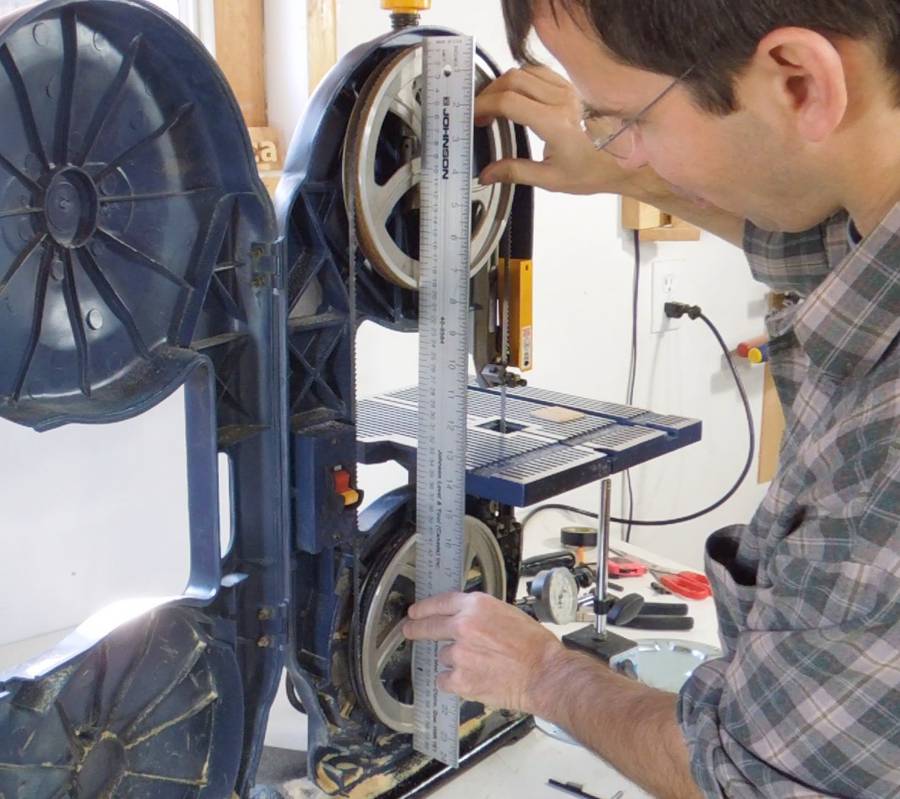
The key concept is coplanarity. When the wheels are intended to operate in the same plane, their rims should provide a consistent path for the blade. A straightedge placed across the wheel rims provides a practical way to identify a wheel that sits too far forward, backward, left, right, or at an angle. The exact adjustment method differs by band saw, so the owner’s manual should take priority over a generic procedure.
Source: woodsmithplans.com
What Band Saw Wheel Alignment Means
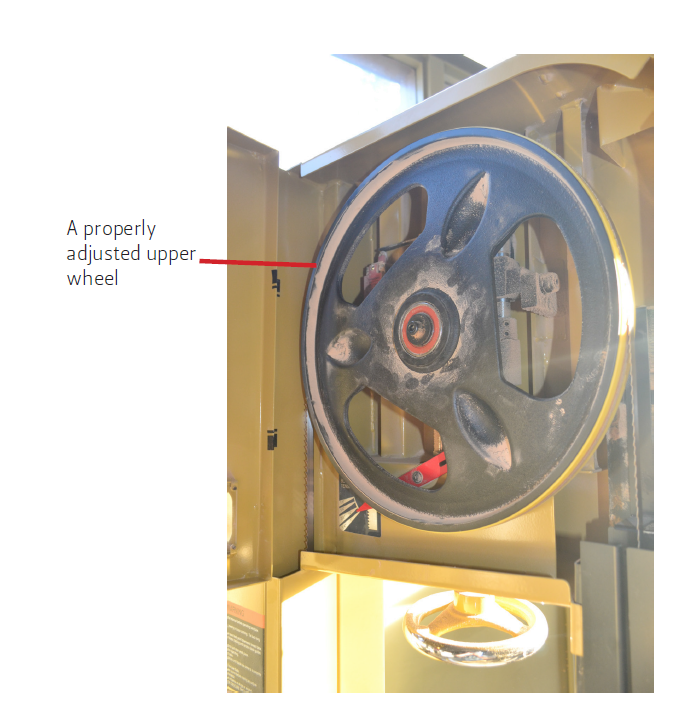
Band saw wheel alignment describes how the upper and lower wheels relate to one another in space. On machines designed for coplanar tracking, the wheel rims should be parallel and occupy the same plane. This allows the blade to move around the wheels without being forced sideways by a mismatch between the upper and lower wheel positions.
Coplanarity does not mean that every band saw must have identical wheel geometry. Some machines use different wheel designs or manufacturer-specific tracking arrangements, so the owner’s manual is the controlling reference. Do not assume that a visible offset is automatically a defect without first checking the machine’s documented setup.
Blade tracking is a separate adjustment. Tracking changes the position of the blade on the wheel, commonly by changing the tilt of the upper wheel. A tracking adjustment can compensate for some wheel-position relationships, but it should not be used to hide a significant structural or lateral alignment problem.
Source: popularwoodworking.com
Wheel alignment
Establishes the geometric relationship between the upper and lower wheels, including their relative plane, parallelism, and lateral position.
Blade tracking
Controls where the blade rides across the wheel tire or crown and is commonly adjusted with the upper-wheel tracking mechanism.
Blade tension
Applies the manufacturer’s specified tension so the blade remains stable during cutting. Tension should be correct before final tracking checks.
Positions the side and thrust guides correctly after the blade has been installed, tensioned, and tracked.
Why Wheel Alignment Matters
A wheel that is not properly aligned can make consistent blade tracking difficult and can contribute to wandering cuts, uneven tire loading, vibration, or accelerated blade and tire wear. These symptoms are not proof of misaligned wheels by themselves because dull blades, incorrect tension, damaged tires, guide problems, and poor setup can produce similar results.
A useful diagnostic approach is therefore to inspect the entire blade path. If the blade repeatedly moves toward an edge even after correct tension and careful tracking adjustment, checking the relationship between the two wheels becomes more important.
Straightedge check
Provides a simple visual and measurement-based method for checking whether the wheel rims occupy the same plane.
Consistent tracking
A properly aligned machine should allow the blade to maintain its intended position as the wheels are rotated by hand.
Tools and Safety Checks Before Alignment
Start with the saw disconnected from electrical power. Unplug a cord-connected machine or follow the manufacturer’s lockout procedure for permanently connected equipment. Do not rely only on the power switch. The wheels must be safe to rotate by hand during inspection.
The basic inspection can be performed with a straightedge long enough to reference both wheel rims, a fine ruler or feeler gauge for measuring gaps, and the appropriate wrenches or sockets for the adjustment hardware. Some machines require shims, while others provide dedicated adjustment bolts or wheel-position mechanisms.
Remove or move anything that prevents you from seeing the wheel rims clearly. If the blade must be removed for a particular manufacturer’s alignment procedure, follow the manual. If the blade remains installed, keep your hands clear of the teeth and treat the blade as a sharp cutting tool even when the machine is disconnected.
Source: oregonstate.edu
Straightedge
Use a rigid, known-straight edge that can reach across the relevant portions of both wheel rims.
Fine ruler or feeler gauge
Use one to quantify a visible gap instead of relying only on visual judgment.
Correct hand tools
Use the wrench, socket, hex key, or adjustment tool specified for your particular machine.
Owner’s manual
Confirm which wheel is adjustable, where the adjustment hardware is located, and whether the manufacturer specifies a particular alignment procedure.
Inspect the Tires Before Measuring
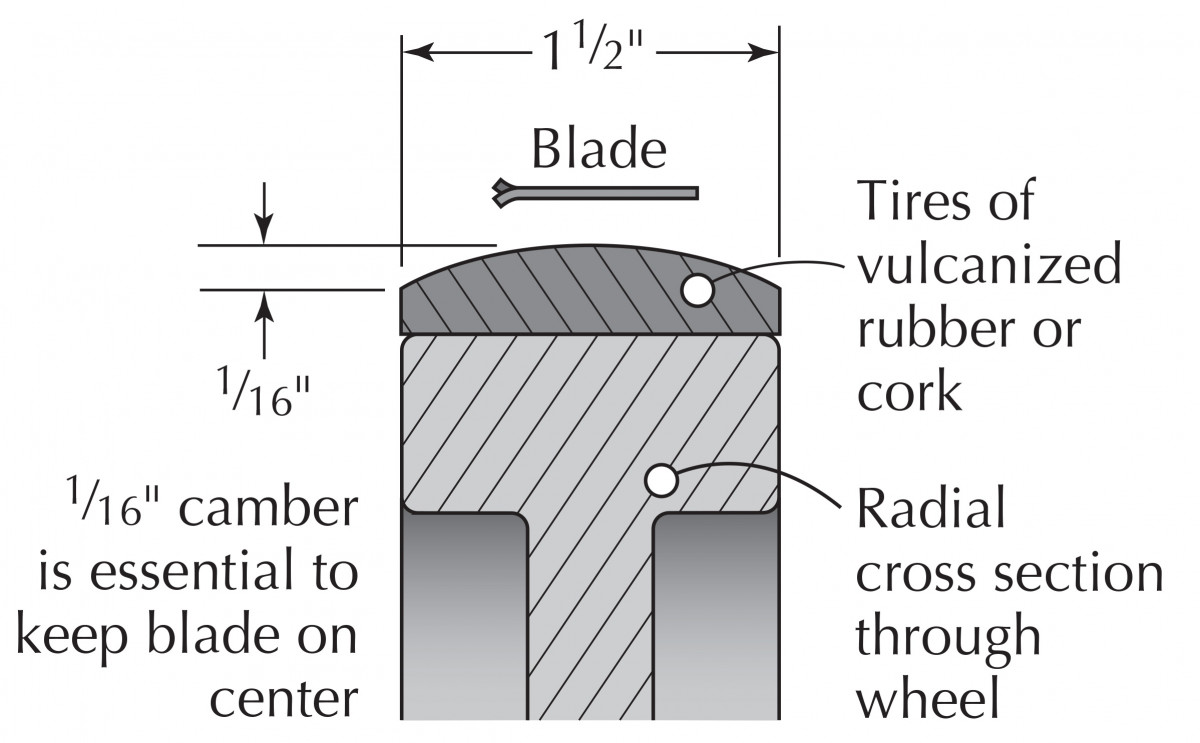
Inspect both wheel tires for cracks, missing material, severe glazing, uneven wear, loose sections, or obvious changes in the wheel profile. A damaged or uneven tire can make a properly aligned wheel appear to track incorrectly. Clean accumulated sawdust and debris from accessible wheel surfaces before taking measurements.
Also check for obvious wheel wobble or looseness. If a wheel rocks on its shaft or the bearings have excessive play, alignment measurements may not represent the machine’s condition during operation. Mechanical defects should be corrected before attempting fine alignment.
Tire condition
Look for damage or uneven wear that could alter the blade path.
Wheel runout
Check for obvious wobble as the wheel is rotated by hand.
Bearing condition
Investigate excessive looseness or unusual movement before making alignment adjustments.
How to Check Band Saw Wheel Alignment
The basic coplanarity check is straightforward: with the machine safely disconnected, place a straightedge against the wheel rims and determine whether both wheels reference the same plane. The exact contact points depend on the wheel design, tire profile, and manufacturer’s procedure.
Do not use the blade position alone as proof of wheel alignment. A blade can appear to track acceptably while the wheels are not perfectly coplanar, and some machine designs intentionally use a particular tracking relationship. The straightedge test provides a direct check of wheel geometry.
Source: woodgears.ca
Step 1: Disconnect power
Unplug or otherwise isolate the band saw from its power source before opening the wheel covers or working near the blade.
Step 2: Open the wheel covers
Expose enough of the upper and lower wheels to inspect their rims and identify the adjustment hardware.
Step 3: Prepare the blade path
Follow the owner’s manual regarding blade tension, blade removal, and guide clearance before measuring.
Step 4: Place the straightedge
Hold the straightedge across corresponding rim areas of the upper and lower wheels without forcing it against either wheel.
Step 5: Look for a gap
Check whether the straightedge contacts the intended reference points on both wheels or whether a measurable gap exists.
Step 6: Identify the direction of error
Determine whether the issue is vertical tilt, front-to-back offset, lateral offset, or a combination of these conditions.
Understanding the Straightedge Result
If the straightedge contacts the appropriate reference points on both wheels, the wheels may already be coplanar and no wheel-position correction may be necessary. If the straightedge contacts one wheel but leaves a gap at the other, measure the gap and compare the result with the adjustment method specified by the manufacturer.
A vertical angular mismatch may be addressed through the upper-wheel tracking mechanism on machines designed for that adjustment. A wheel that is parallel but offset from the other wheel may require shimming or a dedicated lateral adjustment. A lower wheel that is tilted from side to side may require rear adjustment bolts or another manufacturer-specified mechanism.
Parallel and coplanar
The straightedge references both wheels consistently and no correction is indicated by the manufacturer’s procedure.
Vertical angular mismatch
The upper wheel may need a controlled tilt adjustment when the machine is designed to use the tracking mechanism for this purpose.
Parallel but offset
The relevant wheel or shaft may need a position change or shim, but only where the machine design permits it.
Lateral angular mismatch
Some machines provide lower-wheel adjustment bolts for correcting left-to-right wheel orientation.
How to Correct Band Saw Wheel Alignment
Correct the specific type of misalignment rather than turning several adjustments at once. Make one small change, recheck the wheel relationship, and repeat only when the measurement shows that another correction is needed. This prevents one adjustment from masking another.
Many woodworking band saws use the upper-wheel tracking mechanism to control the wheel’s tilt. Other machines allow the lower wheel to be shifted or tilted with adjustment bolts, while some require shimming between a wheel assembly and its mounting surface. Because these mechanisms vary considerably, do not copy the adjustment direction or shim location from another model unless the manufacturer confirms that the design is equivalent.
If the wheels are parallel but occupy different planes, the correction generally involves moving one wheel assembly inward or outward. If one wheel is tilted relative to the other, the correction may involve the appropriate tilt adjustment. Measure the change rather than relying on a visual estimate.
Source: axminstertools.com
Use the designed adjustment first
If the manufacturer provides tracking, tilt, lateral, or wheel-position adjustments, use those mechanisms according to the manual.
Use shims only when appropriate
Shimming can correct a measured positional offset on machines designed to permit it, but an incorrect shim location can affect shaft engagement, bearing loading, pulley alignment, or wheel security.
Change one variable at a time
Record the original condition, make a small adjustment, and repeat the straightedge measurement before changing another component.
Secure all hardware
After alignment, tighten adjustment locks, jam nuts, retaining hardware, and other fasteners to the manufacturer’s specifications.
Recheck Blade Tracking After Alignment
Wheel alignment is not the final setup step. After the wheels are corrected, reinstall the blade if it was removed and set the blade tension according to the machine’s manual. With the power still disconnected, rotate the wheel by hand and observe the blade’s position on the tires.
Many bandsaw manuals instruct users to position the blade so it tracks consistently on the wheel crown or in the manufacturer’s specified location. The exact target is not universal: some designs call for the deepest part of the blade gullets to sit near the crown’s center, while other machines specify a different position. Follow the instructions for your model.
If the blade moves toward the front or rear of the wheel as you rotate it, use the tracking adjustment in small increments. Recheck after each change. Once the blade tracks consistently, lock the tracking adjustment and verify the blade tension again because tension changes can affect tracking.
Rotate by hand
Check several complete wheel revolutions while the machine is disconnected from power.
Watch for repeated movement
A blade that consistently walks toward an edge indicates that further tracking or mechanical inspection may be required.
Do not make large tracking changes
Tracking mechanisms can be sensitive, so small adjustments make it easier to identify the effect of each change.
Troubleshooting Band Saw Wheel Alignment Problems
If alignment appears correct but the band saw still behaves poorly, troubleshoot the rest of the blade path before making more wheel adjustments. A sharp blade with the correct width and tooth configuration, correct tension, clean and properly fitted tires, correctly adjusted guides, and a square table can all affect cutting behavior.
Repeated blade movement can also indicate a bent or damaged blade, inconsistent blade weld, damaged tire, wheel runout, bearing problems, or a tracking mechanism that is worn or loose. Increasing blade tension or forcing the tracking knob farther is not a substitute for finding the mechanical cause.
A useful diagnostic rule is to separate the symptom from the suspected cause. For example, a blade moving toward the front edge does not automatically mean the upper wheel is misaligned. First establish whether the movement is repeatable, whether the blade is correctly tensioned, whether the tires are sound, and whether the tracking mechanism responds normally.
Source: paulsellers.com
Blade walks toward the front or rear
Check blade tension, tracking adjustment, tire condition, wheel alignment, and whether the blade itself is straight and correctly installed.
Blade falls off a wheel
Stop using the machine and inspect tracking, wheel alignment, tire condition, blade installation, and mechanical looseness before restarting.
Uneven tire wear
Inspect wheel alignment and blade tracking, but also check for incorrect blade position, damaged tires, and excessive blade tension.
Saw cuts with excessive drift
Check blade sharpness and tooth selection, tension, guide setup, table alignment, tracking, and wheel geometry rather than assuming wheel alignment is the only cause.
Vibration increases after alignment
Inspect wheel runout, bearings, tire condition, blade condition, wheel balance, and fasteners before making additional alignment changes.
When to Stop Adjusting and Repair the Machine
Stop the alignment process if a wheel has excessive looseness, a shaft appears bent, a bearing is damaged, an adjustment mechanism is stripped, a tire is separating, or the wheel cannot be secured correctly. These conditions can make alignment measurements unreliable and can create a machine-safety problem.
A significant misalignment that cannot be corrected using the machine’s documented adjustments should be investigated with the manufacturer, an authorized service provider, or a qualified machinery technician. Avoid improvising structural modifications to wheel mounts, shafts, or bearing housings unless you have the engineering and machining capability to establish that the modification is safe.
Do not compensate indefinitely
If the tracking knob is near the end of its usable adjustment range, investigate the underlying wheel relationship instead of continuing to force the mechanism.
Do not ignore damaged tires
A tire with significant damage or deterioration should be evaluated before attempting precision tracking.
Escalate structural problems
Bent shafts, damaged bearing mounts, cracked components, and insecure wheel assemblies require repair rather than routine tracking adjustment.
Frequently Asked Questions
Q
How do I know if my band saw wheels are misaligned?
A straightedge check is the most direct starting point on machines designed for coplanar wheels. With power disconnected, place the straightedge across the appropriate wheel-rim reference points and look for a measurable gap or offset. Persistent blade-tracking problems can also justify an alignment inspection, but tracking problems alone do not prove that the wheels are misaligned.
Q
Should the upper and lower band saw wheels be perfectly coplanar?
For many conventional woodworking band saws, the wheels are intended to be parallel and coplanar. However, machine designs differ, and some manufacturers specify a particular wheel relationship. Check the owner’s manual before correcting an apparent offset. Do not assume every visible difference is an error.
Q
Can I align band saw wheels without removing the blade?
Some alignment checks can be performed with the blade installed, while other manufacturer procedures call for blade removal. The correct approach depends on the machine. If the blade remains installed, disconnect power, keep hands away from the teeth, and follow the manufacturer’s instructions for tension and wheel access.
Q
Why does my band saw blade keep moving to one side after I adjust the tracking?
Possible causes include incorrect blade tension, incorrect tracking adjustment, damaged or uneven tires, wheel misalignment, wheel runout, a damaged blade, or worn mechanical components. If the blade repeatedly requires extreme tracking adjustment, check wheel alignment instead of repeatedly turning the tracking knob.
Q
Do I need to align the wheels every time I change the band saw blade?
Usually, the wheels do not need to be realigned after every blade change if the machine has not been disturbed. However, blade tracking should be checked after a blade change, and wheel alignment should be rechecked if tracking suddenly becomes difficult or the blade path changes unexpectedly.
Q
Can wheel misalignment cause a band saw to cut crooked?
It can contribute to poor tracking and wandering, particularly when the wheels are substantially out of alignment on a machine designed for coplanar tracking. However, a crooked cut has several possible causes, including blade selection, blade sharpness, tension, guide setup, table alignment, feed technique, and drift. Diagnose the whole setup rather than attributing the problem to wheel alignment alone.
✦ Wrapping Up
Conclusion
Band saw wheel alignment is primarily a mechanical geometry check: determine whether the upper and lower wheels have the relationship specified by the machine manufacturer, correct measurable misalignment with the intended adjustment method, and then reset blade tracking and tension. A straightedge, careful measurement, and small controlled adjustments are more reliable than repeatedly turning the tracking knob until the blade appears stable.
For a U.S. workshop, the safest practical sequence is to disconnect power, inspect the tires and wheel hardware, check coplanarity, correct only the measured error, secure the adjustment hardware, and then perform the blade setup again. If the wheels cannot be aligned using the documented adjustment system, or if you find damaged shafts, bearings, tires, or mounting components, stop and obtain qualified service rather than improvising a structural repair.
💡 Key Takeaway
Before making another tracking adjustment, disconnect the band saw, inspect the tires and wheel hardware, check the upper and lower wheels with a straightedge, and use your specific owner’s manual to determine the correct adjustment method.