Choose a circular saw blade by matching the blade diameter and arbor to your saw, then select the tooth count, tooth geometry, kerf, and blade material for the specific material and type of cut.
For homeowners, remodelers, carpenters, and contractors in the United States, circular saw blade selection starts with the saw itself. A 7-1/4-inch handheld circular saw needs a blade made for that diameter and arbor configuration, while a table saw or miter saw may require a different blade size and design. Never choose a blade based on tooth count alone.
The cutting job determines the rest of the decision. Fewer teeth generally favor faster, rougher cuts, while more teeth usually produce cleaner cuts. Rip cuts along the grain can benefit from fewer teeth and larger gullets, while crosscuts and finish work generally call for more teeth. Material also matters: a wood blade is not automatically suitable for aluminum, steel, fiber cement, or abrasive boards.
The practical approach is to work through compatibility first, application second, and finish requirements third. Check the saw and blade markings for diameter, arbor, maximum RPM, and intended application before mounting anything. OSHA guidance also emphasizes using the correct blade for the cutting action and using blades and arbors that are correctly sized for the machine.
Source: festoolusa.com
Start With Saw and Blade Compatibility
The first step in circular saw blade selection is confirming that the blade physically and mechanically fits the saw. Look at the saw’s manual, existing blade, or manufacturer’s specifications for the required blade diameter and arbor size. Common U.S. portable circular saw sizes include 6-1/2 inches and 7-1/4 inches, but other sizes are used on compact saws, track saws, miter saws, and table saws.
The arbor is the hole in the center of the blade that fits over the saw’s spindle. The blade must seat correctly on the arbor and any required washers or collars. Do not assume that a blade with the right outside diameter will fit simply because it looks similar to the original blade.
Also check the blade’s maximum RPM against the saw’s operating speed. A blade must be rated for the speed of the machine. Portable saw guards must remain functional, and the blade should never be modified to make an incompatible fit.
Source: boschtools.com
Blade diameter
Use the diameter specified by the saw manufacturer. A larger blade can create clearance, guard, speed, and cutting-depth problems.
Arbor size
The center hole must match the saw’s arbor and required mounting hardware. A loose or incorrectly supported blade is unsafe.
Maximum RPM
The blade’s rated maximum speed must be compatible with the saw. Follow the lower applicable rating when specifications differ.
Tool type
Confirm that the blade is intended for a handheld circular saw, worm-drive saw, table saw, miter saw, track saw, or another specific machine.
Why blade diameter matters
Blade diameter determines the physical cutting capacity and affects the blade’s operating characteristics. For example, a 7-1/4-inch circular saw blade is a common size for U.S. jobsite framing and general construction, while smaller blades are used on compact cordless saws. Do not substitute diameter based only on whether the blade appears to fit inside the guard.
Check the saw label
Use the diameter listed by the saw manufacturer rather than relying on visual clearance.
Check cutting depth
A compatible blade should provide the cutting depth required by the project without creating interference with the saw.
Choose Tooth Count for the Type of Cut
Tooth count is one of the most visible blade specifications, but it should be treated as a cutting-behavior variable rather than a simple quality rating. A lower tooth count can remove material quickly and leave more room for chips in the gullets. A higher tooth count puts more teeth into the material during the cut and is commonly used when a smoother edge is more important.
Manufacturer ranges illustrate this trade-off. Circular saw blades are available in configurations such as 18, 24, 40, 60, and 80 teeth, with manufacturers assigning different counts to fast cutting, framing, general-purpose work, fine finishing, and extra-fine finishing applications.
There is no single tooth count that is best for every job. The correct choice depends on the material thickness, cutting direction, required finish, and saw type.
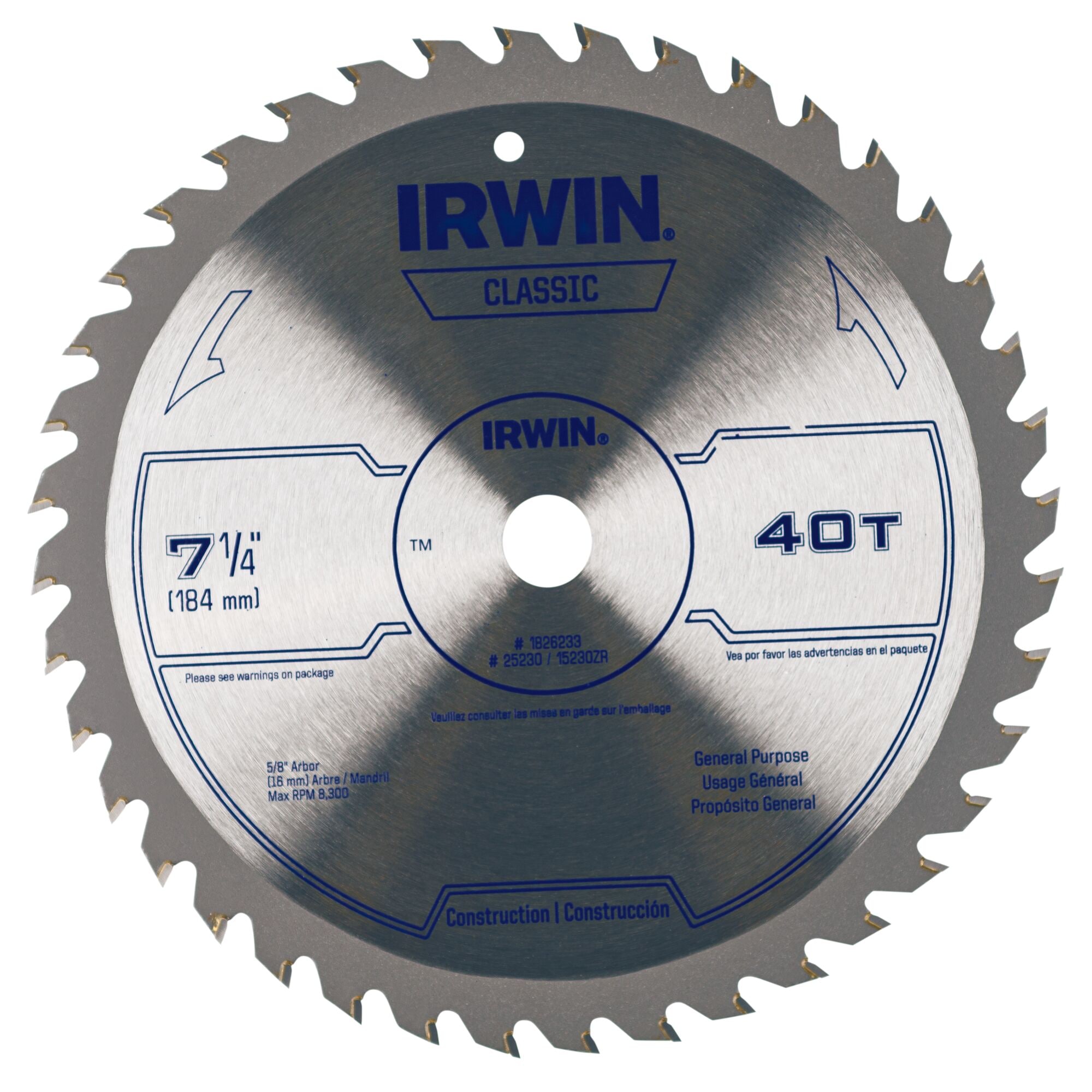
Source: irwintools.com
Low tooth count
Often suited to fast framing, ripping, construction lumber, and rough cuts where speed matters more than a finished edge.
Medium tooth count
Useful for general-purpose wood cutting when you need a balance between cutting speed and edge quality.
High tooth count
Generally better suited to clean crosscuts, plywood, laminated panels, trim, and finish-oriented work.
Does more teeth always mean a better blade?
No. More teeth can improve edge quality for the right application, but they also change how quickly the blade removes material. A high-tooth-count blade used for a demanding rip cut can behave differently from a lower-tooth-count ripping blade. The goal is to match tooth count to the cut rather than automatically choosing the highest number.
For ripping
Fewer teeth are often useful because the larger gullets provide more space for chips and support faster material removal.
For crosscutting
More teeth are commonly preferred when reducing splintering and producing a cleaner edge is important.
Match the Blade to the Material
Material selection is the next major decision. Wood, plywood, OSB, laminates, plastics, aluminum, steel, fiber cement, and other materials place different demands on blade teeth and blade bodies. A general-purpose wood blade should not be treated as a universal blade for every material.
For wood, choose between framing, general-purpose, ripping, crosscutting, and fine-finish designs according to the job. Plywood and laminated panels often benefit from blade designs intended to reduce chipping. For metal, use a blade specifically rated for the metal being cut and the saw speed. Ferrous and nonferrous metals can require different tooth materials and geometries.
Fiber cement and other abrasive materials also need purpose-built blades. Some manufacturers offer very low tooth counts or specialized diamond-impregnated or polycrystalline diamond-tipped designs for these applications.
Source: milwaukeetool.com
Dimensional lumber
A framing or general-purpose wood blade is usually appropriate. Prioritize speed and adequate chip clearance when the cut will be hidden.
Plywood and sheet goods
Choose a blade designed for plywood or fine cutting when minimizing tear-out is important.
Hardwood
Select tooth geometry and count according to whether the cut is a rip, crosscut, or finish operation.
Aluminum and other nonferrous metals
Use a blade specifically designed for nonferrous metal and follow its speed and application limits.
Steel and ferrous metals
Use a dedicated ferrous-metal cutting blade compatible with the saw. Metal-cutting blades can have different RPM requirements from wood blades.
Fiber cement
Use a blade specifically designed for fiber cement. Abrasive dust and material characteristics make ordinary wood blades unsuitable for this task.
Wood blade selection by application
For a typical U.S. framing job using dimensional lumber, a lower-tooth-count carbide-tipped blade is commonly chosen because the priority is fast cutting. For cabinet work, trim, or visible crosscuts, a higher-tooth-count blade can provide a cleaner edge. For plywood and laminated panels, use a blade specifically intended for sheet goods when tear-out is a concern.
Framing
Prioritize fast cutting, chip clearance, and durability.
Fine crosscutting
Prioritize tooth count and geometry that support a clean edge.
Plywood and laminates
Use a sheet-good or fine-finish blade when surface quality matters.
Understand Tooth Geometry
Tooth geometry describes the shape, angle, and arrangement of the cutting teeth. It affects how aggressively the blade enters the material, how chips are formed, and the quality of the resulting edge.
Alternate Top Bevel, commonly abbreviated ATB, is widely used for wood cutting. The alternating tooth angles help shear through wood fibers and are common on crosscut and general-purpose blades. Other geometries, including combination and specialized metal-cutting grinds, are designed around different cutting requirements.
Hook angle also matters. A more aggressive hook can change how quickly the blade pulls into the workpiece, while a lower or negative hook angle can provide a more controlled cutting action in applications where that behavior is desirable. Always use the geometry specified for the intended machine and material.
Source: upload.wikimedia.org
ATB
A common wood-cutting geometry in which the tooth bevel alternates from side to side. It is frequently used for crosscutting and general wood applications.
Combination geometry
Designed to balance ripping and crosscutting in applications where changing blades frequently is inconvenient.
Specialized metal geometry
Metal-cutting blades can use tooth arrangements designed to control heat, chip formation, burrs, and cutting forces.
Why tooth shape matters as much as tooth count
Two blades can have the same number of teeth but behave differently because their tooth geometry, hook angle, gullet shape, and carbide formulation differ. When comparing blades, look beyond the number printed on the package and check the manufacturer’s intended application.
Cut direction
Rip and crosscut operations can require different tooth behavior even when the material is the same.
Material condition
Wet, resinous, abrasive, laminated, or contaminated material can require a specialized blade.
Consider Kerf and Blade Thickness
Kerf is the width of material removed by the blade. A thin-kerf blade removes less material per pass than a wider-kerf blade. That can reduce cutting resistance and material waste, which is especially useful for some cordless saw applications.
Thin kerf does not automatically mean better. A blade’s stiffness, tooth design, saw compatibility, material, and intended application still matter. A very thin blade can behave differently from a heavier blade, so use the configuration recommended for the saw and job.
Manufacturer specifications demonstrate why this matters. Some portable circular saw blades use kerfs around a few hundredths of an inch, while other blades are intentionally wider for particular machines and applications. Compare the actual specification rather than relying only on labels such as thin kerf or ultra-thin.
Source: freudtools.com
Thin kerf
Removes less material and can reduce cutting resistance and waste. It can be particularly useful where battery runtime or feed effort matters.
Standard kerf
Can provide a more substantial blade body and may be preferred for particular saws, materials, and demanding applications.
Check the specification
Look for the manufacturer’s stated kerf or width of cut instead of assuming two blades with the same diameter remove the same amount of material.
A simple kerf calculation
A hypothetical example shows the difference. If a blade removes 0.070 inch of material on each cut and you make 100 cuts, the total theoretical kerf loss is 7 inches of material width across those cuts. A 0.057-inch kerf under the same simplified conditions would account for 5.7 inches. Actual material loss depends on the cut and workpiece, but the example shows why kerf can matter when making many cuts.
Use the calculation as a comparison
Multiply kerf width by the number of cuts for a rough estimate of cumulative material removed. It is not a prediction of final project yield.
Select the Right Blade for Ripping or Crosscutting
The direction of the cut changes blade selection. Ripping means cutting along the grain of solid wood, while crosscutting means cutting across the grain. These operations generate chips differently, so blades are commonly designed around one or both cutting directions.
For ripping, fewer teeth and larger gullets can help clear material efficiently. For crosscutting, more teeth are commonly used to improve the finish across wood fibers. Combination blades are available when one blade needs to handle both operations.
The best choice also depends on whether the edge will be visible. A rough framing cut behind drywall does not require the same edge quality as a cabinet component or finished trim piece.
Source: festoolusa.com
Rip cut
Cutting along the grain. Speed and chip clearance are often priorities.
Crosscut
Cutting across the grain. Cleaner edge quality and reduced splintering are often more important.
Combination cut
A general-purpose blade can be useful when the work includes both ripping and crosscutting.
What if one blade must handle several jobs?
Choose a general-purpose or combination blade when changing blades repeatedly is impractical and the work does not demand specialized finish quality. If a project includes both rough construction cuts and highly visible finish cuts, using separate blades can be more appropriate because each operation has different requirements.
One blade for general work
Choose a balanced design when convenience is more important than optimizing every individual cut.
Separate blades for specialized work
Use dedicated ripping, crosscutting, finish, or material-specific blades when cut quality or productivity justifies the change.
Carbide, Steel, and Specialty Blade Materials
Blade material influences durability, sharpening options, and suitability for the work. Carbide-tipped blades are common for modern woodworking and construction because carbide cutting tips can retain a sharp edge through substantial use. Some specialized blades use different carbide formulations or other cutting materials for particular applications.
Plain steel blades can still be useful in specific applications, but their cutting characteristics and maintenance requirements differ from carbide-tipped blades. Specialty materials such as cermet and polycrystalline diamond are used for certain metal and abrasive-material applications.
Do not compare cutting-tip materials without considering the complete blade design. Tooth geometry, body construction, coating, kerf, application, and machine speed all contribute to how a blade performs.
Source: milwaukeetool.com
Carbide-tipped
Common for wood and construction applications, with carbide teeth attached to a steel blade body.
Cermet
Used in some ferrous-metal cutting blades where the tooth material and geometry are designed for metal-cutting conditions.
Polycrystalline diamond
Used in certain highly abrasive applications such as fiber-cement products and other demanding materials.
When should a specialty blade be used?
Use a specialty blade when the material manufacturer or blade manufacturer identifies the material as an intended application. This is particularly important for ferrous metals, nonferrous metals, fiber cement, and abrasive composites, where a conventional wood blade may be damaged or produce an unsuitable cut.
Follow the application label
Use the blade for the materials and machines specified by its manufacturer.
Do not improvise
A blade that physically fits the saw is not necessarily appropriate for the material.
Use RPM, Blade Condition, and Safety as Final Checks
After choosing the blade type, perform a final safety and compatibility check before installation. Confirm the maximum RPM, inspect the blade for cracks or damage, verify that the teeth and body are intact, and make sure the arbor and mounting hardware are clean and correctly seated.
OSHA guidance for woodworking emphasizes using the correct blade for the required cutting action, operating equipment within its rated capacity, and ensuring blades and collars fit the machine arbor accurately. OSHA also identifies dull, badly set, improperly filed, or improperly tensioned saws as conditions that can contribute to sticking, jamming, and kickback.
For portable circular saws, the upper and lower guards are important safeguards. The lower guard should operate correctly and return to its covering position when the saw is withdrawn from the work. Never defeat or remove a guard simply to accommodate a blade.
Source: irwintools.com
Inspect before installation
Reject blades with cracks, damaged teeth, severe warping, or other visible defects.
Verify RPM
Use a blade whose maximum rated speed is appropriate for the saw.
Check the guard
Make sure the saw’s blade guards move and function as designed.
Secure the workpiece
Support material properly so it cannot shift, pinch the blade, or create an unstable cutting condition.
Wear appropriate PPE
Use eye and face protection as appropriate for the operation, along with hearing protection and other protective equipment required by the work environment.
Signs that the blade may be wrong or worn
A blade that is wrong for the material or application can show itself through burning, excessive vibration, poor cut quality, unusual resistance, repeated binding, or premature tooth damage. These symptoms do not identify one universal cause, so stop the saw and inspect the blade, workpiece support, cutting direction, and machine setup before continuing.
If the blade is dull or damaged, replacing or professionally sharpening it may be appropriate depending on the blade design. Do not continue using a cracked blade or attempt an improvised repair.
Burn marks
Can indicate excessive friction, a dull blade, inappropriate tooth design, poor feed technique, or material conditions.
Excessive splintering
Can indicate an unsuitable tooth count or geometry, a dull blade, unsupported material, or an inappropriate cutting direction.
Blade binding
Can result from workpiece movement, pinching, poor support, incorrect blade selection, or cutting conditions.
Vibration
Stop the saw and check blade condition, mounting, arbor fit, and machine condition before using it again.
Frequently Asked Questions
Q
What tooth count should I use on a 7-1/4-inch circular saw?
The correct tooth count depends on the cut. A lower tooth count such as 18 or 24 teeth is commonly used for fast framing and rough construction cuts, while 40 teeth or more can be appropriate when cleaner cuts are needed. Always consider the material, cutting direction, and blade manufacturer’s application rating.
Q
Is a 24-tooth blade better than a 40-tooth blade?
Neither is universally better. A 24-tooth blade can favor faster material removal and framing work, while a 40-tooth blade can provide a cleaner general-purpose cut. The appropriate choice depends on whether speed, finish quality, or versatility is the main requirement.
Q
Can I use a wood-cutting blade to cut metal?
Do not assume that a wood blade is suitable for metal. Metal cutting requires a blade specifically designed and rated for the metal and saw involved. Ferrous and nonferrous metals can require different blade designs, tooth materials, and operating speeds.
Q
What does thin kerf mean on a circular saw blade?
Thin kerf means the blade removes a narrower strip of material during the cut. This can reduce material waste and cutting resistance. Thin-kerf blades can be particularly useful for some cordless applications, but they must still be compatible with the saw and appropriate for the material.
Q
How do I know when a circular saw blade needs replacing?
Replace a blade when it is cracked, damaged, excessively worn, or no longer produces an acceptable cut after appropriate maintenance. Burning, excessive splintering, vibration, increased cutting effort, and repeated binding can indicate that the blade or setup needs attention. Stop the saw before inspecting the blade.
✦ Wrapping Up
Conclusion
Good circular saw blade selection is a compatibility and application decision, not simply a search for the highest tooth count. Start with the saw’s required diameter, arbor, and RPM. Then match the blade to the material, cutting direction, desired finish, tooth geometry, and kerf.
For common U.S. construction work, a lower-tooth-count carbide blade can make sense for fast framing and rough cuts, while higher-tooth-count blades are generally more appropriate when a clean crosscut or finished edge matters. Specialized materials such as metal and fiber cement require purpose-built blades and should not be treated like ordinary wood.
When in doubt, the blade manufacturer’s application information and the saw manufacturer’s manual should take priority over general rules. A blade that fits physically is not necessarily a blade that is safe or appropriate for the job.
💡 Key Takeaway
Before buying a circular saw blade, write down your saw’s blade diameter, arbor size, operating RPM, material, cut direction, and desired finish. Use those five factors to narrow the blade choice, then verify the manufacturer’s compatibility and application specifications before installation.