The best wood for steam bending is usually straight-grained, defect-free hardwood with suitable moisture content. Red oak, white oak, ash, beech, elm, and some maples are useful choices. Board quality, grain direction, drying history, thickness, and bend radius matter as much as the species.
Across the United States, woodworkers use steam bending to make curved chair parts, furniture frames, boat ribs, handles, and decorative pieces. The process uses heat and moisture to soften wood. This lets a solid board bend around a form without cutting it into short pieces or joining many thin strips.
Good results start at the lumber rack, not at the steam box. A board with knots, twisted grain, or hidden cracks may split even when the steam process is correct. A suitable species also needs the right moisture level and enough clear length for the planned curve.
Steam bending wood selection is not just a choice between oak and ash. Two boards from the same tree species can behave very differently. Their grain, density, drying history, and natural defects can change how well they bend.
This guide explains how to choose suitable lumber for American woodworking projects. It covers common hardwoods, board inspection, grain direction, moisture, thickness, and practical test bends. It also explains when another bending method may be a better choice.
Source: woodcraftwiz.com
Why Wood Selection Matters In Steam Bending
Wood selection controls how easily a board bends and how well it holds its new shape. Steam does not make every species equally flexible. Natural differences in wood structure affect the result.
Wood contains fibers held together by lignin and other natural materials. Heat and moisture soften this structure for a short time. The fibers can then move under pressure as the wood bends around a form.
The outside of a curve experiences tension. The inside experiences compression. Wood handles compression better than stretching. This is why grain quality and a compression strap can have a major effect on success.
A suitable board must handle both forces without splitting, crushing, or developing wrinkles. A good species helps, but poor stock can still fail.
Source: familyhandyman.com
Bending strength
The wood must tolerate compression on the inside of the curve without crushing or forming deep wrinkles.
Grain continuity
Long, continuous fibers help the finished part remain intact throughout the curve.
Moisture response
The board must contain enough moisture to respond well to steam and heat.
Drying stability
The selected wood should dry in its new shape without excessive checking, twisting, or distortion.
Why Straight Boards Are Not Always Good Bending Boards
A board can look straight from the outside and still have poor internal grain direction. Its fibers may run diagonally through the thickness or drift toward one edge. This is called grain runout.
During bending, fibers that leave the surface too quickly create weak spots. These spots may split under tension. Look at the long edges and faces before choosing a board.
The goal is to find stock where the fibers follow the full length of the planned part. A split billet can help reveal grain direction more clearly than ordinary sawn lumber.
Inspect both faces
Look for grain lines that travel smoothly along the full length.
Inspect both edges
Watch for grain that exits an edge at a steep angle.
Best Wood Species For Steam Bending
Several American hardwoods are suitable for steam bending. Oak, ash, beech, elm, maple, and walnut are common choices. Their performance still depends on the individual board.
Red oak and white oak are strong starting points for many furniture projects. Ash is also useful when the stock has clean, straight grain. Beech and elm offer other options for curved parts.
Do not assume that every hardwood bends well. Some tropical species are brittle. Many softwoods also perform less reliably for tight curves. The exact result depends on the species, stock quality, and bending setup.
The following table compares common choices. It is a practical starting guide, not a guaranteed ranking. Test the actual lumber before using it for an important part.
Source: sandiegocraft.org
Red oak
A useful beginner choice. Straight, clear boards are often available in American lumber markets. Inspect kiln-dried stock closely before use.
White oak
A widely used bending hardwood. It suits furniture and boat-related work when the board has suitable grain and moisture.
White ash
Known for useful flexibility and strength. It can be a good choice for chair parts, rails, and curved frames.
Beech
A useful hardwood for furniture components. Select clean stock and test the desired curve.
Elm
Often used for curved wood components. Its grain and natural structure can make it suitable for bending.
Maple
Some maple boards can bend well, but the result depends on the species and stock quality. Use a gentle test bend first.
Walnut
Can produce attractive curved furniture parts. Its bending response can vary from board to board.
Cherry
Can work well with a suitable compression strap. Test the stock before committing to a tight curve.
Red Oak And White Oak
Oak is a practical starting point for many American woodworkers. Both red oak and white oak have a long history in furniture and other woodworking projects.
Red oak can be easier to source in straight-grained stock. White oak is also a strong option for curved components. However, drying quality matters. Poorly dried boards may contain internal stress or cracks that become clear during bending.
Choose clear boards with long, continuous grain. Avoid pieces with large knots or visible checking. If the curve is tight, use a compression strap and test the exact stock.
Best use
Furniture rails, chair parts, curved frames, and selected boat components.
Main concern
Grain runout and drying defects can cause failure even in a suitable oak species.
Ash And Beech
Ash is valued for its useful strength and bending response. It can suit chair frames, curved handles, and furniture parts that need a continuous grain line.
Beech is another option for curved furniture components. It can produce good results when the stock is clean and prepared well. Neither species removes the need for a test bend.
When buying either wood, compare several boards. Choose the one with the clearest grain and fewest defects rather than selecting by color alone.
Ash
A good option when strength and a clean curved appearance matter.
Beech
Useful for furniture work where clear stock is available.
Maple, Walnut, And Cherry
Maple, walnut, and cherry can all be used for selected steam-bending jobs. Their performance can vary more than a simple species list suggests.
Maple may suit moderate curves, but some boards are stiff and less forgiving. Walnut can respond very well or prove difficult, depending on the tree and board. Cherry can be especially useful when a compression strap controls the outer face.
These species are worth testing when their color or appearance is important to the finished project. Do not select them for a severe bend without first checking their actual response.
Maple
Consider for moderate curves and test the exact species and board.
Walnut
Choose clear, consistent stock and allow for differences between boards.
Cherry
Consider a compression strap when the planned bend places high stress on the outer face.
How To Inspect Lumber Before Buying
The best board is the one with sound, continuous grain and enough clear length for the entire part. Inspect every board before paying for it. Do not rely on a species label or a seller’s claim that the wood is suitable for bending.
Start by looking at the full length of each board. Check both faces and both edges. Then inspect the end grain to see how the growth rings run through the stock.
A board may have an attractive face but poor grain near its edges. That hidden problem can become a weak point after steaming. Take time to examine the whole piece.
For demanding curves, splitting a larger billet along the grain may give better results than using ordinary sawn lumber. This takes more preparation but can provide more control over fiber direction.
Source: woodcraftwiz.com
Avoid knots
Knots interrupt the fibers and create areas where stress can build during bending. Avoid both large knots and small knots near the bend.
Avoid checks and splits
Surface cracks and end checks may grow during heating and bending. Choose sound stock with clean ends.
Avoid decay
Rot and fungal damage weaken the wood. Do not use decayed or badly discolored stock for a load-bearing curved part.
Avoid bark pockets
Included bark interrupts the normal wood structure and can create a weak line.
Check for twist
Twisted grain can make a board difficult to bend in a controlled plane.
Look for consistent density
Compare boards from the same species. Unusually light, brittle, or irregular stock deserves extra care and testing.
Understand Grain Runout
Grain runout occurs when the wood fibers do not follow the length of the board. The fibers move toward or away from the surface at an angle. This can make the board weaker during bending.
A useful selection guideline is to avoid grain slopes steeper than about 1 in 15. This means the grain should travel at least 15 inches along the board for every 1 inch of crosswise movement.
This is a screening guideline, not a guarantee. A severe bend may require even better grain. If the fibers move sharply across the board, select another piece.
Good grain
The fibers remain nearly parallel to the board edges.
Poor grain
The fibers drift across the board and leave the surface over a short distance.
Check The End Grain
The end grain reveals the direction of the growth rings. This can help you decide how to position the board on the bending form.
For some ring-porous woods, such as oak and ash, quarter-sawn or rift-sawn stock may help reduce certain bending defects when the grain is oriented correctly. The best orientation depends on the part and bend direction.
Do not choose quarter-sawn wood automatically. A clear, straight-grained flat-sawn board may be a better option than a quarter-sawn board with knots or severe runout.
Inspect ring direction
Check how the growth rings meet the faces and edges.
Match the form
Plan the final orientation before cutting the bending blank.
Moisture Content And Drying History
Moisture content is one of the most important factors in steam bending. Wood that is too dry may crack under pressure. Wood that contains too much free water may also develop problems during compression.
Air-dried hardwood is often a good starting point. Many woodworkers aim for moisture content in the range of about 15 to 25 percent, depending on the species and the required bend. Some published guidance recommends different ranges, so treat these values as starting points rather than universal limits.
A moisture meter helps you check the board before cutting it. Use a meter suitable for the species and wood temperature. Follow its instructions and correct for species where required.
Conventional kiln drying can make bending more difficult. High drying temperatures may change how lignin responds to later steaming. This does not mean every kiln-dried board must fail, but it does mean you should test it rather than assume it will behave like air-dried stock.
Source: woodandshop.com
Air-dried wood
Often preferred for steam bending because it has not gone through the same high-temperature drying process as conventional kiln-dried lumber.
Kiln-dried wood
May be harder to bend, especially for tight curves. Use suitable stock and test it before relying on it.
Green wood
Can bend with less force, but it needs more time to dry and may shrink or distort as it loses moisture.
Very dry wood
May resist bending and crack under stress. Check its moisture level before use.
How To Measure Moisture Content
Use a wood moisture meter before preparing the final bending blanks. Take readings at several points along the board. Avoid relying on a single reading from one end.
A pin-type meter measures electrical resistance between its pins. A pinless meter uses an electromagnetic field. Both can be useful when used within their stated limits.
Check the meter’s species correction settings. Readings can vary with wood density, temperature, and measurement depth. Record the results so you can compare successful and failed test pieces.
Measure several locations
Check the middle and both ends of the board.
Record the result
Write down the species, moisture reading, and board thickness.
Test before soaking
Measure the stock before adding water or beginning steam treatment.
Should You Soak Kiln-Dried Wood?
Some woodworkers soak kiln-dried stock before bending. The goal is to add moisture and improve the response to steam. However, soaking does not reverse every change caused by kiln drying.
Soaking times vary with thickness, species, initial moisture, and the method used. A long soak should not be treated as a guaranteed fix for unsuitable lumber.
If you only have kiln-dried stock, prepare a small test blank first. Compare it with air-dried material if possible. If the kiln-dried piece cracks or refuses to bend, choose another board or use bent lamination.
Do not assume soaking is enough
Extra moisture cannot repair knots, grain runout, checks, or internal damage.
Watch for uneven moisture
Different parts of a thick board may absorb water at different rates.
Choose The Right Board Thickness And Grain Orientation
Board thickness changes how difficult a bend will be. Thick stock needs more heat to reach its center. It also needs more force to move around a form.
Thin stock is often easier to bend, but it still needs clean grain and proper support. A thin board with a knot or grain runout can split just as easily as a thicker one.
The required curve also matters. A wide, gentle arc places less stress on the wood than a tight curve made from the same thickness. Choose the board and form together.
Whenever possible, keep the bending blank rectangular. Complex profiles can distort during bending. It is often easier to bend a rectangular blank first and cut the final profile afterward.
Source: woodlabstudio.co
Thin stock
Usually requires less steaming time and bending force. It is useful for smaller furniture components and test pieces.
Medium-thickness stock
Can suit chair rails and furniture frames when the species and curve are appropriate.
Thick stock
Needs careful heat control, suitable equipment, and a strong form. Tight curves become more demanding.
Understand The Bend Radius
The bend radius describes how tight the curve is. A small radius means a tighter curve. A large radius means a gentler curve.
The relationship between radius and thickness helps you judge the difficulty of a bend. For example, a 1-inch-thick board bent around a 12-inch radius faces a different challenge from the same board bent around a 4-inch radius.
There is no single radius-to-thickness ratio that guarantees success for every species. Grain quality, moisture, compression support, and the actual shape all affect the result.
For a demanding curve, test the exact thickness and radius before preparing the final stock. A successful test provides a better guide than a general species chart.
Large radius
Usually places less bending stress on the board.
Small radius
Needs better grain, suitable moisture, and careful control of compression.
Changing radius
A curve with tight sections and gentle sections should be judged by its tightest point.
When To Use A Compression Strap
A compression strap supports the outside of the bend. It has end stops that help keep the wood from stretching too far as it moves around the form.
This support can improve the chance of success with tighter curves. It is especially useful when the wood needs extra help controlling tension on the outside face.
The strap must fit the workpiece and bending setup. Poorly fitted hardware may shift or fail to control the stock. Use equipment designed for the loads involved and inspect it before bending.
Use for demanding bends
A suitable strap can help control outer-face stretching.
Check the end stops
They must contact the workpiece correctly and prevent unwanted movement.
Test the setup
Confirm that the strap and form work together before using valuable lumber.
A Practical Method For Selecting Steam-Bending Wood
A simple selection process can prevent wasted lumber and failed bends. Start with the project shape, then choose the species, board, and moisture level. Prepare a test piece before making the final component.
Do not begin by buying the cheapest available board. A small amount of extra time spent inspecting lumber can save hours of preparation and repair.
The method below works as a general starting point for furniture-scale projects. Large structural parts and unusual bends may need a more detailed material assessment.
Source: sandiegocraft.org
Step 1: Define the curve
Draw the full shape and mark the tightest radius. Record the required finished length and width.
Step 2: Select a suitable species
Start with red oak, white oak, ash, beech, or elm. Consider other species only after reviewing their bending response.
Step 3: Inspect the board
Check both faces, both edges, and the end grain. Reject boards with knots, decay, cracks, and severe runout.
Step 4: Check moisture
Use a moisture meter and record the readings. Prefer suitable air-dried stock when available.
Step 5: Prepare the blank
Cut a straight-grained blank with extra length. Remove rough saw marks and avoid making deep profiles before bending.
Step 6: Make a test bend
Use the same species, thickness, moisture condition, and bend radius planned for the final part.
Step 7: Review the result
Look for cracks, wrinkles, crushing, and excessive springback. Change the stock or setup if needed.
Example: Selecting Wood For A Curved Chair Rail
Imagine a chair rail that needs a smooth curve and a finished thickness of about 3/4 inch. The design calls for a single solid-wood part with continuous grain.
A straight-grained red oak or white ash board would be a sensible starting point. Select a blank thicker than the finished size if later shaping or sanding will remove material.
Check the grain along the entire rail. Make sure the bend does not pass through a knot or an area with severe runout. Check the moisture level and prepare a matching test piece.
If the test bends without splitting or crushing, proceed with the final blank. If it fails, try a cleaner board, a more suitable moisture level, or a larger bend radius.
Preferred stock
Clear, straight-grained air-dried red oak or ash.
Main selection concern
The grain must remain continuous around the full chair rail.
Final check
The test piece should hold the curve after controlled drying on a form.
How To Record Successful Test Bends
Keep a simple bending record for each species. Write down the board source, thickness, moisture reading, grain quality, steam time, and form radius.
Also record the type of strap used and any visible defects after bending. Check the part again after it dries. Some failures only appear during drying or after the piece leaves the form.
These notes help you repeat a successful process. They also show which material changes improve the result.
Material details
Species, board source, drying method, thickness, and moisture content.
Process details
Steam time, bending form, strap type, and approximate bend radius.
Final result
Cracks, wrinkles, springback, drying time, and final shape.
Common Wood Selection Mistakes
Many steam-bending failures begin before the wood enters the steam box. A poor board can fail even when the form, steam source, and bending method are well prepared.
The most common mistake is choosing lumber by species alone. A clean board from a suitable species is usually a better choice than a defective board from a species with a strong bending reputation.
Another mistake is using a final-size blank without extra length. The ends need room for clamping, and they may need trimming after bending. Plan for this before cutting.
Good stock also needs proper storage. Keep prepared blanks away from direct sunlight, strong heat, and sudden moisture changes before bending.
Source: woodandshop.com
Choosing attractive grain over sound grain
A decorative knot or swirling grain pattern may look good but can create a weak point during bending.
Ignoring the board’s drying history
A board that has been dried at high temperatures may not respond like air-dried stock.
Using very dry lumber without testing
Low moisture content can make a tight bend much harder and increase the risk of cracking.
Buying too little material
A failed test piece or damaged end can leave the project without enough usable stock.
Using a thick blank for a tight curve
The combination may require more force and support than the equipment can provide.
Ignoring the inside face
Excessive compression can create wrinkles or crushed fibers even when the outside face remains intact.
What To Do When Wood Cracks During Bending
A crack on the outside face often points to excessive tension, poor grain direction, or a bend that is too tight for the stock. Check the grain first. Then review the radius, moisture level, and compression strap.
If the inside face develops wrinkles, the wood may be receiving too much compression. Excessive steaming or unsuitable bending pressure can also contribute.
Do not hide a serious crack with filler if the part must carry a load. Replace the damaged stock and correct the cause before making another structural component.
For a nonstructural decorative part, a small surface defect may sometimes be repaired. However, the repair should not be treated as proof that the bent member has recovered its original strength.
Outside cracking
Check grain runout, bend radius, strap support, and stock quality.
Inside wrinkles
Review compression, steaming conditions, and the amount of pressure applied.
Excessive springback
Check drying, form design, and whether the part stayed supported until it was fully dry.
When Bent Lamination Is A Better Choice
Steam bending is not the only way to make curved wood. Bent lamination uses thin strips of wood that are glued together over a form.
This method can be a better choice for very tight curves, difficult species, and projects that need consistent shapes. It also gives the woodworker more control over the final curve.
Steam bending remains useful when a single solid piece with continuous grain is the main goal. Choose the method that fits the shape, appearance, strength needs, and available equipment.
Choose steam bending
When you want a solid piece with continuous grain and have suitable bending stock.
Choose bent lamination
When a tight curve or more predictable shape matters more than a single-piece appearance.
Choose kerf bending
For selected decorative applications where cuts can be hidden and the reduced section strength is acceptable.
Safety And Quality Checks Before Bending
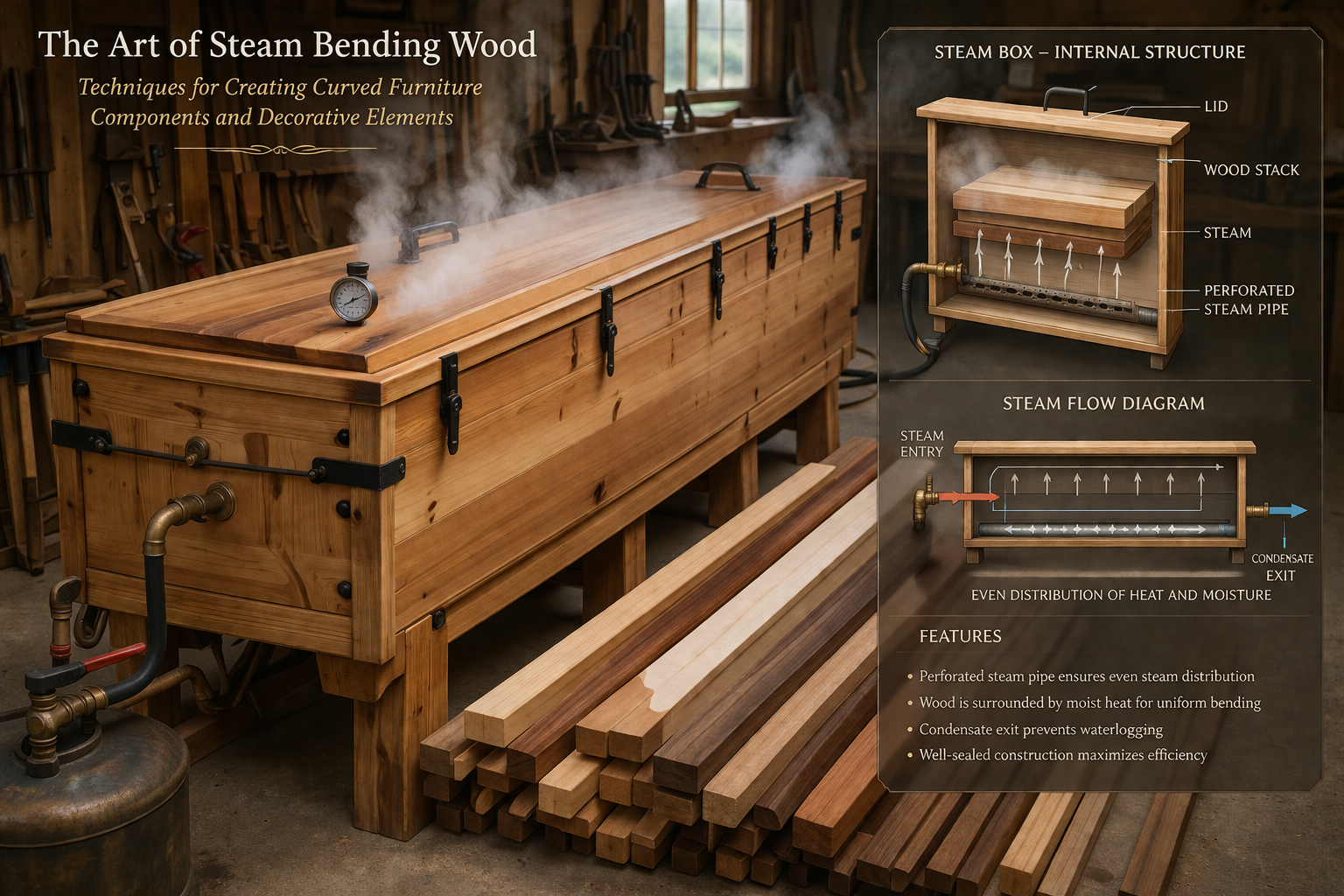
Steam bending uses hot water, hot surfaces, and very hot wood. The steam can cause serious burns. Plan the work area before heating the chamber.
Wear suitable heat-resistant gloves and eye protection. Use tools designed for the job. Keep your hands away from steam outlets and hot chamber openings.
Never seal a steam chamber that is designed to vent. Steam pressure can build inside an enclosed container and cause a dangerous failure. Follow the equipment manufacturer’s instructions and keep drainage and vent openings clear.
A suitable bending form must also be strong enough for the load. Check its clamps, fasteners, strap, and end stops before starting. Keep other people away from the bending path.
For structural furniture parts, boat components, or other load-bearing members, do not treat a successful bend as proof of design strength. The final part needs a suitable design and sound material.
Source: sandiegocraft.org
Control steam exposure
Keep your face and hands away from steam openings. Open the chamber with care.
Use safe equipment
Use a stable steam source, a suitable chamber, and a properly supported work area.
Inspect the bending setup
Check the form, strap, clamps, and end stops before applying force.
Protect the work area
Keep floors clear and remove items that may cause trips while carrying hot wood.
Check the finished part
Look for cracks, crushing, and distortion after bending and drying.
How To Know If The Selected Wood Is Suitable
A suitable board should bend around the planned form without sudden cracking or deep surface wrinkles. Its grain should remain intact along the curve.
After bending, hold the part securely on a drying form. Allow it to dry in a controlled setting. Check for movement, cracks, and changes in the curve.
The wood is ready for further shaping only when its moisture level is suitable for the next stage and the part has become stable. Do not rush sanding, drilling, or final assembly while the stock is still changing shape.
Before bending
The stock has clean grain, no serious defects, and suitable moisture content.
During bending
The board moves smoothly without major cracking, crushing, or strap movement.
After bending
The part dries in the required shape without serious defects or unacceptable springback.
Research Notes And Next-Question Gap Map
This guide draws on established wood science and published woodworking guidance. The USDA Forest Products Laboratory’s Wood Handbook describes wood properties and identifies several hardwoods commonly used for bending. Woodworking guidance from WOOD Magazine and Fine Woodworking adds practical details about grain, moisture, drying history, and stock selection.
The reviewed material supports a clear selection principle: species matters, but the quality of the individual board can matter just as much. The exact result still needs a test bend because wood varies naturally.
The following map separates practical next needs from questions directly supported by the reviewed material. These are editorial research findings, not claims about search volume or verified search trends.
Which wood species should a beginner choose?
Reader stage: Before buying. Basis: Observed topic in the reviewed woodworking guidance. Coverage: Answered, with red oak, white oak, and ash discussed. Benefit: Helps readers choose an accessible starting material. Priority: High.
Can kiln-dried wood be steam bent?
Reader stage: Before preparation. Basis: Observed topic in Fine Woodworking and WOOD Magazine. Coverage: Answered with limits. Benefit: Helps readers avoid assuming that soaking fixes all drying damage. Priority: High.
How much moisture should bending wood contain?
Reader stage: Before steaming. Basis: Observed topic in the reviewed technical and woodworking sources. Coverage: Answered, with varying recommended ranges explained. Benefit: Helps readers measure rather than guess. Priority: High.
How can grain runout be identified?
Reader stage: At the lumber rack. Basis: Inferred next need from the board-selection task. Coverage: Answered with face, edge, and end-grain inspection. Benefit: Reduces the chance of buying weak stock. Priority: High.
How tight can a board bend?
Reader stage: During project planning. Basis: Observed topic in bending references. Coverage: Partly answered because the safe radius depends on species, thickness, grain, and equipment. Benefit: Prevents unsupported universal radius claims. Priority: High.
Should I use steam bending or bent lamination?
Reader stage: Before choosing a construction method. Basis: Inferred next need from the material-selection task. Coverage: Answered with a basic method comparison. Benefit: Helps readers avoid forcing unsuitable lumber into a difficult curve. Priority: Medium.
How should a bent part dry?
Reader stage: After bending. Basis: Observed topic in woodworking guidance. Coverage: Answered at a practical level. Benefit: Helps reduce springback and shape changes. Priority: High.
Research Scope And Evidence Limits
The research review included the USDA Forest Products Laboratory’s Wood Handbook, WOOD Magazine’s steam-bending guide, Fine Woodworking’s species-selection article, Lee Valley’s steam-bending guidance, and technical material from the University of Toronto’s Mass Timber Institute.
The USDA handbook provides a technical foundation for wood structure and bending-stock defects. The woodworking publications provide practical selection guidance and examples of how species and drying history affect results.
No independent bending tests were performed for this article. Species comparisons should therefore be read as established guidance, not as measurements from a new laboratory test. No single moisture range or bend radius should be treated as suitable for every board.
Documented
The cited technical and woodworking references describe species, grain quality, moisture, and bending behavior.
Analysis
The selection method combines those principles into a practical buying and inspection process.
Not established
The precise bending limit of an untested board cannot be known from its species name alone.
Frequently Asked Questions
Q
What Is The Best Wood For Steam Bending?
Red oak, white oak, ash, beech, and elm are useful choices for steam bending. They have a history of use in curved furniture and other woodworking parts.
The best choice depends on the board itself. Look for straight grain, suitable moisture content, and no serious defects. Test the exact stock before making the final part.
Q
Can I Use Kiln-Dried Wood For Steam Bending?
Yes, some kiln-dried wood can be steam bent. However, conventional kiln drying may make the wood less responsive to later steaming.
Air-dried stock is often preferred. If you only have kiln-dried lumber, test a small blank first. Soaking may help add moisture, but it cannot repair poor grain or reverse every effect of drying.
Q
What Moisture Content Is Best For Steam Bending?
A working range around 15 to 25 percent is a useful starting point for many bending projects. Some woodworking sources recommend approximately 20 to 30 percent for suitable air-dried lumber.
The best level depends on the species, board thickness, and bend severity. Use a moisture meter and test the actual stock. Avoid assuming that wetter wood always bends better.
Q
Can Pine Or Other Softwoods Be Steam Bent?
Some softwoods can be bent for selected applications, but many are less reliable than suitable hardwoods for tight curves.
Certain species, including Pacific yew and yellow-cedar, are exceptions. Some softwoods have also been used for moderate boat-planking curves. For general furniture work, start with a proven hardwood unless you have a tested reason to use a softwood.
Q
Why Does Wood Crack Even After Steaming?
Steaming cannot correct every material problem. Knots, grain runout, internal cracks, unsuitable moisture, and an overly tight bend can all cause failure.
Check the outside face for tension cracks and the inside face for compression damage. Review the stock, bend radius, and compression strap. If the part is structural, replace seriously damaged wood rather than hiding the defect.
✦ Wrapping Up
Conclusion
Successful steam bending begins with careful wood selection. Red oak, white oak, ash, beech, and elm are useful starting points for many American woodworking projects. However, no species name can guarantee a successful bend.
Inspect the grain from every side. Reject boards with knots, severe runout, decay, and cracks. Check the moisture content and consider how the wood was dried. Then match the thickness and quality of the blank to the tightest part of the planned curve.
A small test bend can prevent wasted material and time. Use the same stock, moisture condition, and bending radius as the final project. Record the result so you can improve the next attempt.
The best bending board is not always the most expensive or attractive one. It is the board with the right structure, moisture, and grain for the shape you need. Careful selection gives the steam-bending process a much better chance of success.
💡 Key Takeaway
Before your next steam-bending project, select three clear boards from a suitable hardwood species. Inspect their faces, edges, and end grain. Measure their moisture content, prepare matching test blanks, and bend the best candidate around your planned form. Choose the final lumber only after the test piece dries and holds its shape.






Pingback: Wood Preservation Fundamentals: A Practical Guide - wood craftard
Pingback: Wood Consolidation Basics: How To Strengthen Weak Wood - wood craftard