
Wood glue looks harmless because many products are water-based and have little odor. Yet safe use still matters. Glue can reach your eyes, irritate skin, create harmful vapor, or bond skin when the wrong product is handled carelessly.
For woodworkers in U.S. garages, basements, school shops, and professional workshops, the safest rule is simple: identify the glue before using it. A white or yellow PVA glue does not have the same risk profile as polyurethane glue, two-part epoxy, instant glue, or a solvent-based adhesive. **Good Wood Glue Safety starts with knowing what is in the bottle and following its label and Safety Data Sheet.**
Why Wood Glue Safety Matters
Wood Glue Safety is about more than avoiding a sticky mess. Adhesives contain different resins, curing agents, solvents, and additives. The level of risk depends on the formula, the amount used, the work area, and how you handle it.
Many everyday PVA wood glues have relatively low hazard levels during normal use. That does not make every glue harmless. Some products can irritate the eyes and skin, while others may release stronger vapors or react with moisture.
The safest approach is to treat every adhesive as a chemical product. Read the label before opening it. Keep food and drinks away from the bench, wash your hands after use, and never transfer glue into an unlabeled drink or food container.

- ✦ Know the adhesive type
Check whether you are using PVA, polyurethane, epoxy, cyanoacrylate, hide glue, construction adhesive, or another formula.
- ✦ Read the label first
The manufacturer’s label gives product-specific warnings, first-aid steps, ventilation needs, and storage instructions.
- ✦ Find the Safety Data Sheet
The SDS can provide more detail about hazards, personal protection, accidental exposure, storage, and disposal.
- ✦ Control exposure
Use only the amount you need and keep glue away from your face, eyes, mouth, clothing, and unprotected skin.
Common Routes of Exposure
Glue most often reaches the body through skin contact, eye splashes, accidental swallowing, or breathing vapor and mist. Risk rises when people work in small rooms, squeeze bottles close to their face, or clean glue with inappropriate solvents.
- ✦ Skin
Wet adhesive can cause irritation, difficult cleanup, or rapid bonding with some glue types.
- ✦ Eyes
Even mild adhesives can cause pain and irritation when splashed into the eyes.
- ✦ Breathing
Vapors may become a larger concern with polyurethane, solvent-based products, some epoxies, and enclosed work areas.
- ✦ Ingestion
Wood glue is not a food product. Keep bottles away from children, pets, drinks, and meal preparation areas.
Understand the Safety Risks of Different Wood Glues
One of the most important Wood Glue Safety lessons is that the words wood glue describe many products. Two adhesives designed for wood may use very different chemistry. Never apply the safety advice for one formula to every bottle on your shelf.
Traditional PVA glue is common for furniture, cabinetry, crafts, and indoor woodworking. Polyurethane adhesives cure through a different chemical process. Epoxies use separate resin and hardener components, while cyanoacrylate products bond very quickly.
The manufacturer’s directions should always control your final choice of gloves, ventilation, cleanup method, and first aid. Product formulas can change, so old habits should never replace the current label.
- ✦ PVA wood glue
Often water-based and relatively easy to clean while wet, but eye and skin contact should still be avoided.
- ✦ Polyurethane glue
Can require greater care with skin contact and ventilation. Follow the specific label and SDS closely.
- ✦ Epoxy
Contains separate components that can irritate or sensitize some users. Accurate mixing and suitable gloves are important.
- ✦ Cyanoacrylate
Bonds skin very fast and can create strong irritation around the eyes and respiratory system. It needs careful handling.
- ✦ Solvent-based adhesive
May produce stronger fumes and can require stricter ventilation and ignition control.
Why Low Odor Does Not Mean No Risk
Smell is not a reliable safety test. A product with little odor can still irritate your skin or eyes. A strong smell also does not tell you the exact level of danger, so use the label and SDS instead of your nose.
- ✦ Do not rely on smell
Odor alone cannot tell you whether an adhesive needs gloves, eye protection, or stronger ventilation.
- ✦ Do not assume water-based means harmless
Water-based products may have lower solvent exposure, but they can still contain ingredients that require safe handling.
Personal Protective Equipment for Wood Glue
Personal protective equipment should match the glue and the task. You may need only basic protection for a small PVA glue-up. Mixing larger batches of epoxy or working with stronger adhesive chemistry can call for more care.
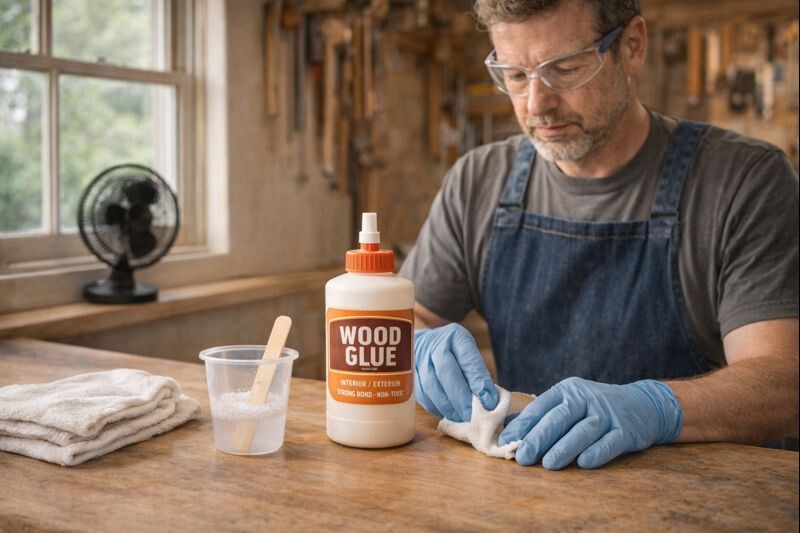
**Safety glasses are one of the simplest Wood Glue Safety upgrades.** Glue can shoot from a clogged nozzle or squeeze from a joint under clamp pressure. Eye protection is especially useful during large assemblies and overhead work.
Gloves can also reduce direct contact, but glove material matters. Check the SDS when chemical resistance is important. Replace damaged or heavily contaminated gloves instead of wiping them clean and continuing to work.

- ✦ Safety glasses
Wear eye protection when squeezing, mixing, spreading, pressurizing, or clamping adhesive.
- ✦ Protective gloves
Use gloves that the product maker or SDS recommends for the adhesive chemistry involved.
- ✦ Work clothing
Wear clothing that protects your skin and that you can clean or replace if glue spills on it.
- ✦ Respiratory protection
Do not choose a respirator by guesswork. Follow the SDS and workplace rules when respiratory protection is required.
Glove Safety and Good Work Habits
Gloves do not replace clean technique. Avoid touching your phone, face, door handles, or tools with glue-covered gloves. Remove contaminated gloves safely and wash your hands when the job is complete.
- ✦ Change dirty gloves
Do not spread uncured glue from your bench to switches, clamps, drawers, or personal items.
- ✦ Wash after use
Wash exposed skin with suitable soap and water after handling glue, even when no irritation is visible.
Ventilation and Indoor Wood Glue Safety
Ventilation matters whenever an adhesive releases vapor. A large open garage behaves very differently from a small basement room with closed doors and windows. Concentrated exposure can increase when you use more adhesive or work for long periods.
For common water-based woodworking glue, normal room airflow may often be enough when the product label allows it. Stronger products can need more fresh air or local exhaust. Always follow the ventilation guidance supplied with the exact glue.
Do not try to solve every ventilation problem with a household fan. Air should move contaminants away from your breathing zone and toward a safe exhaust point. A fan that blows fumes across your face can make exposure worse.
- ✦ Open the work area
Use suitable fresh-air ventilation when the product instructions call for it.
- ✦ Keep your face away
Do not lean directly over freshly mixed or curing adhesive.
- ✦ Avoid enclosed spaces
Take extra care in closets, cabinets, vehicles, basements, and other areas with poor air movement.
- ✦ Control ignition sources
If a product contains flammable solvents, keep it away from flames, sparks, heaters, and other ignition sources according to its label.
Ventilation During Curing
Safe handling does not always end when the clamps go on. Some adhesives continue curing for hours. Keep the project in an appropriate area for the full curing period stated by the manufacturer.
- ✦ Follow cure guidance
Do not move a freshly glued project into a bedroom or other occupied space before the adhesive has cured as directed.
What to Do if Wood Glue Gets on Your Skin
Skin contact is one of the most common Wood Glue Safety problems. The correct response depends on the adhesive. With many water-based products, prompt washing with soap and water is the normal first step, but you should follow the specific label.
Do not use harsh chemicals on your skin simply because they dissolve glue on tools. A solvent that cleans a workbench may irritate or damage skin. Never use gasoline or other unsafe shop chemicals as a skin cleaner.
Fast-bonding adhesives need special care because trying to pull bonded skin apart can cause injury. Follow the product’s first-aid directions and seek medical advice when skin is badly bonded, burned, painful, or irritated.
- ✦ Act promptly
Remove contaminated clothing or gloves when appropriate and follow the manufacturer’s skin-contact instructions.
- ✦ Use gentle cleaning
For products that permit it, wash with soap and water instead of aggressive solvents.
- ✦ Do not force bonded skin apart
With instant adhesives, forced separation can tear skin. Follow the label or contact a medical professional when needed.
- ✦ Watch for symptoms
Persistent redness, swelling, burning, blistering, or other symptoms deserve medical attention.
Can Wood Glue Cause an Allergic Reaction?
Some people can develop skin sensitivity to certain adhesive ingredients, especially after repeated exposure. Reactions depend on the formula and the person. If exposure causes a recurring rash or other unusual symptoms, stop using the product and seek medical advice.
- ✦ Prevent repeat exposure
Do not keep using a product on bare skin after you notice irritation or sensitivity.
What to Do if Wood Glue Gets in Your Eyes
Eye exposure deserves quick attention. Even a product that seems mild can cause strong discomfort when it reaches the eye. **Do not rub the eye or wait for the glue to dry.**
Follow the first-aid instructions on the product label or SDS. These instructions commonly call for prompt rinsing with clean water, but the exact guidance and rinse time can vary by product.
Contact a poison center or medical professional when the label directs you to do so, when symptoms are severe, or when glue remains in the eye. Rapid-bonding adhesive in the eye requires especially careful professional guidance.
- ✦ Start first aid quickly
Use the manufacturer’s eye-contact instructions as soon as exposure occurs.
- ✦ Do not rub
Rubbing can increase irritation or cause mechanical injury.
- ✦ Remove contact lenses only when appropriate
Follow the product’s first-aid guidance and never force a lens that is stuck.
- ✦ Get help when needed
Seek professional medical guidance for ongoing pain, vision changes, severe irritation, or difficult adhesive exposure.
Safe Wood Glue Application and Clamping
Safe application begins before you open the bottle. Dry-fit the joint, prepare your clamps, clear the bench, and place cleanup materials within reach. Good preparation means you do not need to rush while wet glue is spreading across the project.
Use enough adhesive to wet the bonding surfaces without creating unnecessary pools. Excess glue increases cleanup and exposure. It can also spread onto clamp handles, floors, cords, and tools.
A useful professional practice is to plan the entire glue-up before applying adhesive. Complex assemblies become stressful when glue starts setting before the parts are aligned. A calm process improves both joint quality and Wood Glue Safety.

- ✦ Dry-fit first
Assemble the parts without glue so you can find alignment problems before working time begins.
- ✦ Prepare clamps
Set clamp positions and pressure points before applying adhesive.
- ✦ Control squeeze-out
Apply a practical amount of glue rather than flooding the joint.
- ✦ Keep the floor clean
Wipe or isolate spills quickly so they do not become slip hazards.
Clamp Pressure and Safety
Clamps can create hazards of their own. Excess force may cause parts to shift, clamps to fall, or glue to spray from a joint. Use controlled pressure and keep your face away from the glue line while tightening.
- ✦ Tighten gradually
Increase pressure in small steps while checking alignment.
- ✦ Support large assemblies
Make sure heavy panels or furniture parts cannot fall when clamp pressure changes.
Safe Cleanup of Wood Glue
The safest cleanup method depends on whether the glue is wet or cured. Many water-based PVA glues can be cleaned from tools with water while fresh. Other adhesives require a specific cleanup method listed by the manufacturer.
Avoid reaching automatically for strong solvents. A chemical that removes adhesive may create extra inhalation, fire, or skin hazards. Use the least hazardous cleaning method that the product maker recommends.
Cured glue often needs mechanical removal such as scraping or sanding. When sanding cured adhesive and wood together, control dust and use suitable eye and respiratory protection for the dust-producing task.
- ✦ Clean early
Remove fresh squeeze-out using a method that is compatible with the adhesive and your project surface.
- ✦ Follow product instructions
Use only cleaners or solvents recommended for that adhesive.
- ✦ Handle rags carefully
Treat contaminated wipes according to the adhesive and cleaner instructions, especially when flammable materials are involved.
- ✦ Control sanding dust
Use dust collection and suitable personal protection when sanding cured glue.
Safe Storage of Wood Glue
Storage is a major part of Wood Glue Safety. Keep adhesive in its original labeled container with the cap closed. Never pour leftover glue into a beverage bottle, food jar, or another container that could cause confusion.
Temperature also matters. Some water-based glues can lose performance after improper freezing or extreme heat. Other adhesive types may have different storage limits, so follow the manufacturer’s recommended temperature range.
Choose a secure shelf or cabinet away from children and pets. Keep incompatible chemicals separated when required, and protect containers from puncture, crushing, or leaks.

- ✦ Keep the original label
The original container identifies the product and preserves important safety and first-aid information.
- ✦ Close the cap
A sealed container reduces spills, contamination, drying, and unwanted vapor release.
- ✦ Control temperature
Store glue within the range specified by the manufacturer.
- ✦ Restrict access
Store adhesives where children and pets cannot reach them.
When to Discard Old Wood Glue
Age alone does not tell you everything about adhesive quality. Thickening, separation, lumps, unusual odor, damaged packaging, or failed test bonds can suggest that a product should not be used. Check the manufacturer’s shelf-life and disposal guidance before discarding it.
- ✦ Do not restore glue blindly
Do not add water, solvent, or another chemical unless the manufacturer specifically permits that adjustment.
Wood Glue Safety Around Children and Pets
A workshop can look interesting to children and pets. Glue bottles are easy to knock over, and small caps or applicator parts can become hazards. Store adhesives high up or inside a secure cabinet when they are not being used.
Do not leave open glue, mixing cups, contaminated rags, or wet assemblies unattended in an accessible area. Even adhesives with low toxicity should not be eaten, licked, or treated as toys.
If a child or pet swallows adhesive, do not guess at treatment. Keep the product container available and contact the appropriate poison, medical, or veterinary resource for product-specific instructions.
- ✦ Secure bottles
Close containers immediately after use and return them to safe storage.
- ✦ Clean spills
Remove wet glue from floors and other surfaces before children or animals can reach it.
- ✦ Keep labels available
Product identification helps medical or veterinary professionals give accurate guidance after an exposure.
Is Wood Glue Food Safe?
Do not assume a wood glue is suitable for food-contact items because it becomes hard after curing. Food-contact suitability depends on the exact product, its intended use, its cure state, and the manufacturer’s current guidance.
Projects such as cutting boards, serving trays, salad bowls, butcher blocks, and wooden utensils deserve extra care. Choose an adhesive whose manufacturer specifically states that the fully cured product is suitable for the intended food-contact application.
Water resistance and food-contact suitability are separate issues. A waterproof or water-resistant rating does not automatically prove that a glue is appropriate for a cutting board or kitchen utensil.

- ✦ Check the exact product
Do not apply food-safety claims from one adhesive to another product from the same brand.
- ✦ Allow full cure
Follow the complete curing period before placing a food-contact item into service.
- ✦ Consider the final use
A decorative serving piece may face different exposure than a cutting board that is washed, cut on, and used every day.
- ✦ Do not rely on marketing terms alone
Look for clear manufacturer guidance tied to the intended application.
Food Safe Does Not Mean Safe to Eat
A cured adhesive considered suitable for a defined food-contact application is not the same as an edible product. Never intentionally consume wood glue. Keep uncured adhesive away from food and food preparation surfaces.
- ✦ Separate workshop and kitchen use
Do not use glue-covered tools, brushes, cups, or containers for food preparation.
Is Wood Glue Safe After It Dries?
Many woodworking adhesives become far easier to handle after they fully cure. However, the phrase dry does not always mean fully cured. Surface drying can happen before the chemical curing process is complete.
Follow the manufacturer’s stated cure time before exposing the joint to heavy loads, food contact, moisture, heat, or occupied indoor spaces when those factors matter. Temperature, humidity, wood species, joint size, and glue thickness can affect curing.
Cutting, routing, or sanding a cured glue line can also create dust. At that stage, Wood Glue Safety includes dust control as well as chemical safety. Use proper woodworking dust collection and suitable personal protection.
- ✦ Dry and cured are different
Do not assume a joint has reached full cure simply because the exposed glue feels dry.
- ✦ Wait before heavy use
Give the adhesive the full cure period recommended for the intended load.
- ✦ Control machining dust
Collect dust when cutting or sanding wood that contains cured adhesive.
How to Read a Wood Glue Safety Data Sheet
A Safety Data Sheet gives structured information about a chemical product. It can help you understand hazards, first aid, fire response, accidental releases, handling, storage, exposure controls, and personal protection.
You do not need to memorize the entire document. Before a new glue enters your shop, review the sections related to hazards, first aid, handling, storage, and exposure controls. Keep access to the SDS in a place where workers can find it quickly.
For professional U.S. workplaces, chemical handling may also fall under workplace safety rules and employer procedures. Employees should follow their company’s hazard communication, training, PPE, and emergency requirements.
- ✦ Hazard identification
Look for the hazards associated with normal use and foreseeable exposure.
- ✦ First-aid measures
Review what to do after eye, skin, inhalation, or ingestion exposure.
- ✦ Handling and storage
Check temperature limits, ventilation needs, incompatible materials, and storage precautions.
- ✦ Exposure controls
Use this section to help determine recommended engineering controls and personal protection.
Why the SDS Should Match the Exact Product
Do not use a generic wood glue SDS as a substitute for the product on your bench. Different versions and formulas can have different ingredients and warnings. Match the product name and other identifying details whenever possible.
- ✦ Keep current information
Use the latest manufacturer-provided safety information available for the adhesive you are using.
Wood Glue Disposal and Environmental Safety
Do not pour unwanted adhesive down a drain unless the manufacturer and local rules clearly allow it. Disposal requirements can depend on the glue type, its ingredients, whether it is cured, and local waste policies.
Small amounts of fully cured material may be handled differently from liquid adhesive, but you should confirm local requirements. Solvent-based products, certain reactive adhesives, and contaminated cleanup materials can need greater care.
The safest approach is to minimize waste from the start. Mix only the amount of two-part adhesive you need. Keep caps clean so bottles seal well, and store products correctly to extend their useful life.
- ✦ Check local rules
Waste programs can vary by city, county, and state.
- ✦ Do not mix chemicals
Combining leftover adhesives or cleaners can create unexpected reactions.
- ✦ Keep waste labeled
Maintain product identity when storing material temporarily for proper disposal.
- ✦ Reduce waste
Plan glue-ups carefully and dispense only what the job requires.
Common Wood Glue Safety Mistakes
Most adhesive problems are preventable. They often happen because the job feels routine. Familiarity can make a woodworker skip glasses, leave a bottle open, or ignore a warning that would receive more attention with an unfamiliar chemical.
A good Wood Glue Safety routine should be simple enough to follow every time. Prepare the job, protect yourself, control exposure, clean up, and store the product correctly. Repetition turns those steps into normal workshop practice.
- ✦ Assuming every wood glue is the same
Adhesive chemistry varies widely, so read the label for each product.
- ✦ Skipping eye protection
A clogged nozzle or squeezed joint can send adhesive toward your face without warning.
- ✦ Using too much glue
Excess adhesive increases squeeze-out, cleanup, skin contact, and mess.
- ✦ Cleaning skin with aggressive solvents
Use the skin-cleaning method specified by the product maker instead.
- ✦ Leaving containers unlabeled
Unknown liquids create unnecessary exposure and emergency-response risks.
- ✦ Working in poor ventilation
Enclosed spaces can increase exposure to adhesive vapor.
- ✦ Assuming cured glue is automatically food safe
Food-contact suitability must be confirmed for the exact adhesive and intended use.
A Simple Wood Glue Safety Checklist
A short checklist can prevent most routine mistakes. Use it before unfamiliar glue-ups and whenever you change adhesive types. The few seconds spent preparing can save much more time during cleanup or an emergency.
This checklist works well for home woodworkers and can support a more detailed shop procedure in professional settings. Always add any product-specific requirements from the label or SDS.
- ✦ Identify the glue
Know the product type and intended use before opening it.
- ✦ Read warnings
Review the label and keep the SDS available.
- ✦ Ventilate the space
Provide the level of airflow required for the adhesive and job size.
- ✦ Protect eyes and skin
Wear suitable PPE based on the product instructions.
- ✦ Prepare the assembly
Dry-fit parts and position clamps before spreading glue.
- ✦ Clean safely
Use the recommended cleanup method rather than improvised solvents.
- ✦ Close and store
Seal the original container and place it in the recommended storage area.
- ✦ Wash your hands
Clean exposed skin before eating, drinking, or leaving the shop.