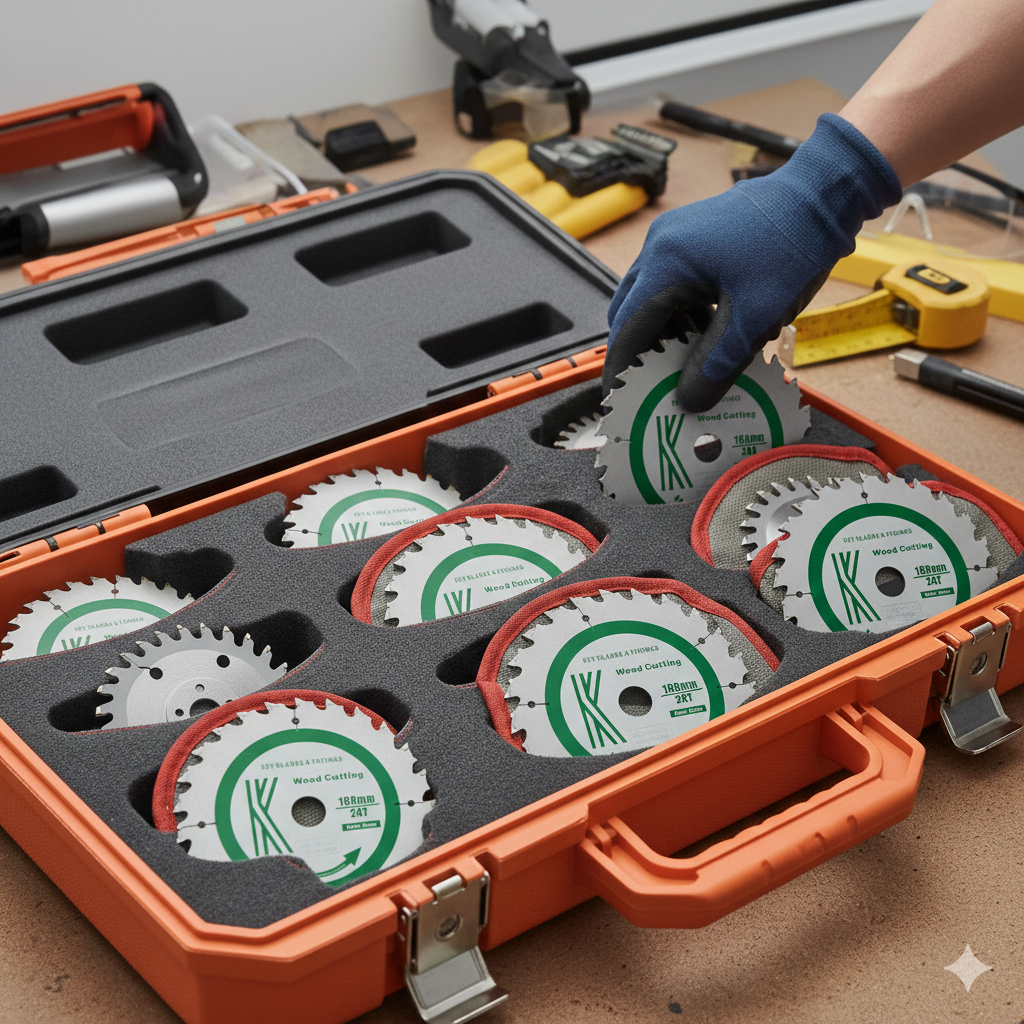
Store circular saw blades individually or with protective dividers in a clean, dry location where the teeth cannot strike other blades, tools, or hard surfaces. A dedicated case, drawer organizer, or separated rack is safer and more protective than leaving loose blades in a toolbox or stacking them directly on top of one another.
For U.S. homeowners, DIYers, woodworkers, and contractors, proper circular saw blade storage is a simple workshop habit that protects both the blade and the person handling it. A carbide-tipped blade can be damaged when its teeth repeatedly contact other blades or hard surfaces, while an exposed blade can cause a cut when someone reaches into a drawer or toolbox without seeing it.
The best storage method depends on how many blades you own, their diameters, how often you transport them, and how much workshop space you have. A small protective case works well for a few blades, while separated trays, drawers, or wall-mounted holders make more sense for a larger collection. Whatever system you choose, the basic goal is the same: keep the blades separated, protected, dry, identifiable, and easy to remove without touching the cutting teeth.
Source: woodworkersjournal.com
Why Proper Circular Saw Blade Storage Matters
Circular saw blades are precision cutting accessories, and the teeth are among their most vulnerable parts. Carbide-tipped teeth can chip if blades are thrown together in a drawer, dropped onto a hard surface, or allowed to contact one another repeatedly. Even when the damage is small, a chipped or damaged tooth can affect cutting performance and may create an unsafe condition.
Storage also affects handling safety. A loose 7 1/4-inch or 10-inch blade can be difficult to pick up safely because the cutting edge is exposed around the entire circumference. A storage system that provides a handle, center support, protective cover, or individual slot reduces the need to grab the blade near its teeth.
Good organization has another practical benefit: it makes it easier to select the correct blade. A workshop may contain blades intended for framing lumber, plywood, finish cuts, composite materials, or other applications. Keeping them separated and labeled reduces unnecessary handling and helps prevent installing the wrong accessory for a job.
Source: rockler.com
Protect the teeth
Prevent the cutting teeth from contacting other blades, metal tools, concrete, shelving, or other hard surfaces.
Reduce handling risk
Choose storage that lets you remove a blade by its center, protective carrier, or designated handle rather than grabbing the teeth.
Keep blades identifiable
Labels or separate compartments make it easier to identify diameter, tooth count, and intended cutting application.
The Best Ways to Store Circular Saw Blades
There is no single storage system that fits every workshop. The right choice is the one that keeps the blades physically separated, prevents accidental contact with the teeth, and remains practical for the number and sizes of blades you actually use.
For a small collection, individual plastic cases or the original manufacturer packaging can be sufficient if the packaging remains intact and provides adequate protection. For several blades, a divided drawer or dedicated storage cabinet is usually easier to organize. Wall-mounted holders can save drawer space, but they should be installed securely and positioned where the blades cannot be knocked down or contacted accidentally.
Source: popularwoodworking.com
Individual blade cases
Best for protecting individual blades during storage or transportation. Cases should fit the blade correctly without allowing excessive movement.
Divided drawers
Useful when you have multiple blade sizes or cutting types. Separators prevent adjacent blades from contacting one another.
Wall-mounted racks
A space-saving option for organized workshops. Use a purpose-built holder or a properly secured rack that supports the blade without exposing people to unnecessary contact with the teeth.
Portable storage boxes
Useful for contractors and mobile workshops because the blades remain contained while being transported between a shop, truck, and jobsite.
DIY plywood organizers
A practical option for woodworkers who want custom compartments sized for their blade collection. Dividers should prevent teeth from contacting adjacent blades.
Keep Blades Separate Rather Than Stacking Them Loose
Loose stacking is one of the simplest storage methods, but it offers little protection. When blades are stacked directly together, teeth can contact the plate or teeth of another blade. A better arrangement uses individual slots, trays, spacers, or protective sleeves so each blade has a defined place.
If blades must be placed in the same container, use rigid separators that cannot easily shift during handling. The separator should keep the cutting edges apart rather than simply creating a small amount of space between blade plates.
Separate by size
Keep common sizes such as 6 1/2-inch, 7 1/4-inch, and larger blades in clearly defined compartments.
Separate by condition
Consider keeping serviceable blades apart from blades awaiting cleaning, sharpening, inspection, or disposal.
How to Store Circular Saw Blades Safely Step by Step
Before putting a circular saw blade into storage, make sure the blade is no longer mounted on the saw and is safe to handle. For a corded saw, disconnect the power source. For a cordless saw, remove the battery before handling the blade. Follow the saw and blade manufacturer’s instructions for removal and handling.
Once the blade is removed, inspect it before putting it away. Storage should not be used to hide a damaged blade. Look for chipped or missing teeth, cracks, excessive wear, warping, corrosion, or other damage. If the condition is questionable, set the blade aside for appropriate inspection, repair, sharpening, or replacement rather than returning it to the active blade collection.
Source: systainer.works
Step 1: Make the saw safe
Disconnect the cord or remove the battery before removing or handling the blade.
Step 2: Handle the blade by safer areas
Use the center plate or another non-cutting area and keep fingers away from the teeth.
Step 3: Inspect the blade
Check the teeth, plate, bore, and overall condition for visible damage or corrosion.
Step 4: Clean when appropriate
Remove built-up resin, pitch, or debris using a cleaning method compatible with the blade manufacturer’s recommendations.
Step 5: Place the blade in protected storage
Use a case, sleeve, individual slot, drawer tray, or other system that prevents contact between cutting edges.
Step 6: Label the storage location
Record useful identification details such as diameter, tooth count, material application, and condition.
Step 7: Store the container securely
Place the storage system somewhere stable, dry, and protected from unnecessary impact.
Signs That Your Storage Method Is Working
A good storage system lets you identify and remove a blade without moving a pile of other blades. The teeth should not be rubbing against neighboring blades, the blade should remain stable when the container or drawer is moved, and the storage location should remain clean and dry.
If blades frequently fall over, slide into one another, become difficult to identify, or accumulate corrosion, the storage arrangement needs to be changed. The problem is usually not the blade itself but inadequate separation, environmental exposure, or an organizer that does not match the blade sizes.
Stable storage
Blades stay in their assigned positions when the drawer, case, or rack is opened.
Protected teeth
Cutting edges do not repeatedly contact other blades or hard surfaces.
Easy identification
You can select the appropriate blade without sorting through an unorganized pile.
Choosing a Storage System for Your Workshop
The most useful storage system is determined by your collection and workflow rather than by the storage material alone. A homeowner with two frequently used blades has different needs from a cabinetmaker with several specialized blades or a contractor transporting blades between multiple jobsites.
Consider blade diameter first. The storage compartment needs enough clearance for the entire blade without forcing it into place. Also consider the arbor hole, blade thickness, protective cover, and whether the blade needs to remain accessible while other blades are stored nearby.
For transport, containment and impact protection become more important. A portable case with individual recesses or compartments can prevent blades from shifting while the case is moved. For a stationary shop, a drawer or cabinet may provide better access and use less visible wall space.
Source: keybladesfixings.co.uk
One to three blades
Individual protective cases or original protective packaging may be all you need.
Several blades of different sizes
A divided drawer, cabinet, or multi-size organizer makes identification and retrieval easier.
Large blade collection
A dedicated cabinet with individual trays or compartments provides better organization than loose stacking.
Frequent transportation
Choose a closed, durable case that keeps blades separated and prevents movement during transport.
Limited workshop space
Wall-mounted or under-cabinet storage can preserve valuable drawer and bench space when installed securely.
What Should You Label on a Blade?
Useful labels include blade diameter, tooth count, intended material, kerf when relevant, and general application. You can also mark whether a blade is new, in regular service, awaiting sharpening, or retired.
Labeling becomes particularly useful when several blades look similar. A quick identification system reduces unnecessary handling and makes it easier to select a suitable blade before starting a cut.
Diameter
Record the blade’s nominal diameter so it is easy to match with the intended saw.
Tooth count
Record the tooth count when it helps distinguish framing, general-purpose, and finer-cutting blades.
Application
Identify the material or cutting purpose for which the blade is intended.
Where Should You Store Circular Saw Blades?
Store circular saw blades in a dry, stable location away from unnecessary moisture, impact, and contamination. A workshop cabinet, protected drawer, dedicated tool case, or secure wall-mounted organizer can work well when it keeps the blades protected and accessible.
Avoid locations where blades can be knocked onto the floor, exposed to standing water, or buried beneath heavy tools. A blade that looks protected because it is inside a drawer can still be damaged if other tools are repeatedly dropped on top of it.
For garages and unconditioned workshops, environmental control matters more because temperature changes and humidity can encourage corrosion on exposed steel surfaces. If corrosion becomes a recurring problem, improve the storage environment and inspect blades more frequently.
Source: i.pinimg.com
Keep storage dry
Protect exposed steel surfaces from moisture and conditions that promote corrosion.
Avoid high-traffic areas
Do not place sharp blade storage where people can easily bump, drop, or contact it accidentally.
Protect from heavy objects
Do not allow heavy tools or materials to rest on blade cases or storage trays.
Keep storage accessible
A practical location reduces unnecessary handling and makes it easier to return blades to their proper compartments.
Common Circular Saw Blade Storage Mistakes
Many storage problems come from treating saw blades like ordinary flat discs. Their cutting edges, carbide teeth, plate geometry, and sharp circumference require more care than typical workshop hardware.
The most common mistake is allowing blades to contact one another. Another is putting blades loose in a toolbox where they can move as the box is carried. A third is storing a blade without checking its condition first. Good storage protects a blade, but it does not make a damaged blade safe to use.
Source: popularwoodworking.com
Throwing blades into a toolbox
Loose tools can strike the teeth and damage the blade while also creating a hidden sharp edge for the next person reaching inside.
Stacking blades directly together
Direct contact can damage carbide teeth and makes individual blades harder to remove safely.
Storing damaged blades with good blades
A damaged blade should be clearly identified and separated so it is not accidentally selected for use.
Ignoring moisture
Damp storage can promote corrosion on exposed steel components.
Using an oversized compartment
Too much free space allows blades to shift during storage and transportation.
Forcing a blade into a tight compartment
A storage slot should provide adequate clearance rather than requiring the blade to flex or scrape against the organizer.
Should You Store Blades Flat or Upright?
Either orientation can work when the storage system supports the blade properly and prevents movement or tooth contact. Flat storage can be convenient in drawers with individual trays, while upright storage can make a large collection easier to see and access.
The orientation itself is less important than how the blade is supported. Avoid arrangements where the blade can fall onto its teeth, slide into another blade, or become unstable when the storage container is moved.
Flat storage
Works well with individual trays or compartments that prevent blades from sliding into each other.
Upright storage
Works well with individual slots or holders that support each blade and keep it separated.
DIY Circular Saw Blade Storage Ideas
A DIY organizer can work very well if it is designed around the blades you actually own. Common approaches include plywood drawers, slotted cabinets, individual trays, wall-mounted racks, and removable blade cards. The key design requirement is separation: the cutting edges should not be able to collide with neighboring blades.
For a drawer organizer, measure the largest blade you intend to store and provide enough clearance for easy removal. Add dividers so each blade has its own location. A small finger-access opening or handle can make removal easier without requiring you to reach near the teeth.
For a wall-mounted design, use a strong mounting method appropriate for the wall material and expected load. Position the organizer where blades will not be struck by passing materials or equipment. If the organizer uses hooks, pins, or arbor-hole supports, follow the blade manufacturer’s storage guidance and make sure the design keeps the blade stable.
Source: systainer.works
Plywood drawer organizer
Build individual trays or slots sized for different blade diameters and label each position.
Slotted wall rack
Create separate slots that hold each blade without allowing the teeth to contact neighboring blades.
Protective blade cards
Use individual rigid cards or panels to separate blades while making them easy to identify and remove.
Custom storage cabinet
A cabinet can combine drawers, dividers, and labels into one dedicated blade-storage station.
DIY Design Checklist
Before cutting material for a DIY organizer, measure your largest blade and account for any protective sleeve or holder you plan to use. Make sure the finished compartments allow you to retrieve the blade without scraping its teeth against the surrounding structure.
Use smooth, durable materials and remove sharp edges from the organizer itself. The storage system should not introduce new hazards such as protruding screws, unstable shelves, weak wall fasteners, or exposed hardware that can contact the blade.
Measure first
Design around the actual blade diameters and quantities in your collection.
Separate every blade
Provide dividers or individual compartments rather than relying on loose stacking.
Make removal easy
Include enough clearance or a safe handhold so blades can be retrieved without touching the teeth.
Secure the structure
Make sure shelves, drawers, and wall-mounted components can support the intended load without shifting.
Frequently Asked Questions
Q
Can I store circular saw blades in the original packaging?
Yes, if the original packaging is still structurally sound and protects the blade from impact and contact with other objects. Keep the packaging dry and replace damaged or deteriorated packaging with a more protective case or organizer.
Q
Should circular saw blades be stored flat or upright?
Either can work. The important factor is whether the storage system supports the blade and prevents it from moving, falling, or contacting other blades. Flat trays and individual upright slots are both practical options when properly designed.
Q
How do I prevent circular saw blades from rusting in storage?
Store blades in a dry environment, avoid prolonged exposure to moisture, and inspect exposed steel surfaces periodically. If your workshop has persistent humidity problems, improve environmental control and follow the blade manufacturer’s recommendations for protective treatment.
Q
Can I stack circular saw blades on top of each other?
Directly stacking loose blades is not a good storage practice because the teeth can contact other blades and become damaged. If blades must be stored in a stack, use suitable separators or individual protective trays that keep the cutting edges apart.
Q
How should I store circular saw blades for transportation?
Use a rigid or otherwise protective case with compartments, sleeves, or dividers that prevent the blades from moving during transport. Close and secure the case before moving it, and position it so heavy objects cannot fall onto it.
Q
When should I replace a stored circular saw blade?
Storage does not determine whether a blade is usable. Before installation, inspect the blade for damaged or missing teeth, cracks, warping, severe corrosion, or other defects. Follow the blade manufacturer’s instructions and have questionable blades professionally inspected, sharpened, repaired, or replaced as appropriate.
✦ Wrapping Up
Conclusion
Effective circular saw blade storage is mainly about separation, protection, and controlled access. Whether you use individual cases, a drawer organizer, a wall-mounted rack, or a custom plywood cabinet, the storage system should keep cutting edges from contacting other objects while protecting the blades from impact and moisture.
A well-organized collection also makes everyday work safer and more efficient. Labeling blades by size and application reduces unnecessary handling, while regular inspection helps ensure that a blade taken from storage is suitable for use. For a small collection, simple protective cases may be enough. For a larger workshop, individual trays or compartments provide a more scalable solution.
💡 Key Takeaway
Choose a storage system that gives every circular saw blade a stable, protected location, keeps the teeth separated, stays dry, and lets you identify and remove the correct blade without reaching through a pile of sharp tools.