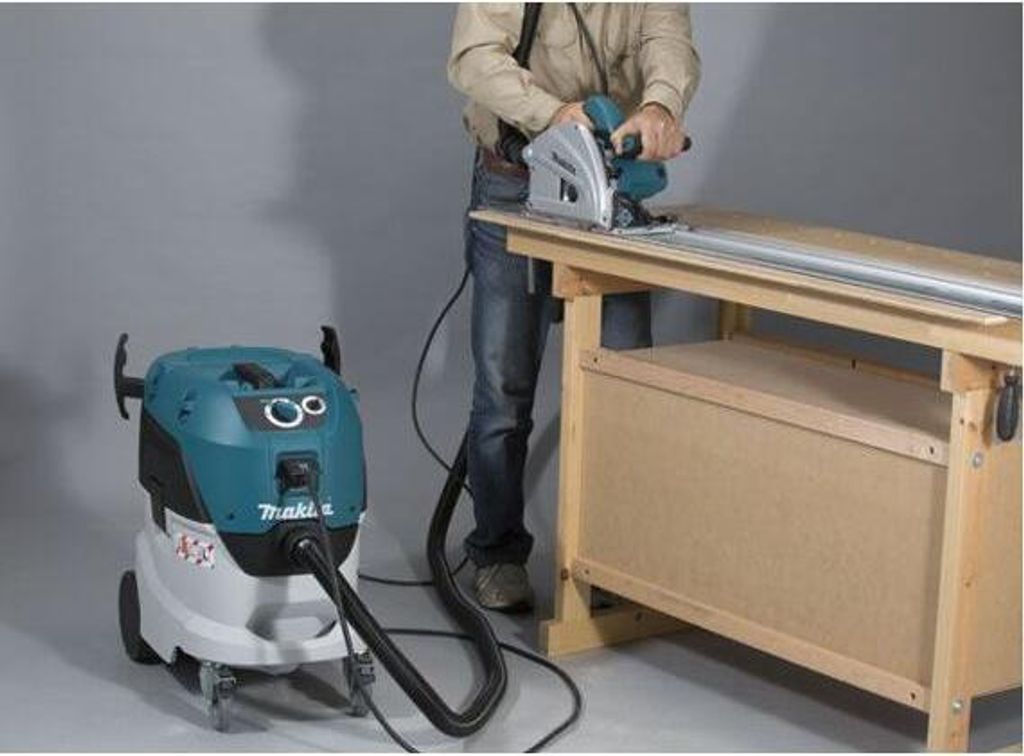
The most effective circular saw dust control method is to capture dust at the saw with a properly fitted dust port, shroud, or extraction attachment connected to a suitable vacuum or dust extractor, then combine source capture with good housekeeping and appropriate personal protection.
For homeowners, remodelers, contractors, and woodworkers in the United States, controlling circular saw dust starts at the point where the blade creates it. A circular saw can throw chips and fine particles away from the cut, so sweeping the floor afterward does not address the airborne dust created during cutting. A connected dust extractor or vacuum can capture a substantial portion of the material before it spreads through a garage, workshop, occupied room, or jobsite.
Wood dust is more than a cleanup problem. OSHA identifies wood dust as an occupational health concern, while NIOSH recommends limiting exposure to wood dust. Local exhaust ventilation is the primary engineering approach because it removes dust close to its source. For ordinary wood cutting, a practical setup is a compatible circular saw dust port or shroud, a properly sized hose, and a vacuum or dust extractor with suitable filtration. Cutting fiber-cement or other materials that can generate respirable crystalline silica requires a different hazard assessment and silica-specific controls.
Source: images.ctfassets.net
What Is Circular Saw Dust Control?
Circular saw dust control is the combination of engineering controls, work practices, housekeeping, and personal protective equipment used to reduce the amount of dust released into the breathing zone and surrounding work area during sawing. The most useful control is source capture: collect dust where the blade produces it before the particles become widely dispersed.
A handheld circular saw differs from a table saw because the cutting point moves with the operator. That makes a built-in or attached dust port especially useful. Some saws have a dedicated dust outlet, while others accept an optional chute, adaptor, dust bag, or extraction shroud. The exact connection and hose size depend on the saw and accessory.
A dust-control system should not interfere with the lower blade guard, shoe movement, sight line, trigger operation, or safe handling of the saw. Any attachment that restricts the guard or forces the operator into an awkward position should not be used.
Source: osha.gov
Source capture
A dust port, hood, or shroud collects particles close to the blade before they disperse.
Air transport
A suitable hose carries the captured material from the saw to a vacuum or dust extractor.
Filtration
The extractor needs filtration appropriate to the dust being generated so collected particles are not simply discharged back into the workspace.
Housekeeping
Remaining dust should be removed using methods that do not unnecessarily re-suspend fine particles.
Why Source Capture Works Better Than Cleanup Alone
Sweeping or blowing dust after a cut addresses material that has already escaped into the workspace. Source capture works earlier in the process. OSHA identifies local exhaust ventilation as the primary method for controlling wood dust because it removes dust at or near the emission source.
This distinction matters on enclosed jobsites and in small garages. A pile of chips on the floor is visible, but the finer airborne fraction may be difficult to see. Reducing the amount released in the first place is therefore more useful than depending on cleanup after every cut.
Better approach
Connect the saw directly to a suitable extractor whenever the tool and material allow it.
Weaker approach
Allow the saw to discharge freely and depend on a broom or blower afterward.
How to Set Up a Circular Saw Dust Collection System
Start by identifying the dust outlet or approved extraction accessory for your specific circular saw. Do not assume that a universal hose will fit safely or that an improvised attachment will maintain adequate suction. The manufacturer’s instructions should determine which dust port, adaptor, hose connection, and extractor arrangement are compatible.
Once the components are matched, inspect the system before cutting. The hose should remain securely connected while the saw moves through the workpiece. Avoid routing the hose where it can catch on the workpiece, guide rail, clamps, feet, or other tools.
Source: media.bosch-pt.com.au
Step 1: Check the saw
Confirm that the saw has a dust port or that the manufacturer specifies a compatible dust chute, adaptor, bag, or extraction accessory.
Step 2: Match the connection
Use the specified connector or an appropriate adapter rather than forcing an incompatible hose onto the port.
Step 3: Connect the extractor
Attach the hose securely to the vacuum or dust extractor and make sure the filter and collection container are ready for the expected dust load.
Step 4: Test suction
Turn on the extractor before cutting and verify that air is moving through the hose and that the connection does not leak significantly.
Step 5: Make a controlled test cut
Cut a small section of the same material and watch whether dust is being captured near the blade without interfering with saw control.
Step 6: Recheck during work
Stop if the hose becomes blocked, the extractor loses suction, the dust port fills, or the attachment shifts out of position.
Signs the Setup Is Working
A good setup captures visible chips and reduces the dust plume around the cut. The work surface should accumulate less loose material, and the operator should see less dust escaping from the saw’s discharge area.
Do not judge performance only by whether the floor looks clean. Fine particles can escape even when a collection system captures larger chips. The goal is meaningful reduction at the source, not a claim of completely dust-free cutting.
Good suction
Dust moves toward the collection outlet instead of forming a persistent cloud around the blade.
Secure connection
The hose and adaptor remain attached while the saw moves through the complete cut.
Unrestricted saw movement
The dust-control equipment does not interfere with the blade guard, shoe, trigger, handle, or cutting line.
Choose the Right Vacuum or Dust Extractor
The extractor must provide enough airflow and filtration for the tool and material being cut. A household vacuum may connect physically to a dust port, but physical compatibility does not automatically mean the vacuum is suitable for prolonged fine-dust extraction. A tool-rated dust extractor is generally designed for this type of application and may include features such as improved filtration, automatic filter cleaning, or tool activation.
For routine woodworking, filtration is particularly important because fine wood dust can pass through inadequate filters and return to the work area. Some professional extractors are designed around recognized dust classifications or filtration systems. Follow the extractor manufacturer’s instructions for the dust class, filter, bag, and material being collected.
A cyclone or pre-separator can also be useful when large amounts of chips are generated. It can reduce the material reaching the main filter, helping preserve airflow and making collection containers easier to manage. It does not replace the need for appropriate final filtration.
Source: media.cdn.kaufland.de
Shop vacuum
Useful for many small DIY cutting tasks when it has suitable filtration and a compatible hose, but performance varies widely between models.
Tool dust extractor
Designed specifically for connecting power tools and handling dust, often with features intended to maintain airflow and filtration.
Dust collector
Common in stationary woodworking shops and larger systems, particularly where machines produce substantial volumes of chips and dust.
Cyclone pre-separator
Separates a portion of chips and heavier material before they reach the main vacuum filter.
What About a Dust Bag?
A dust bag can be convenient for portable cutting, but it should not be treated as equivalent to powered extraction. Some circular saws have no suction of their own and therefore require an external extractor if active dust removal is needed.
If your saw supports a dust bag, use the bag specified for the tool and empty it before it becomes overloaded. A full or blocked collection system can reduce airflow and make dust control less effective.
Use a bag when appropriate
A compatible bag can provide simple collection for limited tasks where the manufacturer supports its use.
Use powered extraction for demanding work
Frequent cutting, enclosed work areas, and fine dust applications generally call for a properly filtered powered extractor.
Improve Dust Control at the Blade
Extraction works best when dust is directed toward the collection point. The blade, cut depth, cutting technique, and material all affect how much debris escapes. Use the correct blade for the material and cutting operation, and keep the blade sharp and properly installed.
A dull or unsuitable blade can increase resistance and produce more uncontrolled chips. OSHA guidance for woodworking emphasizes using appropriate blades, maintaining sharp blades, and operating equipment according to manufacturer specifications. These practices also support predictable cutting behavior.
Set the blade depth according to the manufacturer’s instructions and the material. Excessive blade exposure can increase the amount of rotating blade outside the workpiece and may affect how debris is thrown. Never modify a blade guard simply to make a dust attachment fit.
Source: m.media-amazon.com
Use the correct blade
Select a blade designed for the material and the intended rip, crosscut, framing, finish, or specialty application.
Keep the blade sharp
A properly maintained blade can make the cut more predictable and reduce unnecessary resistance.
Use the correct blade depth
Set the cutting depth according to the saw and material instructions instead of exposing more blade than necessary.
Keep the guard functional
The dust-control setup must not prevent the lower guard from operating as designed.
Why Cutting Technique Matters
Do not force the saw through the workpiece. Maintain the cutting speed recommended by the manufacturer and keep the shoe properly supported. A controlled feed helps the blade maintain its intended cutting action and reduces the chance of binding or sudden movement.
Support sheet goods and offcuts so the kerf does not close on the blade. This is primarily a cutting-safety issue, but it also matters for dust control because binding, vibration, and unstable material can create unpredictable chip discharge.
Support the material
Provide stable support for both the retained workpiece and the portion being removed.
Follow the cutting line
Avoid twisting the saw while the blade is engaged because lateral pressure can affect cutting behavior.
Control Remaining Dust and Clean the Work Area
Even a well-designed extraction system will not capture every particle. After cutting, clean the work area without unnecessarily putting settled fine dust back into the air. Avoid using compressed air or a leaf blower to disperse accumulated sawdust around an enclosed workspace.
Use a suitable vacuum for fine dust and follow its filter and disposal instructions. For larger chips, collect them carefully and keep accumulated dust away from ignition sources. OSHA identifies dust accumulation and housekeeping as important parts of controlling fire and explosion hazards in woodworking environments.
In a professional shop, inspect hoses, ducts, filters, collection containers, and extraction points regularly. A blocked filter or damaged hose can gradually reduce collection performance even when the saw itself appears to be operating normally.
Source: lovelessash.com
Vacuum settled dust
Use a vacuum with filtration appropriate for the material rather than deliberately blowing fine dust into the air.
Inspect hoses
Look for cracks, crushed sections, loose couplings, and blockages that can reduce airflow.
Maintain filters
Clean or replace filters according to the extractor manufacturer’s instructions.
Empty collection containers safely
Do not allow chips and dust to accumulate around motors, electrical equipment, heaters, sparks, or other potential ignition sources.
How Often Should You Clean a Dust Extractor?
There is no single cleaning interval that fits every shop. The correct interval depends on the extractor, filter type, material, cutting volume, and manufacturer’s instructions. Check the system whenever suction decreases, the filter indicator signals restriction, or the collection container approaches its recommended capacity.
If suction drops suddenly, stop the saw and inspect the hose, dust port, filter, collection bag, and container before continuing. Running a system with a blocked airflow path can reduce dust capture and may place additional load on the extractor.
Reduced suction
Check for a blocked hose, full bag, clogged filter, or obstruction at the saw.
Dust escaping from the exhaust
Check the filter and make sure the extractor is configured for the type of dust being collected.
Circular Saw Dust Control Safety for U.S. Jobsites
Dust control should be treated as one part of circular saw safety, not as a substitute for guarding, proper work positioning, eye protection, and safe cutting practices. OSHA requires specific safeguards for portable circular saws in construction, including upper and retractable lower guards. The manufacturer’s safety instructions should also be followed.
Wood dust can irritate the eyes, skin, and respiratory system, and occupational exposure has been associated with more serious health effects. NIOSH has recommended a 1 mg/m3 exposure level for total wood dust, while OSHA rules and other requirements may apply differently depending on the workplace, industry, material, and task. An exposure limit or recommended level should not be interpreted as proof that any particular setup is risk-free.
The material being cut changes the hazard. Ordinary lumber and plywood primarily raise wood-dust concerns, while fiber-cement products, concrete, brick, and some other construction materials can generate respirable crystalline silica. Silica control requirements are more specific and can involve engineered controls, work practices, respiratory protection, exposure assessment, and other measures.
Source: lovelessash.com
Wear eye protection
Circular saws can throw chips, splinters, and broken blade fragments. Use appropriate eye and face protection for the task.
Protect your hearing
Use hearing protection when noise exposure warrants it, particularly during repeated or prolonged cutting.
Use respiratory protection when required
A respirator may be necessary depending on the material, exposure, workplace requirements, and effectiveness of engineering controls. Select and use respiratory protection according to applicable requirements.
Do not defeat guards
A dust attachment should never require disabling, removing, tying back, or otherwise defeating a required blade guard.
Treat silica separately
Do not apply ordinary wood-dust practices to silica-generating materials without checking the applicable OSHA requirements and manufacturer instructions.
When a Dust Mask Is Not Enough
A disposable dust mask should not be treated as a universal substitute for source control. Engineering controls such as local exhaust are preferred because they reduce airborne dust before it reaches the worker. Where respiratory protection is required, the correct respirator, filter, program, fit testing, medical evaluation, and workplace procedures depend on the hazard and applicable rules.
For contractors cutting fiber cement, concrete, masonry, or other silica-containing materials, consult the applicable OSHA silica requirements and the material manufacturer’s cutting instructions before choosing a control method.
Start with engineering controls
Capture dust at the saw with a properly designed extraction system whenever feasible.
Add work practices
Control cutting methods, housekeeping, maintenance, and access to the dusty area.
Use PPE appropriately
Select eye, hearing, and respiratory protection based on the actual task and applicable workplace requirements.
Troubleshooting Poor Circular Saw Dust Collection
When dust collection is poor, check the simplest and safest causes first: the hose, dust port, filter, collection container, and attachment. Do not immediately assume that the vacuum needs more power. A blockage or leaking connection can reduce collection just as effectively as an undersized extractor.
Stop the saw and disconnect its power source before removing a blockage, adjusting an attachment, inspecting the blade, or working near the cutting area. Never reach toward the blade while the saw is connected to power.
Dust comes out around the blade
Check whether the dust port or shroud is positioned correctly and whether the hose is actually drawing air.
Vacuum has weak suction
Check for a full collection container, clogged filter, blocked hose, crushed hose section, or air leak.
Dust port keeps clogging
Inspect the port and hose for chips, confirm the hose diameter is appropriate, and check whether the material is generating unusually large chips.
Dust escapes despite strong suction
The collection point may be too far from the source or the attachment may not adequately enclose the discharge path.
Saw becomes difficult to control
Stop and inspect the hose routing, attachment, blade, material support, and cutting technique. Dust control should never compromise safe saw handling.
A Practical Troubleshooting Sequence
First, turn the saw off and disconnect it from its power source. Second, inspect the dust port and hose for obvious blockages. Third, inspect the extractor filter and collection container. Fourth, check the hose connection for leaks. Fifth, verify that the attachment is compatible with the saw and has not shifted. Finally, make a controlled test cut and reassess the dust path.
If the system still performs poorly after these checks, consult the saw and extractor manuals. For workplace exposure concerns that cannot be resolved through normal engineering controls, a qualified safety professional or industrial hygienist can help assess the task.
Stop first
Disconnect power before inspecting or clearing the cutting and extraction system.
Check airflow
Look for restrictions before replacing equipment or increasing extractor capacity.
Check compatibility
Confirm that the dust attachment and hose are appropriate for the specific saw.
Frequently Asked Questions
Q
Can I connect a shop vacuum to a circular saw?
Yes, if the circular saw has a compatible dust port or approved adapter and the vacuum is suitable for the dust being generated. Check the saw and vacuum manufacturer’s instructions for hose size, fittings, filtration, and operating requirements. A physical connection alone does not guarantee effective dust collection.
Q
How do I reduce circular saw dust without a vacuum?
Use a compatible dust bag if the saw manufacturer supports one, work in a location where dust can be controlled safely, keep the blade sharp and appropriate for the material, and clean settled dust with a suitable vacuum rather than blowing it around. Without source extraction, however, you should expect more airborne and surface dust than with a properly connected extractor.
Q
Does a better circular saw blade reduce dust?
The blade can affect the amount and character of chips produced, but blade selection is only one part of dust control. Use a blade designed for the material and cut, keep it properly maintained, and combine it with source extraction. A blade should never be selected solely for dust reduction if it is inappropriate for the cutting operation.
Q
Is wood dust dangerous when using a circular saw?
Wood dust can irritate the eyes, skin, and respiratory system, and occupational exposure has been associated with more serious health effects. Risk depends on the material, concentration, duration, and work conditions. Source capture, appropriate housekeeping, ventilation, and task-specific personal protection help reduce exposure.
Q
Can I use the same dust-control setup for fiber cement?
Not necessarily. Fiber-cement cutting can generate respirable crystalline silica, which has specific OSHA requirements and control methods. Follow the product manufacturer’s cutting instructions and the applicable U.S. OSHA silica standard rather than assuming that a wood-dust vacuum setup is sufficient.
✦ Wrapping Up
Conclusion
Effective circular saw dust control starts at the blade. A compatible dust port, shroud, or extraction attachment connected to a properly filtered vacuum or dust extractor can capture dust before it spreads through a workshop or jobsite. Good blade maintenance, stable material support, correct cutting technique, regular extractor maintenance, and careful housekeeping strengthen the system.
For U.S. users, the material being cut matters. Wood dust requires appropriate exposure controls, while fiber cement, concrete, and other silica-generating materials require additional consideration. Dust collection should always work alongside the saw’s required guards and normal safe operating practices rather than replacing them.
💡 Key Takeaway
Before your next cut, connect a compatible dust extractor directly to the circular saw, inspect the hose and filter, confirm that the blade guard operates freely, and make a short test cut. If dust still escapes heavily, stop and troubleshoot the collection path before continuing.