Circular saw kickback happens when the blade becomes pinched, bound, twisted, or misaligned in the material, causing the saw to lift or move unexpectedly toward the operator. In a U.S. workshop or jobsite, the main ways to reduce the risk are proper workpiece support, a sharp and suitable blade, correct cutting depth, a firm two-hand grip, proper body position, and a functioning blade guard.
For homeowners, DIYers, remodelers, and construction workers in the United States, kickback is one of the most important hazards to understand before using a handheld circular saw. The reaction can happen quickly when the kerf closes around the blade or the blade becomes twisted in the cut. A saw that was moving predictably can suddenly climb out of the material or move backward toward the operator.
The safest approach is to control the conditions that cause binding rather than trying to overpower the saw after a problem starts. U.S. Occupational Safety and Health Administration guidance emphasizes functioning guards, properly maintained blades, safe operator positioning, and keeping workers out of the line of a potential kickback. Manufacturer instructions for handheld circular saws likewise call for both hands on the tool, correct support of large panels, suitable blades, secure depth and bevel adjustments, and stopping the blade before removing a saw from a binding cut.
Source: obi.de
What Is Circular Saw Kickback?
Circular saw kickback is a sudden reaction in which a handheld saw moves unexpectedly up and out of the workpiece, often toward the operator. The immediate trigger is usually a blade that has become pinched, bound, stalled, twisted, or otherwise misaligned in the cut.
A circular saw normally removes material through the kerf, which is the narrow slot created by the blade. When the material closes against the blade, friction and resistance increase sharply. If the blade stalls or its rear teeth catch the material because the saw has twisted, the stored mechanical forces can push the saw out of the cut.
Kickback does not necessarily mean the blade broke or that the motor failed. A saw can be operating normally immediately before the reaction. That is why setup, workpiece support, blade condition, and operator position matter before the cut begins.
Source: upload.wikimedia.org
Blade binding
The kerf closes around the blade or otherwise grips it tightly, increasing friction and potentially stopping the blade.
Blade twisting
The saw moves away from the intended cutting line, causing the blade to become misaligned and allowing teeth at the rear portion of the blade to climb into the material.
Workpiece movement
A board or panel shifts, sags, bends, or falls during the cut and changes the shape of the kerf around the blade.
Loss of control
An unstable stance, one-handed operation when two hands are required, or excessive force can make it harder to resist an unexpected reaction.
Why Can a Circular Saw Kick Back Toward You?
The blade’s rotation and the geometry of a handheld circular saw can turn a binding event into a backward or upward movement of the tool. If the blade is pinched, the motor reaction can drive the saw rapidly in the opposite direction. If the blade twists, teeth toward the rear of the blade can grab the top surface of the material and help lift the saw from the kerf.
The exact direction and severity of movement depend on the saw design, blade position, material, cut, and how the blade becomes trapped. For that reason, the operator should not assume that standing directly behind the saw is safe.
Stay out of the blade line
Position your body to either side of the blade rather than directly behind its path, while maintaining stable footing and full control of the saw.
Do not fight a binding blade
If the saw starts to bind or stall, stop the cutting action and allow the blade to come to a complete stop before correcting the problem.
What Causes Circular Saw Kickback?
Most kickback prevention starts with identifying why the blade could become trapped. Improper workpiece support, an unsuitable or dull blade, excessive blade depth, a shifting adjustment, forcing the saw, and restarting a saw while its teeth are engaged in the material can all increase the risk.
Large sheets such as plywood and OSB are especially important because their weight can make the material sag as the cut progresses. If the unsupported portion bends downward or the cut-off section moves upward, the kerf can close around the blade. A setup that looks stable at the beginning can therefore become unsafe near the end of the cut.
Source: slideserve.com
Poor workpiece support
Supporting a board only at its far ends can allow the material to sag into the blade as the cut weakens the board.
The cut-off section closes the kerf
If the waste or offcut shifts toward the blade instead of falling clear, it can pinch the blade before the cut is complete.
Dull or damaged blade
A blade that no longer cuts efficiently can create additional friction and resistance. Damaged, improperly set, or unsuitable blades should not be used.
Incorrect blade depth
Excessive blade exposure increases the amount of blade below the workpiece and can make the saw more difficult to control. Follow the saw manufacturer’s specified depth-setting procedure.
Loose bevel or depth adjustment
If the blade angle or depth changes while cutting, the blade can move sideways in the kerf and bind.
Forcing the saw
Pushing harder when the saw is struggling can increase resistance and reduce control. Let the correct blade and normal cutting action do the work.
Restarting inside a cut
Starting the saw while its teeth are engaged in the material can cause the blade to walk upward or produce a kickback reaction.
Why Kickback Often Happens Near the End of a Cut
The end of a cut deserves special attention because the remaining material may no longer support itself. As the blade approaches the far edge, a long board or sheet can bend, allowing the two sides of the kerf to move toward each other. The offcut can also drop, rotate, or shift into the blade.
A safer setup allows the cut-off section to move away from the blade without trapping it. The supported keep side should remain stable, while the waste side should have enough clearance to separate cleanly.
Support both sides of large material
Arrange supports so the workpiece does not sag into the blade as the cut progresses. Follow the support arrangement specified by the saw manufacturer for large panels.
Keep the offcut free
Do not place a support where it will force the waste section upward into the blade or otherwise close the kerf.
How to Prevent Circular Saw Kickback
The most effective prevention strategy is to eliminate conditions that can trap the blade before you start cutting. Inspect the saw, choose the correct blade, secure the material, set the blade correctly, establish a stable stance, and keep the saw moving along a controlled cutting path.
For U.S. workplaces, OSHA requires appropriate guarding for covered portable circular saws and specifies guarding requirements for woodworking machinery. OSHA also advises keeping equipment and guards in proper working condition. These workplace requirements do not replace the operating instructions for a particular saw.
Source: id-live-01.slatic.net
Inspect the saw
Before cutting, check that the blade, shoe, depth adjustment, bevel adjustment, lower guard, and other relevant safety components are in proper working condition.
Use the correct blade
Select a blade that is designed for the material and compatible with the saw’s diameter, arbor, kerf, and other manufacturer requirements.
Keep the blade sharp and undamaged
Replace a blade that is cracked, damaged, improperly set, or no longer cuts normally. Do not continue cutting simply because the blade can still rotate.
Support the material correctly
Prevent boards and panels from sagging, shifting, or closing the kerf during the cut.
Set cutting depth correctly
Use the depth-setting procedure in your saw’s manual. Avoid unnecessary blade exposure below the workpiece.
Secure the adjustment locks
Check that depth and bevel locking mechanisms are tight before starting the cut.
Use both hands when required
Maintain the grip specified by the manufacturer and keep both hands on the saw when the saw’s operating instructions call for two-hand control.
Stand to the side
Keep your body out of the blade’s direct line while maintaining stable footing and enough room to control the saw.
How Should You Support a Board to Reduce Kickback?
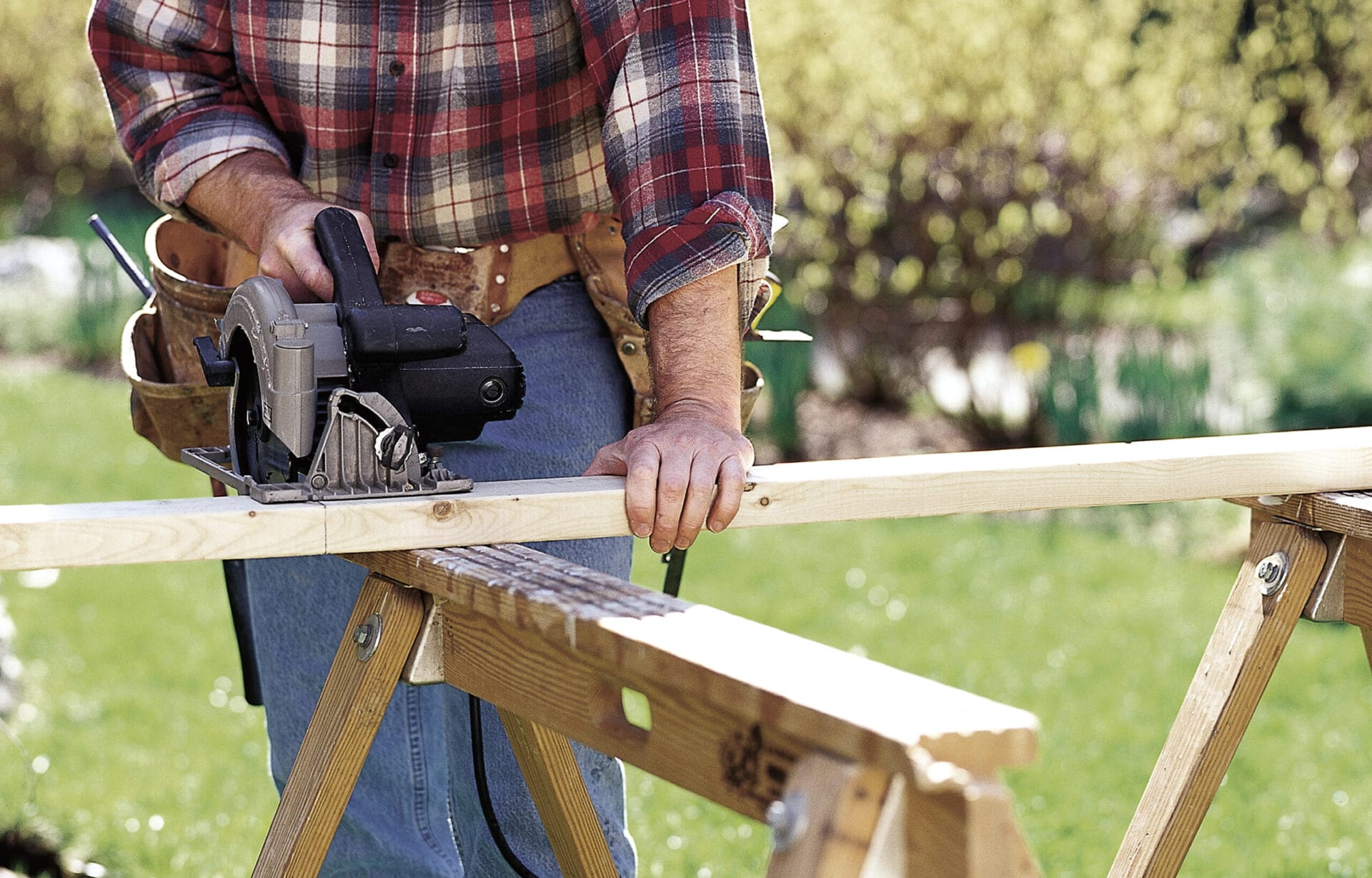
Support the workpiece so it remains stable throughout the entire cut and so the kerf does not close around the blade. A common problem is placing a long board across two supports at its ends and cutting between them. As the cut progresses, the board can sag and pinch the blade.
For large panels, use a support arrangement that prevents the panel from bending into the blade. The exact support locations depend on the panel size, cut location, material, and manufacturer’s instructions. Never place a hand, knee, foot, or another body part underneath the workpiece to support it while cutting.
Stable support
The material should remain firmly supported rather than rocking or shifting as the saw advances.
Clear blade path
Make sure the blade will not strike a support, fastener, hidden obstruction, or surface underneath the material.
Clear offcut
Arrange the setup so the waste section can separate without pushing into the blade.
What to Do If a Circular Saw Binds or Starts to Kick Back
If the blade binds, stalls, or the saw begins to move unexpectedly, do not try to force it through the cut or pull it backward while the blade is still moving. Release the trigger and hold the saw steady in the material until the blade has completely stopped. Then identify and correct the cause of the binding before continuing.
A binding event is a warning that something about the setup or cutting conditions needs attention. The problem could be workpiece movement, a closing kerf, an incorrect blade, a dull blade, excessive cutting depth, a shifted bevel setting, or an obstruction.
Source: thisoldhouse.com
Release the trigger
Stop the saw rather than trying to overpower the resistance.
Keep the saw still
Do not pull the tool backward while the blade is rotating because removing a bound saw under power can increase the chance of kickback.
Wait for a complete stop
Do not remove the saw from the cut until the blade has stopped completely.
Inspect the workpiece
Look for sagging, movement, a closing kerf, trapped offcut, nails, screws, or another obstruction.
Check the blade
Inspect for dullness, damage, incorrect type, incorrect mounting, or other conditions that could increase resistance.
Correct the setup
Reposition supports, adjust the cutting depth or bevel as appropriate, and make sure all adjustment locks are secure before restarting.
What You Should Never Do During Kickback
Do not reach toward the blade to control the saw, grab the workpiece near the cut, or attempt to catch a falling offcut while the blade is moving. Do not clamp or tie the lower guard open. Do not continue using a saw if a safety guard does not operate correctly.
If the saw has been dropped, the lower guard has become damaged, the blade is cracked, or the tool has developed a mechanical problem, stop using it and follow the manufacturer’s inspection or service instructions.
Do not pull the saw backward under power
A moving blade can catch the workpiece as the tool is withdrawn.
Do not grab the offcut
The offcut can move unexpectedly and can place your hand near the blade.
Do not defeat the guard
A lower guard that does not move freely or close correctly is a reason to stop using the saw until it is serviced.
Blade Selection, Depth, and Cutting Technique
Blade selection affects cutting resistance and therefore matters to kickback prevention. Use a blade that matches the material and the saw manufacturer’s requirements. A blade intended for one application may perform poorly or create unnecessary resistance in another.
Cutting depth also matters. Manufacturer instructions commonly specify limiting blade exposure rather than simply lowering the saw to its maximum depth. Follow the exact adjustment procedure for your model because different saw designs and applications can have different requirements.
During the cut, keep the saw shoe seated firmly on the material and maintain a controlled feed. Do not twist the saw to force it back onto a cut line. If the blade starts to bind, stop and investigate rather than increasing pressure.
Source: randstad.lu
Match the blade to the material
Use a blade specifically approved or recommended for the material and cutting application.
Check blade compatibility
Confirm diameter, arbor size, blade body thickness, kerf, and any riving-knife compatibility requirements listed by the saw manufacturer.
Avoid damaged blades
A cracked, warped, excessively worn, or otherwise damaged blade should be removed from service.
Keep the shoe stable
The base plate should remain properly seated on the workpiece throughout the cut so the saw does not twist unexpectedly.
Does a Sharp Blade Prevent Kickback?
A sharp, properly selected blade can reduce unnecessary cutting resistance, but it does not make kickback impossible. Kickback can still occur if the workpiece is poorly supported, the blade becomes pinched, the saw is twisted, or another unsafe condition develops.
Blade maintenance is therefore one part of a larger prevention system. The blade, saw, workpiece, support arrangement, cutting direction, and operator position all need to work together.
Replace rather than force
If a blade requires unusual pressure to cut material that it normally handles, stop and investigate instead of pushing harder.
Clean when required
Material buildup can affect cutting performance. Follow the blade and saw manufacturer’s cleaning recommendations.
Circular Saw Kickback Safety Checklist
Use this checklist before making a cut in a U.S. home workshop, garage, or construction setting. It is a practical summary rather than a substitute for the instructions supplied with your specific saw.
Source: thisoldhouse.com
Before powering on
Confirm the blade is correct, undamaged, properly installed, and compatible with the saw.
Check the guard
Make sure the lower guard moves freely and returns to its protective position as designed.
Check the adjustments
Set the cutting depth and bevel as required, then secure the adjustment locks.
Check the workpiece
Remove or account for nails, screws, hardware, and other hidden obstacles that the blade could contact.
Check the support
Make sure the board or panel cannot sag, rock, shift, or close the kerf during the cut.
Check your position
Stand securely and keep your body out of the blade’s direct line.
Start correctly
Allow the blade to reach normal operating speed when required by the manufacturer’s instructions before entering the material.
Maintain control
Keep the saw stable and avoid twisting or forcing it through the material.
Stop correctly
If the blade binds, release the trigger and wait for the blade to stop completely before removing the saw or changing the setup.
When Should You Stop Using a Circular Saw?
Stop using the saw if a safety guard fails to operate correctly, the blade is damaged, the saw develops an unexplained mechanical problem, the blade repeatedly binds despite a corrected setup, or you cannot establish a stable and controlled cutting position.
For workplace equipment, OSHA guidance calls for unsafe woodworking equipment and improperly functioning safety devices to be taken out of service until the problem is corrected. For homeowners and DIY users, the same basic principle is sensible: do not continue operating a power saw when a safety-critical component is not functioning properly.
Damaged lower guard
Do not use the saw until the guard has been properly serviced.
Cracked or damaged blade
Remove the blade from service and replace it with a compatible blade.
Repeated unexplained kickback
Stop cutting and have the setup, blade, and tool evaluated before continuing.
Frequently Asked Questions
Q
What is the main cause of circular saw kickback?
The main mechanism is blade binding, pinching, or misalignment in the workpiece. Poor support can cause the material to sag or move into the blade, while a dull or unsuitable blade, excessive blade depth, or a twisted cutting path can also contribute.
Q
Can a circular saw kick back at the end of a cut?
Yes. The end of a cut can be hazardous because the remaining material and offcut may shift as the cut separates. A board can sag and close the kerf around the blade, or the offcut can move into the blade. Proper support and a clear path for the waste section help reduce this risk.
Q
Should I pull a circular saw backward if it gets stuck?
No. If the blade binds, release the trigger and keep the saw motionless until the blade has completely stopped. Pulling a powered saw backward while the blade is still rotating can increase the chance of kickback.
Q
How should I stand when using a circular saw?
Position your body to the side of the blade rather than directly behind its path, while keeping stable footing and maintaining control of the saw. Follow the specific body-positioning instructions in your saw’s manual.
Q
Does cutting depth affect circular saw kickback?
It can. Excessive blade exposure can make the saw harder to control and can increase the opportunity for the blade to twist or catch. Set the depth according to the manufacturer’s instructions for your particular saw and material.
Q
Can a sharp blade completely prevent circular saw kickback?
No. A sharp, suitable blade can reduce unnecessary cutting resistance, but kickback can still occur if the workpiece shifts, the kerf closes, the blade becomes twisted, or another unsafe condition develops.
✦ Wrapping Up
Conclusion
Circular saw kickback is primarily a control and binding problem: the blade becomes trapped, pinched, stalled, or misaligned, and the saw reacts suddenly. The most useful prevention steps are therefore practical ones. Use a compatible and properly maintained blade, support the material so the kerf stays open, set the blade correctly, secure depth and bevel adjustments, maintain a stable two-hand grip when required, and keep your body out of the blade line.
If a saw binds, do not try to overpower it. Release the trigger, hold the saw still until the blade stops, then find and correct the cause. A functioning blade guard and properly maintained equipment are essential parts of the safety system. For U.S. workplace use, also follow applicable OSHA requirements and your employer’s procedures, along with the instructions supplied with the specific saw.
💡 Key Takeaway
Before your next cut, check the blade, guard, depth, support, and your body position. If any part of the setup could allow the material to pinch the blade, stop and correct it before starting the saw.