The best tabletop fastening methods hold the top firmly while allowing solid wood to expand and shrink across its grain. Common options include figure-eight fasteners, Z-clips, wooden buttons, screw blocks, slotted screws, dovetail cleats, and pocket screws.
Building a wood table in the United States means planning for changes in indoor humidity. Homes in Florida may face humid summer air, while homes in states such as Colorado and Minnesota can have very dry indoor air during winter. Heating and air conditioning can also change the moisture level inside a home. These changes affect solid wood, including a finished dining table or desk.
A tabletop needs a strong connection to its base. Yet a solid wood top cannot be locked in place at every point. Wood grows wider as it takes in moisture and becomes narrower as it dries. Most of this change happens across the grain. A rigid joint can stop that movement and lead to cracks, loose joints, or a warped top.
The right fastening system solves both problems. It keeps the top in place but gives it room to move. Some methods use simple metal clips. Others use wooden blocks, shaped cleats, or screws in long holes. The best choice depends on the table design, wood type, top width, and tools available.
This guide explains the main methods, how they work, how to install them, and how to choose between them. It also covers common mistakes, screw placement, seasonal movement, and the difference between solid wood and engineered panels.
Source: craftsmanspace.com
Understanding How Tabletop Fastening Works
A tabletop fastening system joins the top panel to the table base. The base may include legs, aprons, rails, stretchers, or a central support. The fastening system keeps these parts together during normal use.
The challenge is that the top and base may react to moisture in different ways. A solid wood top changes in width as its moisture content changes. A table base may not change at the same rate or in the same direction. A good joint must account for this difference.
Wood movement is not a defect. It is a natural property of the material. A finish can slow moisture exchange, but it cannot stop the wood from responding to its surroundings.
Most tabletop fastening problems start when a builder treats a solid wood panel like a sheet of metal. A row of tight screws may hold the panel in place at first. Over time, the wood may try to move against those fixed points. Stress can then build in the top or the apron.
Source: craftsmanspace.com
Secure attachment
The fasteners must keep the tabletop from lifting, sliding, or shifting during normal use.
Room for movement
The joint must let the top change width without placing too much stress on the wood.
Even support
Fasteners should hold the top down across the base rather than leave large unsupported areas.
Easy service
A removable top can make repairs, transport, and future refinishing easier.
Why Wood Moves Across Its Grain
Wood has three main movement directions. These are tangential, radial, and longitudinal. Tangential movement runs around the growth rings. Radial movement runs across the growth rings. Longitudinal movement follows the length of the grain.
For most furniture work, movement across the board width matters most. A wide flatsawn board can change more in width than a similar quartersawn board. Movement along the length is usually much smaller.
This explains why a solid wood tabletop needs special care. A long table may have a top made from several boards joined edge to edge. The finished panel can become quite wide. Even a small change in each board can add up across the full panel.
Flatsawn wood
Its growth rings often create greater tangential movement across the board width.
Quartersawn wood
Its growth ring layout usually results in less width movement than flatsawn stock.
Long grain
Wood changes very little along its length compared with its width.
What Happens When a Top Cannot Move
Imagine a wide oak tabletop fixed to an apron with tight screws in round holes. During a humid season, the top tries to grow wider. The apron and screws resist that change. The stress has to go somewhere.
The top may crack along a glue line or near a screw. The apron may pull apart. A joint may also loosen after repeated cycles of expansion and shrinkage. These problems may take months or years to appear.
The solution is not to make the screws weaker. It is to design the connection so the top can move in the right direction while remaining supported.
Cracks
Restrained movement can cause splits near screw holes or along weak areas of the panel.
Loose joints
Repeated stress can weaken the connection between the apron and the table base.
Warping
Uneven restraint can contribute to distortion or changes in the tabletop shape.
The Most Common Tabletop Fastening Methods
Several fastening systems can hold a tabletop without locking it across the grain. The most common choices are figure-eight connectors, Z-clips, wooden buttons, screw blocks, and slotted screw holes.
Each method uses a different way to create movement. Some connectors pivot. Others slide inside a groove. Some use a screw that travels along a slot as the top changes width.
There is no single method that suits every table. A small side table may need only a few figure-eight connectors. A wide dining table may benefit from Z-clips or long wooden buttons. A traditional handmade table may look better with shop-made dovetail cleats.
Source: craftsmanspace.com
For quick installation
Figure-eight fasteners and Z-clips are common choices because they need little custom shaping.
For custom furniture
Wooden buttons and dovetail cleats let the builder match the connection to the table design.
For simple construction
Slotted screw holes can provide movement without special tabletop hardware.
Figure-Eight Fasteners
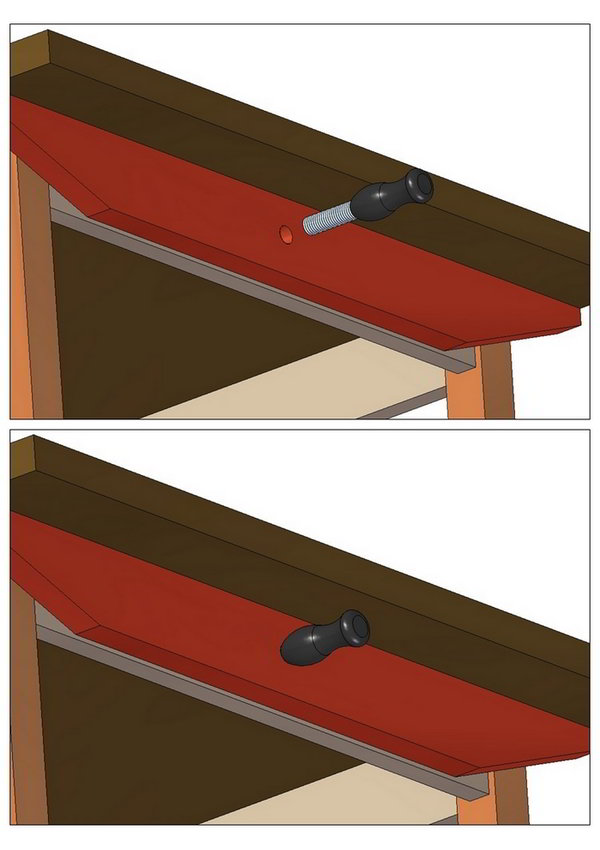
Figure-eight fasteners are small metal connectors shaped like the number eight. One end attaches to the apron. The other end attaches to the underside of the tabletop.
The connector sits in a shallow recess near the top edge of the apron. One side is screwed to the apron, while the other side is screwed to the tabletop. As the top moves, the connector can pivot inside its recess.
This movement helps the tabletop expand and contract without placing too much stress on the base. The connector also has a clean appearance because most of the hardware stays hidden.
A Forstner bit makes the round recess. A chisel can open the edge of the recess so the connector has room to turn. The recess should be deep enough for the metal to sit flush or slightly below the apron surface.
Figure-eight fasteners are useful for small and medium tables. Their movement range is limited by the shape of the connector and the recess. Check the hardware size and movement range before using them on a wide top.
Advantages
They are compact, affordable, discreet, and simple to install with basic drilling tools.
Limitations
They have a limited pivot range and may not provide enough movement for every wide tabletop.
Best use
They suit many side tables, small dining tables, desks, and furniture with accessible aprons.
Z-Clips and Tabletop Clips
Z-clips are metal fasteners with two offset ends. One end fits into a groove in the apron. The other end attaches to the underside of the tabletop with a screw.
The clip slides inside the groove as the solid wood top changes width. This makes it a useful choice for tables that need a larger movement range than a basic pivoting connector can provide.
The groove can be cut with a table saw, router, or biscuit joiner. Its size must match the clip. Check the hardware dimensions before cutting the groove because clip shapes and sizes can vary.
Z-clips work well on many dining tables, desks, and work tables. They are also easy to replace if a clip becomes damaged. Their main drawback is that they need a suitable groove in the apron.
When installing the clips, make sure the free end can slide. A screw that is too tight or a groove that is too narrow can stop the fastener from doing its job.
Advantages
They are quick to fit, offer useful movement, and hold the tabletop securely.
Limitations
They need a properly sized groove and enough apron material for safe installation.
Best use
They suit solid wood tables with aprons and enough space for a continuous or partial groove.
Wooden Buttons
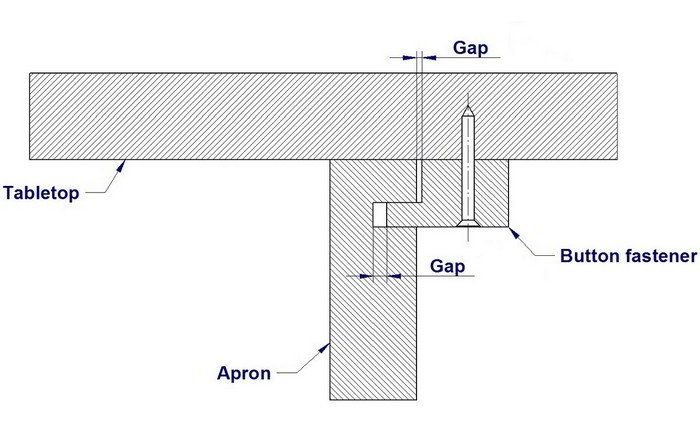
Wooden buttons are small blocks made from scrap wood. Each button has a shaped tongue that fits into a groove in the table apron. A screw holds the button to the underside of the top.
The tongue stays inside the apron groove while the screw holds the button against the tabletop. A well-made button can slide within the groove as the top changes width.
Woodworkers often make these fasteners from the same wood used for the table base. This can create a traditional look and reduce the need for purchased metal hardware.
The groove must be deep enough to hold the tongue while leaving room for movement. The button should also have a suitable screw hole or slot. A tight round hole can limit movement, so the design must match the direction of expansion.
Wooden buttons are useful for handmade furniture, dining tables, desks, and traditional designs. They take more time to make than ready-made metal clips, but they offer control over size and appearance.
Advantages
They use common materials, are easy to repair, and can blend with traditional furniture.
Limitations
They require accurate shaping and a well-cut apron groove.
Best use
They suit custom tables where a wooden connection is preferred.
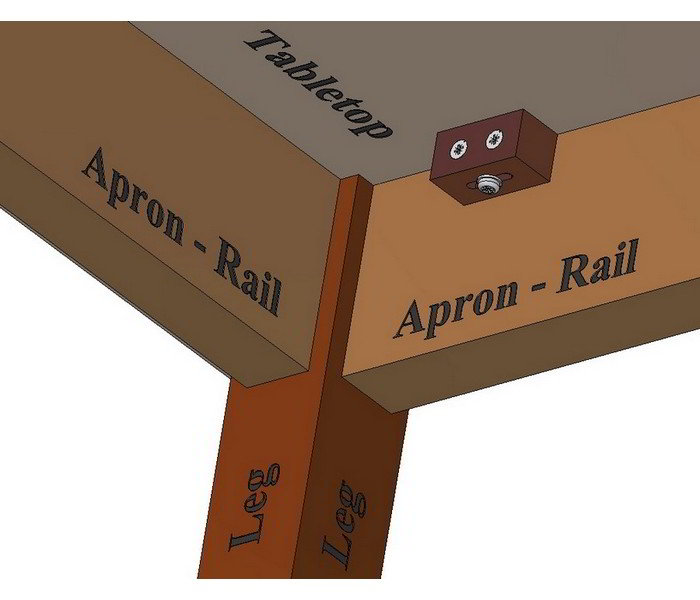
Screw Blocks and Cleats
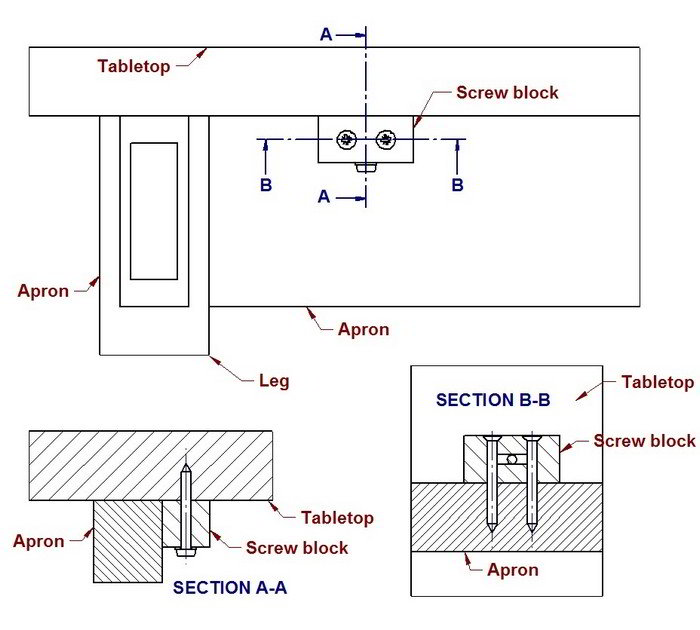
Screw blocks are small wood blocks fixed to the apron or rail. Screws pass through the blocks and into the underside of the tabletop.
A basic block with a tight round screw hole can lock the top in place. To allow movement, the block needs a slot or another suitable sliding feature. The slot should run across the grain of the tabletop.
Some blocks are glued to the apron and screwed to the top. Others are attached to the apron with screws. The grain direction matters when a block is glued. Its long grain should meet the apron rather than relying on a weak end-grain glue joint.
A screw block is easy to make from workshop offcuts. It also provides a useful bearing area for the mounting screw. However, a block with no movement allowance is not a suitable fastening system for a wide solid wood top.
For better control, make the blocks consistent in size and place them at planned points along the apron. Check that each slot gives the top enough room to move.
Advantages
They are inexpensive, simple to make, and can be sized to suit the table.
Limitations
A poorly designed block can lock the top or split along a weak glue joint.
Best use
They work well for custom furniture when the builder can control the block and slot design.
Other Methods for Attaching a Tabletop
Some table designs need a different type of connection. A wide workbench may need stronger support. A traditional table may call for a hidden wooden joint. A simple desk may need only a few screws with the right clearance.
These methods can work well when they match the table structure. The key is to understand whether the connection allows movement or holds the panel rigidly.
Source: craftsmanspace.com
Dovetail cleats
Use shaped sliding joints to hold a top while allowing controlled movement.
Slotted screw holes
Use elongated holes to let screws move as the tabletop changes width.
Pocket screws
Use angled screws with suitable clearance when the table design and panel material permit the connection.
Corner irons
Use metal brackets for suitable fixed or engineered-panel assemblies, with care around solid wood movement.
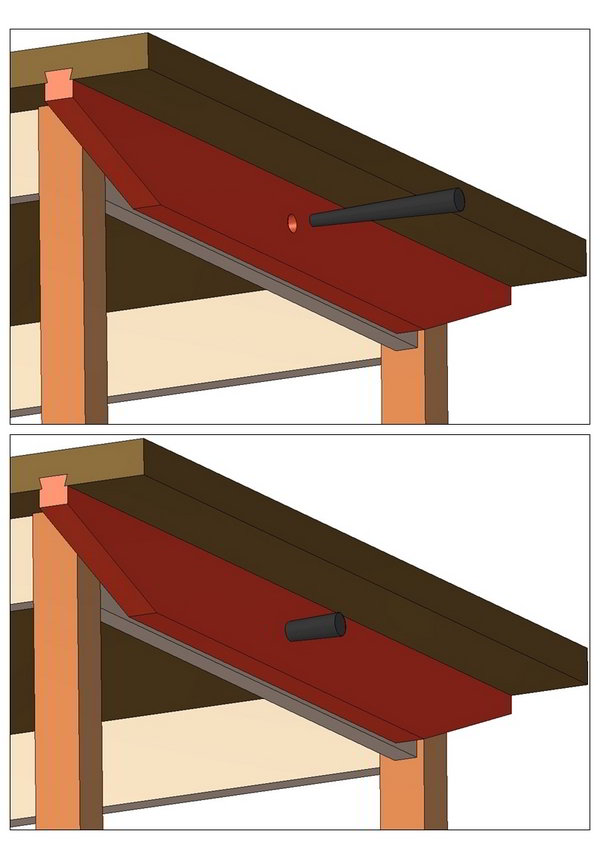
Dovetail Cleats
A dovetail cleat uses a sliding dovetail shape to connect the tabletop and its supporting rail or block. One part has a dovetail-shaped tongue. The other has a matching groove.
The angled sides help prevent the joint from pulling apart. At the same time, the joint can slide in the direction of the tabletop’s movement if designed with the correct clearance.
This method can provide strong support without visible metal hardware. It is useful for traditional furniture and carefully built custom tables.
The main challenge is accurate cutting. The two parts must fit closely enough to stay secure but not so tightly that seasonal movement becomes difficult. A long sliding joint also needs a suitable way to prevent unwanted movement along its length.
A tapered dovetail cleat can be useful because it can be fitted from one end. However, its taper and final position must be planned before assembly.
Advantages
It provides a hidden wooden connection and can offer strong support with controlled sliding movement.
Limitations
It takes more skill and careful fitting than ordinary clips or screws.
Best use
It suits traditional tables, custom furniture, and projects where visible hardware is not wanted.
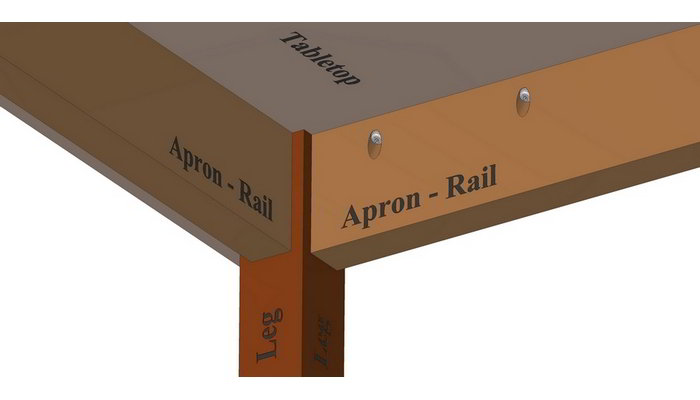
Slotted Screw Holes
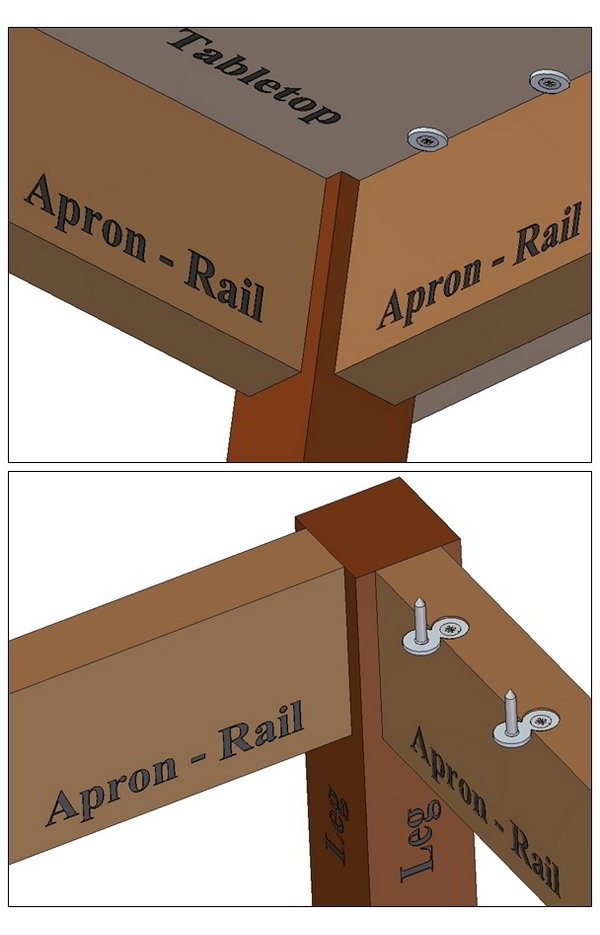
Slotted screw holes are a simple way to attach a solid wood top to an apron or support rail. Instead of using a round hole, the builder makes an elongated opening in the rail or mounting block.
The screw passes through the slot and enters the tabletop. A washer or suitable screw head holds the rail against the top while allowing the screw to move along the slot.
The slot must run in the direction of the tabletop’s expected movement. For a rectangular top, this usually means the slots in the long side rails run across the top’s width.
The screw should be snug enough to hold the parts together but not so tight that the connection cannot move. A washer can help spread the load and prevent the screw head from digging into the wood.
A center fixing point may be used to help keep the tabletop aligned. Other fixing points can then allow movement away from that point. The exact layout depends on the frame and the top shape.
Advantages
They need little special hardware and can be made with common woodworking tools.
Limitations
The slots must be placed in the correct direction and sized for the expected movement.
Best use
They suit work tables, desks, custom furniture, and simple apron designs.
Pocket Hole Fastening
Pocket hole screws enter the wood at an angle through a drilled pocket. They are often used to connect table aprons, rails, and other frame parts.
They can also attach some tabletops to their supporting structure. However, a standard pocket hole connection should not be assumed to allow wood movement. A tight screw in a fixed hole may restrain a wide solid wood panel.
If pocket screws are used for a solid wood top, the fastening layout must provide suitable clearance or another movement feature. The screw must not lock the top across its grain.
Pocket holes are more straightforward for plywood, stable composite panels, and other assemblies that do not need the same movement allowance as a wide solid wood panel.
Use a pocket hole jig that matches the stock thickness. Select the correct screw length and avoid driving screws so deep that they break through the visible surface.
Advantages
Pocket holes are quick to drill and make it easy to join frame parts.
Limitations
A standard fixed pocket screw may restrain solid wood movement.
Best use
They are useful for apron construction and suitable engineered-panel assemblies.
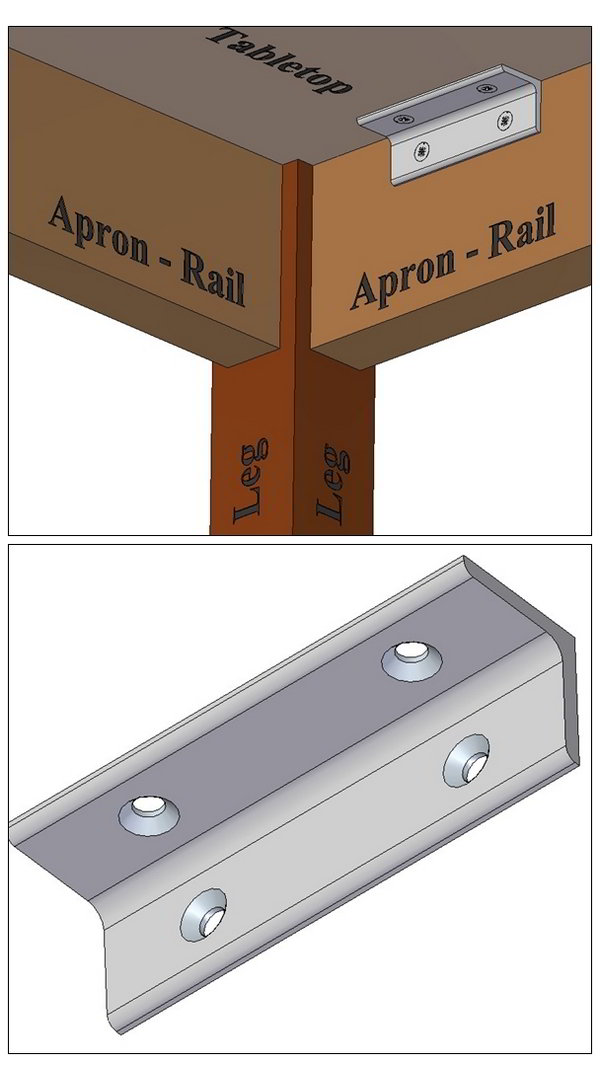
Corner Irons and Fixed Brackets
Corner irons are metal brackets that connect two parts at an angle. They are often used inside tables, cabinets, and other furniture frames.
They can provide a simple connection between a tabletop and a supporting rail. They may also help reinforce corners and reduce unwanted frame movement.
A rigid bracket with round screw holes can be suitable for plywood or other stable panels. It can be risky when used to lock a wide solid wood top across its grain.
If the design uses solid wood, select a bracket with suitable movement slots or combine it with another movement-friendly connection. The bracket should hold the top without forcing it to stay at one fixed width.
Advantages
They are easy to find, simple to fit, and useful for suitable frame connections.
Limitations
Rigid brackets can restrict seasonal movement in solid wood.
Best use
They suit stable panels and table designs that provide the needed movement clearance.
How to Choose the Right Tabletop Fastening Method
Choose a fastening method based on the tabletop material, width, base design, and amount of movement the joint must allow. The right connection for a small plywood desk may not work for a wide solid oak dining table.
Start by identifying the panel material. Solid wood needs movement allowance across the grain. Plywood and many engineered panels are more stable because their layers or structure reduce changes in overall size.
Next, inspect the base. A table with full aprons offers room for clips and buttons. A pedestal base may need a different mounting plate or a purpose-made movement system. A simple rail frame may work well with slotted holes.
Finally, consider access and appearance. A hidden wooden button may suit fine furniture. A Z-clip may be more practical for a utility table. A figure-eight fastener can be useful when the apron is already assembled.
Source: craftsmanspace.com
Small side table
Figure-eight fasteners or properly designed slotted blocks can provide a simple connection.
Wide dining table
Z-clips, wooden buttons, or long movement slots may provide more suitable travel.
Traditional furniture
Wooden buttons and dovetail cleats can keep the connection in line with the design.
Plywood desk
Fixed screws or corner brackets may work when the panel and frame design allow them.
Heavy workbench
Use a strong support system with enough movement clearance for the solid wood top.
Comparison of Common Fastening Methods
The table below compares common options by installation, movement, and practical use. These are general design comparisons. Actual performance depends on the fastener dimensions, wood thickness, screw placement, and quality of installation.
Figure-eight fasteners
Best for a compact connection with a pivoting action. They need a shallow recess and careful screw placement.
Z-clips
Best for a sliding connection with a suitable apron groove. They offer a useful balance of ease and movement.
Wooden buttons
Best for traditional furniture and shop-made connections. They need accurately cut grooves.
Screw blocks
Best for low-cost custom construction. They must include a suitable movement feature.
Dovetail cleats
Best for hidden wooden support. They require accurate joinery and careful fitting.
Slotted screws
Best for a simple connection with controlled screw travel. The slots must face the correct direction.
Pocket screws
Best for joining suitable frame parts. Fixed pocket screws need special care when used on solid wood tops.
How Much Room Does a Tabletop Need?
The required movement depends on the wood species, grain orientation, panel width, moisture content, and expected indoor humidity range. There is no single clearance figure that works for every table.
A wood movement calculator can help estimate the change in width. These tools use the wood species, board orientation, current moisture content, and expected moisture change. Their results are estimates, not exact predictions for every board.
For example, consider a hypothetical 36-inch-wide solid wood top. If the expected seasonal change in its width is one-quarter inch, the fastening system needs to allow at least that amount of total travel, with suitable clearance for the direction of movement.
Do not treat the example as a universal allowance. The actual value must come from the species and moisture conditions. A quartersawn panel may move less than a flatsawn panel of the same width.
Place the fasteners so the tabletop can move away from a chosen center area. This helps avoid forcing the entire panel toward one side of the frame.
Check the species
Different woods have different shrinkage and expansion rates.
Check grain direction
Flatsawn, riftsawn, and quartersawn boards do not move in the same way.
Check moisture conditions
Indoor humidity changes affect the amount of movement expected during the year.
Check fastener travel
The available slot or sliding range must be large enough for the estimated movement.
Choose by Table Material
Solid wood needs a fastening system that allows width movement. This applies to oak, maple, walnut, cherry, pine, and other common furniture woods.
Plywood usually changes size less than a solid wood panel of similar dimensions. Its cross-layer construction helps balance movement. Fixed screws may be suitable, depending on the panel and base.
MDF and particleboard also have different movement behavior from solid lumber. They can be more sensitive to moisture damage at edges and screw locations. Use suitable screws and avoid over-tightening.
Veneered panels need special care. A veneered plywood panel is not the same as a solid wood slab. A thick solid wood edge band or frame may still move differently from the panel beneath it.
Solid hardwood
Use clips, buttons, cleats, or slotted screws that allow cross-grain movement.
Solid softwood
Use the same movement rules as hardwood, while considering the lower screw-holding strength of some softwoods.
Plywood
Fixed screws are often suitable when the panel and frame are designed for a stable connection.
MDF
Use suitable fasteners and protect the panel from moisture, especially around screw holes and edges.
Step-by-Step Guide to Attaching a Solid Wood Tabletop
A reliable tabletop installation starts before the first screw goes into the wood. Check the top, frame, fasteners, and expected movement before assembly.
The following process works as a general guide for a rectangular solid wood tabletop with an apron. Adjust the layout to match the selected fastener instructions and the table design.
Work on a flat surface. Protect the finished face of the tabletop with a clean pad. Keep the screws, drill bits, and measuring tools close at hand.
Source: craftsmanspace.com
Tools
Prepare a drill, suitable bits, tape measure, square, pencil, clamps, screwdriver, and chisel when needed.
Materials
Prepare the tabletop, assembled base, selected fasteners, suitable screws, and washers if the design requires them.
Safety
Wear eye protection, secure the work, and keep hands clear of cutting tools and rotating bits.
Step 1: Inspect the Tabletop and Base
Check the tabletop for cracks, loose glue lines, deep twists, and uneven edges. Make sure the panel is dry and suitable for indoor furniture use.
Inspect the apron and rails. Look for loose joints, damaged corners, and weak screw locations. A fastener cannot correct a badly built base.
Place the top and base together without screws. Check the overhang on every side. Use a tape measure to make sure the top is centered.
Good result
The tabletop sits flat and the base is centered beneath it.
If the fit fails
Correct the frame or tabletop alignment before installing any fasteners.
Step 2: Identify the Direction of Wood Movement
Find the grain direction on the tabletop. On a rectangular panel, the boards often run along the longer dimension. The main seasonal movement will occur across the shorter dimension.
Mark the center of the top and the center of the base. These marks help keep the assembly aligned. They also help you plan a layout that allows movement toward the outer edges.
Do not assume that the table’s longest dimension is always the direction of movement. Follow the actual grain direction of the panel.
Good result
You know which direction needs movement clearance before placing the fasteners.
If the direction is unclear
Inspect the board grain and glue-up layout before marking the fastening points.
Step 3: Select and Lay Out the Fasteners
Choose clips, buttons, or slotted screws based on the frame design. Read the hardware dimensions and installation details before cutting any recesses or grooves.
Space the fasteners along the apron so the top receives even support. Avoid placing them too close to the end of a rail or a weak joint.
Use the selected fastener’s movement range to determine where the screws and slots should sit. A symmetrical layout often makes the work easier to check.
Good result
The fastening points are evenly placed and provide enough movement in the correct direction.
If the layout is crowded
Adjust the number or position of the fasteners without weakening the apron or support rails.
Step 4: Cut Recesses or Movement Slots
If you use figure-eight connectors, drill shallow recesses with a Forstner bit. Clean the edges with a chisel so each connector can pivot.
For Z-clips, cut a groove that matches the hardware. Test a clip in a short sample groove before cutting the full apron.
For slotted screw holes, drill or rout elongated openings in the correct direction. Remove rough edges that could catch the screw or washer.
For wooden buttons, make a consistent groove and check that each tongue can slide. Do not make the fit so tight that seasonal movement becomes difficult.
Good result
Every fastener fits its recess or groove without binding or standing too high.
If a clip binds
Check the groove width, depth, and alignment. Correct the problem before attaching the top.
Step 5: Drill Pilot Holes
Pilot holes help reduce the risk of splitting and make it easier to drive screws straight. Select a drill bit based on the screw core diameter and the wood species.
Use a depth stop or tape marker to control the hole depth. The screw must hold the tabletop securely without passing through its finished surface.
Check the screw length against the actual thickness of the top and fastener. A screw that is too long can damage the visible face.
Good result
The pilot holes are centered, straight, and deep enough for the chosen screws.
If a hole is misplaced
Stop and assess the damage. Do not force a screw into a poor hole or leave a weak connection.
Step 6: Attach the Fasteners
Set the base on the underside of the tabletop and check the overhang again. Install each connector according to its design.
For a figure-eight connector, fasten one side to the apron and the other to the top. Leave enough freedom for the connector to pivot.
For a Z-clip, place the free end in the groove and secure the opposite end to the tabletop. Check that the clip can slide.
For slotted screws, use a suitable washer or screw head. Tighten the screw enough to hold the parts together, but do not clamp the joint so tightly that movement stops.
Use the correct number of fasteners for the table design. Do not add extra screws simply because more screws seem stronger.
Good result
The top is secure, the overhang remains even, and the movement features still work.
If the top shifts
Recheck the center marks and fastening layout before tightening the remaining screws.
Step 7: Check the Finished Connection
Turn the table upright and inspect the connection from all sides. Look for gaps, loose hardware, uneven overhang, or a top that rocks against the base.
Check that the screws do not protrude through the finished surface. Confirm that the clips or buttons remain seated and that the slots have not been blocked by excess hardware.
The tabletop should feel secure during normal handling. Its fastening system should also retain the planned movement clearance.
Good result
The top is centered, stable, and firmly attached without being locked across the grain.
If the connection fails
Remove the load, inspect the fasteners, and correct any binding, loose screws, or damaged wood before use.
Common Tabletop Fastening Mistakes to Avoid
Most tabletop fastening problems come from poor planning rather than a lack of hardware. A strong screw or thick bracket cannot fix a joint that prevents the wood from moving.
The safest approach is to check the material, grain direction, screw length, and movement range before assembly. Small errors at this stage can become costly repairs later.
Source: craftsmanspace.com
Using too many fixed screws
A large number of tight screws can restrain a solid wood panel and create stress.
Ignoring grain direction
Slots placed in the wrong direction may not provide useful movement.
Long screws can break through the tabletop and damage its finished face.
Over-tightening fasteners
Excessive pressure can stop sliding or pivoting connectors from working.
Using weak apron material
A fastener needs sound wood around its screw holes and grooves.
Gluing the Tabletop Directly to the Apron
Gluing a wide solid wood top directly to a cross-grain apron is usually a poor choice. The glue joint can stop the top from changing width. This creates stress when the humidity changes.
The result may be a split tabletop, a damaged apron, or a failed glue joint. The fact that a glue is strong does not make the design suitable.
Use movement-friendly hardware instead. Glue can still be used for suitable joints within the tabletop itself, such as joining boards edge to edge with compatible grain direction.
Avoid
Do not glue the full underside of a wide solid wood top to a fixed apron.
Use instead
Choose buttons, clips, or slotted fasteners that permit movement.
Making Slots Too Short
A slot must provide enough travel for the expected change in tabletop width. A very short slot may work at first but stop the top from moving during a dry or humid season.
Estimate movement before cutting the slots. Consider the species, board orientation, top width, and expected moisture range.
Check that the screw head or washer can travel along the slot without catching its edge. Remove splinters and sharp burrs that could block movement.
Avoid
Do not use a fixed slot size without checking the actual movement requirement.
Use instead
Size the slot to suit the expected movement and the selected screw hardware.
Ignoring Screw Depth and Pilot Holes
A screw that is too long can pierce the tabletop. A screw that is too short may not provide enough grip. Both errors can weaken the finished connection.
Pilot holes should match the screw and wood. Dense hardwood often needs more careful drilling than softwood. The correct pilot size also depends on the screw design.
Always test the screw length on scrap wood of the same thickness before installing it in a finished tabletop.
Avoid
Do not guess the screw length or drive screws without checking the available wood thickness.
Use instead
Measure the parts, drill controlled pilot holes, and test the hardware before final assembly.
Using the Same Fastener Layout for Every Table
A small round table, a wide dining table, and a long workbench do not have the same support needs. Their dimensions, base structures, and movement patterns differ.
A figure-eight connector may be suitable for one table but have too little travel for another. A Z-clip may work well on an apron but be unsuitable for a base with no room for a groove.
Plan the connection around the actual furniture. Do not copy a fastener layout without checking the panel width and grain direction.
Avoid
Do not assume one fastener type is suitable for every tabletop.
Use instead
Match the connector to the material, dimensions, and base design.
Maintaining Tabletop Fasteners Over Time
A well-designed tabletop connection needs little routine care, but it should not be ignored. Changes in humidity, daily use, and repeated movement can affect screws, clips, and wooden blocks.
Inspect the underside of the table from time to time. Look for loose screws, damaged grooves, broken clips, and signs of stress near the apron.
Do not tighten every screw without checking the fastener design. Some connections need a little freedom to move. Tightening a sliding fastener too much can create the same problem that the original design was meant to prevent.
Source: craftsmanspace.com
Check screw heads
Look for loose, damaged, or protruding screws.
Check metal clips
Look for bending, corrosion, or signs that the connector no longer pivots or slides.
Check wooden buttons
Inspect the tongues, screw holes, and apron grooves for cracks or wear.
Check the tabletop
Look for new cracks, raised areas, and changes in alignment.
What to Do When a Fastener Becomes Loose
First, find out why the fastener is loose. The screw may have backed out, the wood may have worn around the hole, or the connector may have become damaged.
If the screw is loose but the wood is sound, remove it and inspect the hole. A suitable replacement screw may solve the problem if it has the correct size and length.
If the hole is damaged, repair the wood before reinstalling the screw. A suitable hardwood plug or other sound repair may be needed. Avoid forcing a larger screw into a thin apron without checking the remaining wood.
Replace bent or broken clips rather than trying to force them back into shape. Make sure the new fastener fits the existing groove and provides the needed movement.
Loose screw
Inspect the screw and hole, then use a suitable repair or replacement.
Damaged clip
Replace it with a compatible connector and check its movement.
Cracked apron
Repair the damaged structure before relying on the tabletop fasteners.
How Indoor Humidity Affects Table Fasteners
Indoor humidity changes can affect a solid wood tabletop throughout the year. In many parts of the United States, summer air can be humid, while winter heating can make indoor air much drier.
A table in a climate-controlled room may experience smaller changes than one in an unheated garage or a room with large humidity swings. Outdoor furniture faces even greater exposure to changing conditions.
Keep indoor furniture in a reasonably stable environment when possible. Avoid placing a solid wood table right next to a heater, strong heat outlet, or damp exterior wall.
A finish helps slow moisture exchange. It does not remove the need for movement-friendly fasteners.
Stable indoor conditions
They can reduce large moisture changes in furniture.
Direct heat
It can dry one part of the tabletop faster than another.
Outdoor exposure
It can increase the need for suitable materials, finishes, and movement clearance.
Research Findings and Useful Questions for Table Builders
A review of woodworking guidance from WOOD Magazine, Woodcraft, and Fine Woodworking shows a consistent design principle: a solid wood tabletop needs a secure connection that does not prevent seasonal movement.
The reviewed material covers figure-eight connectors, Z-clips, wooden buttons, screw blocks, slotted screws, and sliding cleats. The main difference between these systems is how they provide movement and how much work they need during installation.
One useful distinction is the difference between a fastener that pivots and one that slides. Figure-eight connectors use a pivoting action. Z-clips and wooden buttons use a sliding connection. Slotted screws use a screw that can travel along an opening.
A second useful point is that the material changes the answer. A plywood top may accept a fixed attachment that would be unsuitable for a wide solid wood top. The builder should identify the panel type before choosing hardware.
The reviewed pages also support a practical improvement for readers: check the required movement before selecting the fastener. Many basic explanations describe how a connector works but do not give enough attention to the actual movement range needed by a particular tabletop.
Source: craftsmanspace.com
Observed question: Which fastener allows wood movement?
Woodworking guidance discusses figure-eight connectors, Z-clips, buttons, and slotted screws. These methods answer the question through pivoting or sliding action.
Inferred next need: How much movement is required?
A builder must calculate movement from the wood species, grain direction, panel width, and moisture range before cutting slots.
Inferred next need: Can I use ordinary screws?
Ordinary screws can work with suitable slots or clearance, but tight screws in fixed holes can restrain a solid wood top.
Inferred next need: Can I use the same method on plywood?
Plywood is more stable than solid lumber, so the attachment can often be more direct. Panel thickness and edge strength still matter.
Inferred next need: How do I repair a loose connection?
Inspect the screw, hole, fastener, and apron before choosing a repair. Replacing a damaged connector may be safer than tightening it further.
Coverage and Research Gap Map
The following map separates questions found in the reviewed woodworking material from questions inferred from the installation task. It does not claim that these are the most searched questions or that every website has the same coverage.
The main reader benefit is a clearer link between fastener selection, material type, movement allowance, installation, and later repair.
Fastener types and basic functions
Observed in the reviewed Fine Woodworking, Woodcraft, and WOOD Magazine material. Coverage is strong. The practical benefit is a clear comparison of pivoting and sliding connections.
Required movement for a specific top
Inferred next need. Coverage varies across the reviewed material. The useful addition is a clear explanation of species, grain direction, moisture range, and panel width.
Installation checks and screw depth
Inferred next need. General installation guidance is available. A step-by-step inspection helps prevent damage to the finished tabletop.
Solid wood versus engineered panels
Observed as a related distinction in woodworking guidance. The useful addition is a direct material-based decision aid.
Repairing a loose fastener
Inferred next need. The useful addition is a safe inspection order that separates a loose screw from damaged wood or hardware.
Research Sources and Evidence Limits
The research review used woodworking articles available on November 4, 2026. It included Fine Woodworking’s guidance on attaching solid wood tabletops, Woodcraft’s tabletop fastener guide, and WOOD Magazine’s articles on wood movement and tabletop attachment.
These sources provide documented woodworking methods and construction guidance. They are not a laboratory test of every connector, wood species, or table design.
The exact movement allowance for a particular tabletop still requires species-specific information and suitable moisture estimates. Hardware dimensions must also be checked against the actual product instructions.
No first-hand workshop testing, load testing, or long-term product testing was performed for this article. The recommendations are based on the reviewed construction principles and practical analysis of their use.
DOCUMENTED
Solid wood changes size with moisture, mainly across the grain. Figure-eight connectors pivot, while Z-clips slide in grooves.
ANALYSIS
The most suitable fastener depends on panel width, material, base construction, and required movement.
NOT ESTABLISHED
No universal fastener spacing, exact movement allowance, or maximum table size applies to every species and design.
NOT TESTED BY US
No physical fastening tests or long-term furniture trials were conducted for this guide.
Frequently Asked Questions
Q
What is the best way to fasten a solid wood tabletop?
Figure-eight fasteners, Z-clips, wooden buttons, and slotted screw blocks are common choices. Each can hold a solid wood top while allowing it to move across the grain.
For many tables with aprons, Z-clips provide a useful balance of strength, movement, and easy installation. Figure-eight fasteners are a good option for smaller tops. The best choice depends on the panel width and base design.
Q
Can I screw a tabletop directly to the apron?
You can use screws, but the design matters. Tight screws through round holes can restrain a wide solid wood tabletop as it changes width.
Use slotted holes or suitable movement-friendly fasteners instead. Fixed screws are often more suitable for stable engineered panels such as properly supported plywood.
Q
How many tabletop fasteners do I need?
The number depends on the table size, fastener type, apron layout, and support needs. A small table may need only a few connectors, while a large dining table may need more.
Follow the fastener maker’s spacing guidance and make sure the top has even support. More fasteners do not automatically make a better connection if they restrict wood movement.
Q
Should tabletop screws be tight or loose?
The screw should hold the tabletop securely without blocking the movement feature. The correct setting depends on the fastener design.
A pivoting connector must be able to pivot. A sliding clip must be able to slide. A slotted screw connection needs enough freedom for the screw to travel along the slot.
Q
Can I use glue instead of tabletop fasteners?
Glue alone is usually not suitable for attaching a wide solid wood top directly to a cross-grain apron. It can stop the top from expanding and shrinking.
Use a movement-friendly fastening system instead. Glue remains useful for suitable woodworking joints, including edge joints between boards in a properly designed tabletop.
Q
Do plywood tabletops need wood movement fasteners?
Plywood usually moves less than solid wood because its layers have different grain directions. Many plywood tops can use fixed screws or brackets when the panel thickness and frame design support them.
Check the panel type, edge strength, and screw-holding ability before choosing a connection. A solid wood edge band or frame may still need movement allowance.
Q
Can I attach a tabletop without an apron?
Yes. Tables without traditional aprons can use mounting plates, slotted brackets, suitable cleats, or other purpose-made support systems.
The connection must provide enough support while allowing the top to move if it is solid wood. A pedestal table may need a custom mounting layout based on the size and shape of its base.
✦ Wrapping Up
Conclusion
Choosing the right tabletop connection is about more than holding two pieces of wood together. The fastener must support the top, keep it aligned, and allow it to respond to changes in moisture. This is especially important for wide solid wood tables used in homes and workshops across the United States.
Figure-eight fasteners, Z-clips, wooden buttons, screw blocks, slotted screws, and dovetail cleats each offer a different solution. Figure-eight connectors are compact and easy to fit. Z-clips offer a useful sliding action. Wooden buttons and dovetail cleats suit custom furniture where a traditional wood connection is preferred.
Before installation, identify the material, follow the grain, estimate the expected movement, and check the fastener dimensions. Use suitable pilot holes and screw lengths. After assembly, check that the tabletop is secure and that every movement feature can still work.
A well-designed connection should not fight the wood. It should hold the table together while giving the top enough room to change with the seasons. That simple idea helps prevent cracks, damaged aprons, and costly repairs.
💡 Key Takeaway
Before attaching your next tabletop, identify whether it is solid wood or an engineered panel. If it is solid wood, mark the grain direction, estimate seasonal width movement, and choose a fastener that allows movement across the grain. Test the connection on scrap wood before final assembly.