The most effective track saw dust collection setup connects the saw’s dust port directly to a properly sized dust extractor or shop vacuum, keeps the hose unobstructed, uses a clean filter and collection bag, and matches the hose or adapter to the saw. A good setup captures dust at the blade before it spreads across the work area.
For woodworkers, cabinetmakers, remodelers, and contractors in the United States, track saw dust collection is more than a cleanup issue. Cutting plywood, MDF, particleboard, solid wood, and other sheet materials can release a large amount of airborne and settled dust. A track saw’s enclosed blade area gives it an advantage over a conventional circular saw, but that advantage depends on having an effective extraction path.
The basic system is simple: the blade produces dust and chips, the saw housing directs much of that material toward its dust port, a hose carries it away, and the extractor provides the airflow needed to move it into a filter or collection bag. Problems usually occur when one part of that path is restricted, poorly fitted, overloaded, or incompatible with the saw.
This guide explains how track saw dust collection works, how to choose between a shop vacuum and a dedicated dust extractor, how to connect hoses and adapters, how to manage the hose during long cuts, and how to troubleshoot poor collection. The recommendations are intended for typical U.S. woodworking and construction applications; always follow the specific saw and extractor manuals and applicable workplace requirements.
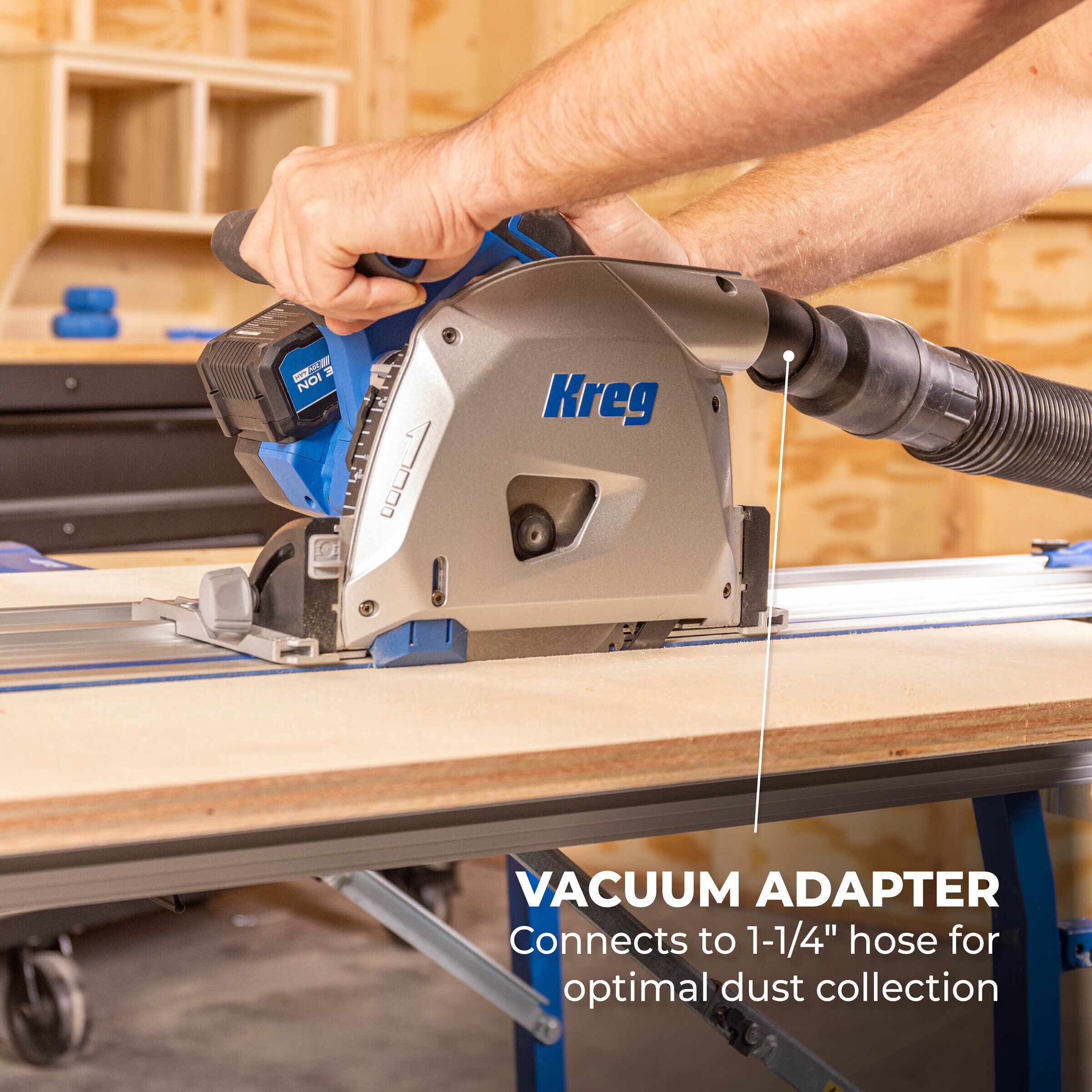
Source: kregtool.com
How Track Saw Dust Collection Works
A track saw uses an enclosed blade guard and dust port to control the chips produced during a cut. As the blade rotates through the workpiece, chips and fine particles move inside the blade housing. The extractor creates negative pressure at the dust port, pulling that material through the hose and into a collection system.
This is why a track saw can produce considerably less visible mess than an open circular saw when both are connected to effective extraction. The enclosure helps contain material near the blade, while the vacuum removes it before it can spread over the panel or floor.
Dust collection is not the same as capturing every particle. Some fine dust can escape around the blade, through small gaps, or from the underside of the workpiece. Cutting speed, blade design, material, blade sharpness, hose restrictions, and extractor performance all influence the amount of dust that remains.
The goal is therefore not simply to connect any vacuum. The goal is to maintain a reasonably unrestricted airflow path from the saw to the collection container while keeping the saw’s dust port and extractor filter in usable condition.
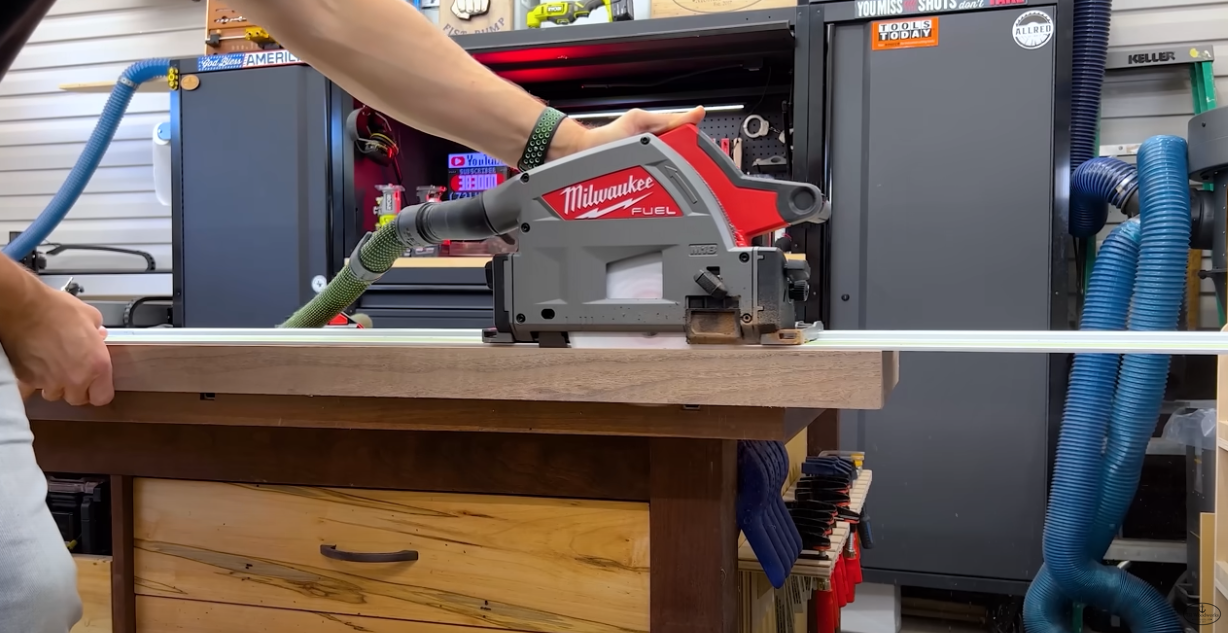
Source: tooltheory.com
Dust port
The port provides the connection between the track saw and the extraction hose. Its size and connection style vary by saw.
Extraction hose
The hose carries chips and dust from the saw to the extractor. Kinks, crushed sections, excessive length, and restrictive fittings can reduce airflow.
Dust extractor or vacuum
The extractor generates airflow and pressure that moves material through the hose.
Filter and collection container
The filter captures fine particles while the bag, bin, or container holds the collected material.
Why Track Saws Can Collect Dust Effectively
The blade is surrounded by more housing than it is on a conventional circular saw, and the cut takes place against a guide rail rather than in an open cutting area. These design features help direct chips toward the extraction port.
The result depends heavily on the connection. A track saw with an excellent dust port can still leave a dusty work area if the hose is blocked, the extractor filter is overloaded, or the connection leaks air.
Enclosed blade area
The housing limits the directions in which chips can escape.
Short extraction path
The dust port is positioned close to the blade, allowing extraction to act near the point where dust is generated.
Guide rail support
The rail keeps the saw aligned and can help maintain a controlled cutting path.
Choose the Right Vacuum or Dust Extractor
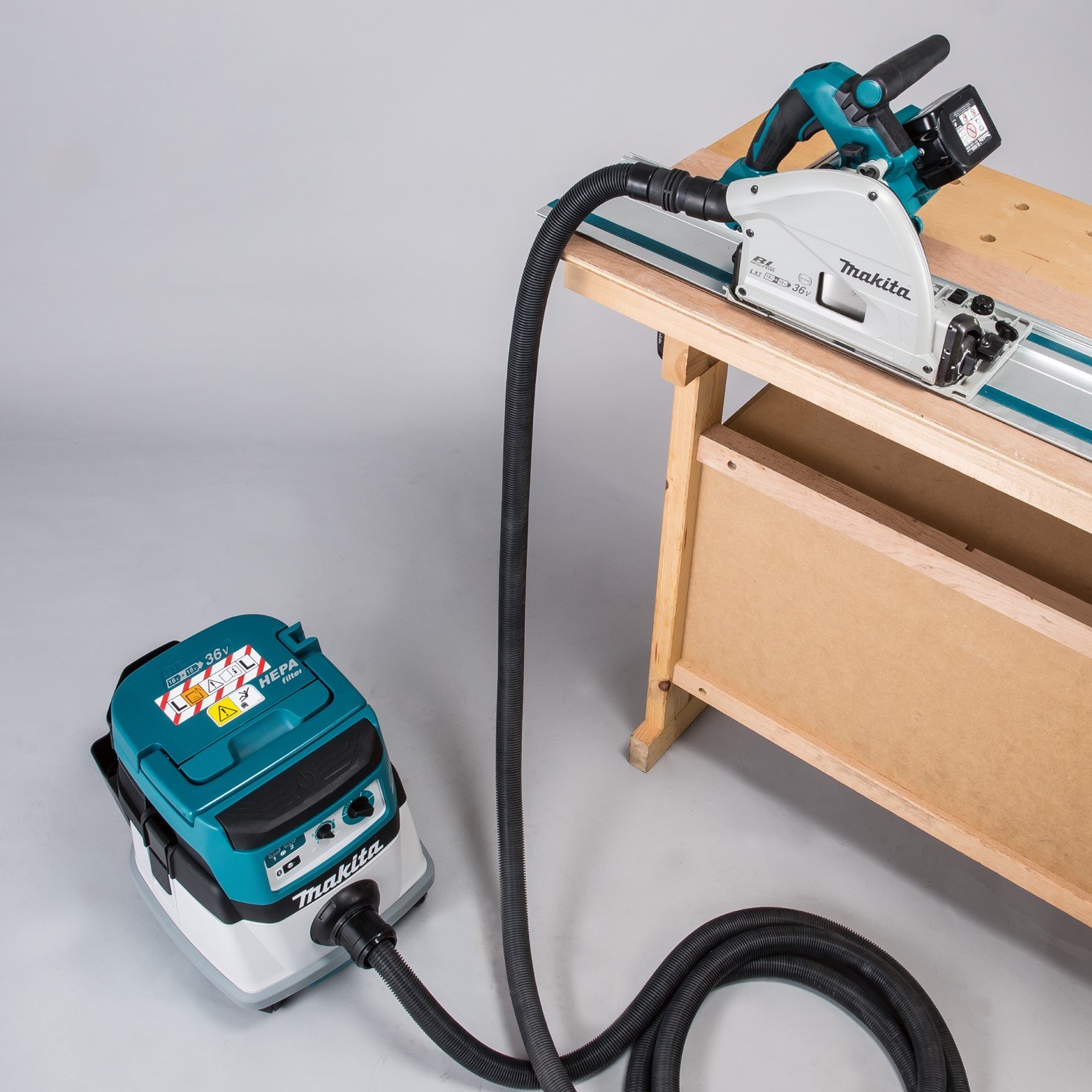
For most track saw work, a suitable shop vacuum can provide useful dust collection, while a dedicated dust extractor can offer better system integration, filtration, capacity, and control. The correct choice depends on the saw, material, frequency of use, and working environment.
A compact shop vacuum can make sense for occasional plywood cuts, remodeling work, or a portable setup. A dedicated dust extractor is more useful when the track saw is used frequently, when fine dust control matters, or when the extractor is also connected to sanders, routers, drills, or other tools.
Do not select an extractor solely by its advertised horsepower. Airflow, pressure, hose diameter, filter condition, collection capacity, and the restrictions in the complete system all affect real-world performance. A powerful extractor can still perform poorly if the hose or adapter creates a severe restriction.
For U.S. workplaces, material-specific dust requirements can also affect the equipment and controls needed. Cutting ordinary wood is different from cutting materials that generate respirable crystalline silica or other hazardous dusts. Check the material manufacturer’s information, the tool manual, and applicable OSHA requirements when working professionally.
Source: construproductos.com
Occasional DIY work
A quality shop vacuum with a compatible hose and clean filter can be practical for infrequent track saw cuts.
Frequent woodworking
A dedicated dust extractor can provide better filtration, capacity, automatic tool switching, and purpose-built connections.
Jobsite work
Portability, power source, filter maintenance, container capacity, and hose storage become especially important.
Fine-dust applications
Choose an extractor and filter system appropriate for the type and quantity of dust being generated rather than relying on a generic vacuum.
Shop Vacuum vs. Dust Extractor
A shop vacuum is generally designed for general-purpose debris collection, while a dust extractor is typically designed around power-tool dust capture and filtration. The distinction is not absolute because products overlap, but the design priorities are different.
For a track saw, the most useful characteristics are a suitable connection, sufficient airflow for the hose and tool, effective filtration, a collection system that does not quickly become restrictive, and convenient automatic switching if desired.
Shop vacuum advantage
Usually less expensive and widely available, making it practical for occasional cutting and general cleanup.
Dedicated extractor advantage
Often provides better tool integration, filtration options, hose compatibility, and features intended specifically for power-tool dust.
Main limitation
Neither system can compensate indefinitely for a blocked hose, full bag, clogged filter, leaking connection, or unsuitable adapter.
How to Set Up Track Saw Dust Collection
A reliable setup starts at the saw and works backward toward the extractor. Before making a cut, confirm that the saw, hose, adapter, and extractor form one continuous and secure path.
The following process works as a general setup method, but the manufacturer’s instructions take priority because dust-port sizes and connection systems differ between track saw models.
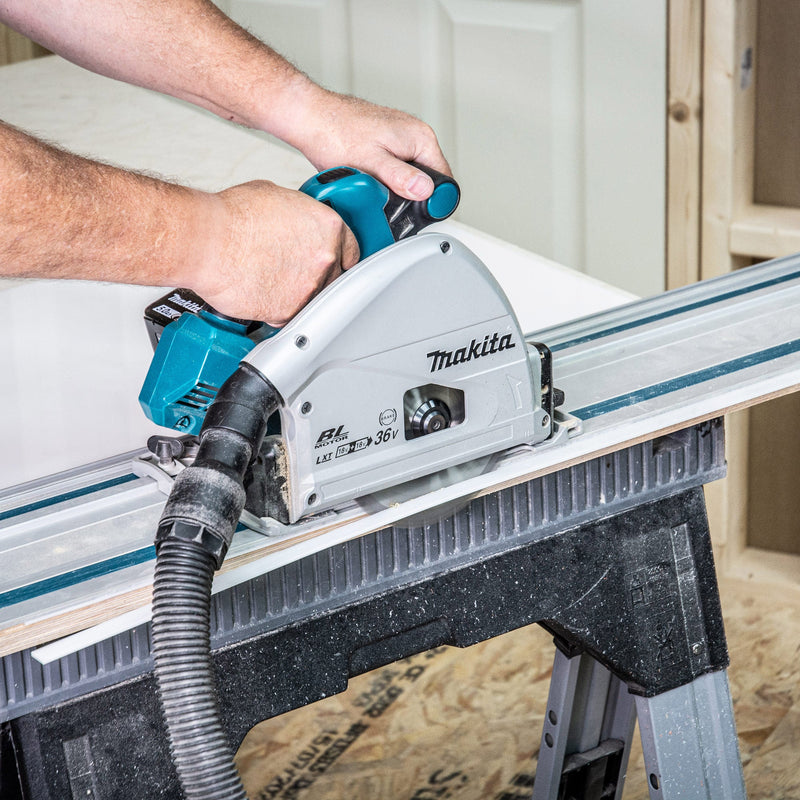
Source: toolstoredirect.co.uk
1. Inspect the dust port
Make sure the saw’s dust port is clear and undamaged. Remove accumulated chips only with the tool powered off and disconnected from its power source.
2. Confirm the hose size
Check the saw manual for the intended hose or dust-port diameter. Do not force a hose onto a connection that does not fit securely.
3. Use the correct adapter
If the extractor hose and saw port differ, use a properly designed adapter rather than an improvised connection that can leak or detach.
4. Connect the hose securely
Push or lock the connection fully into place. A loose joint can reduce extraction and allow dust to escape.
5. Inspect the hose path
Position the hose so it does not form tight bends or loops that could restrict airflow or interfere with the cut.
6. Check the extractor
Make sure the collection bag or container has capacity and the filter is not excessively loaded.
7. Start extraction
If the system has automatic tool activation, verify that it switches on correctly. Otherwise, start the extractor before beginning the cut.
8. Make a controlled test cut
Use scrap material first when setting up a new combination of saw, hose, adapter, and extractor. Watch for visible dust escaping around the saw.
How to Manage the Hose During a Long Cut
Hose management can determine whether an otherwise good dust collection system works comfortably. Place the extractor where the hose can reach the full cut without stretching. Whenever practical, keep the hose behind the saw and allow it to follow the direction of travel instead of crossing in front of the tool.
A hose that drags across the guide rail can interfere with the saw’s movement or pull the tool away from its intended path. A hose that catches on the edge of a panel can also interrupt the cut. For large sheet goods, a hose boom, overhead support, or carefully positioned extractor can reduce these problems.
Avoid using an unnecessarily long hose when a shorter compatible hose will reach the extractor. Every additional length and restrictive fitting can affect the airflow available at the tool.
Keep the hose behind the saw
This often reduces interference with the cutting path.
Avoid sharp bends
Smooth curves generally provide a less restrictive airflow path than tight bends.
Prevent snagging
Make sure the hose cannot catch on the guide rail, workpiece, sawhorse, clamp, or operator.
Support long hoses
An overhead support or boom can keep a long hose from dragging across the workpiece.
Improve Dust Collection When the Saw Still Leaves Dust
If dust is escaping despite having a connected vacuum, troubleshoot the system in order from the saw toward the extractor. Start with simple restrictions and connection problems before assuming the vacuum is too weak.
A sudden reduction in collection usually points to a blockage, full collection container, loaded filter, disconnected hose, or damaged connection. Gradually worsening performance can also result from a filter that is becoming increasingly clogged or a bag that is filling up.
Source: 731woodworks.com
Check the hose
Look for crushed sections, kinks, internal obstructions, or a hose that has pulled partly out of the tool.
Check the dust port
Fine chips can accumulate inside the saw’s dust passage and restrict airflow.
Check the filter
A loaded filter can reduce airflow. Follow the extractor manufacturer’s instructions for cleaning or replacing it.
Check the collection bag
An overfilled bag can reduce available capacity and may affect airflow depending on the extractor design.
Check the adapter
An adapter that is too restrictive or poorly fitted can create a significant bottleneck.
Check the blade
A dirty, damaged, or unsuitable blade can affect cutting behavior and chip production, even when the extraction system is working correctly.
Troubleshooting by Symptom
When only a small amount of dust escapes, inspect the blade area and the underside of the workpiece first. Some residual dust can occur even with effective extraction, especially with certain materials and cutting conditions.
When a large amount of dust suddenly appears, stop and inspect the extraction path. A disconnected hose, blocked port, full container, or filter problem is more likely than a fundamental change in the saw.
When the extractor sounds normal but collection is weak, inspect the complete hose and adapter path. Airflow can be reduced by a restriction between the saw and extractor even when the vacuum motor is operating normally.
Dust appears immediately at the saw
Check the dust port connection, hose fit, and port for blockage.
Dust increases after several cuts
Check the collection bag, container level, and filter condition.
Hose pulls the saw
Reposition the extractor or support the hose to reduce drag and tension.
Vacuum loses suction
Check for a blocked hose, loaded filter, full bag, or separator restriction.
Dust leaks around a connection
Stop the tool and correct the fitting rather than relying on tape or an unstable improvised joint.
Dust Collection for Different Materials
The material being cut affects both the quantity and characteristics of the dust. Plywood, MDF, particleboard, solid wood, laminates, and specialty construction materials do not produce identical debris, so the extraction system should be selected and maintained accordingly.
MDF and other engineered wood products can create substantial fine dust. For these materials, effective source capture and appropriate filtration are especially important. Keep the extractor close enough to maintain a practical hose length and do not continue cutting when a clogged extraction path is obvious.
When cutting a material outside ordinary woodworking applications, check the material safety information before deciding what dust controls are appropriate. Cement board, masonry products, stone, and other silica-containing materials can require controls that are different from those used for ordinary wood cutting.
Source: corebral.com.br
Plywood
A track saw and vacuum can provide effective point-of-generation collection, although some chips may still escape from the underside.
MDF
Fine dust makes effective source extraction and suitable filtration particularly important.
Particleboard
The cut can produce both larger chips and fine particles, making an unobstructed extraction path useful.
Solid wood
The amount and form of debris vary with species, moisture, blade condition, and cutting speed.
Non-wood materials
Use material-specific dust controls and verify whether the saw and extraction system are approved or suitable for the intended material.
When a Shop Vacuum Is Not Enough
A shop vacuum may be convenient for general woodworking, but there are situations where a purpose-built dust extraction system is more appropriate. Frequent professional use, large quantities of fine dust, long work sessions, specialized filtration requirements, and multiple connected tools can justify a more capable system.
Do not try to solve every dust problem by simply buying a larger vacuum. First identify whether the actual restriction is at the saw, hose, adapter, filter, bag, separator, or collection container. Fixing the restriction can produce a larger improvement than replacing a functioning extractor.
Frequent professional work
A dedicated extractor may provide better durability, filtration, capacity, and tool integration.
Fine dust
Choose filtration appropriate for the material and workplace rather than assuming a standard shop-vac filter provides every required control.
Multiple tools
A larger dust-management system may be more practical when several power tools need extraction.
Track Saw Dust Collection Safety and Maintenance
Dust collection is one part of safe track saw operation, not a substitute for the other controls required by the job. Wear appropriate eye protection, follow the saw manufacturer’s operating instructions, keep hands away from the blade path, and use respiratory protection when the hazard assessment or workplace requirements call for it.
Never direct sawdust toward yourself or another person. Before clearing a blockage, changing a blade, cleaning the dust port, or servicing the extractor, switch off and disconnect the saw according to the manufacturer’s instructions. For cordless tools, remove the battery when the manual calls for it before maintenance or clearing an obstruction.
Some manufacturers specifically warn that static charge can occur when using extraction equipment and recommend appropriate anti-static hoses or systems. Follow the instructions supplied with the saw and extractor instead of improvising electrical or hose connections.
Source: kregtool.com
Inspect before cutting
Check the hose, dust port, blade area, guide rail, and extractor connection before starting.
Maintain the filter
Clean or replace the filter according to the extractor manufacturer’s instructions.
Empty the collection system
Do not allow bags or containers to become excessively full when doing so can restrict airflow or interfere with operation.
Keep the work area clean
Source extraction reduces dust but does not eliminate settled debris. Use appropriate housekeeping practices.
Use material-specific controls
For materials that produce hazardous dust, follow the applicable safety data, manufacturer instructions, and workplace requirements.
How Often Should You Clean the Dust Port?
Inspect the dust port whenever you notice a change in extraction performance and as part of regular tool maintenance. The correct cleaning interval depends on how frequently the saw is used and what materials are cut.
A small amount of debris can become a significant restriction if it accumulates inside a narrow passage. Cleaning should be performed with the tool safely powered down and according to the manufacturer’s maintenance instructions. Avoid forcing objects into passages where they could damage internal components.
After heavy cutting
Inspect the dust path when cutting large amounts of sheet goods or fine material.
After a sudden performance change
A noticeable drop in collection is a reason to inspect the port and hose immediately.
During routine maintenance
Include the dust port, hose connection, filter, and collection system in regular inspection.
Common Track Saw Dust Collection Mistakes
Most dust collection problems come from a small number of setup mistakes. Correcting these issues can improve collection without changing the saw or buying a larger extractor.
One common mistake is treating the hose diameter as an interchangeable accessory. Different track saws use different dust-port systems, and an adapter that technically fits can still introduce a restriction. Another mistake is focusing on the vacuum motor while overlooking a loaded filter or blocked hose.
Hose routing is another frequent problem. A long hose that drags over the panel may make the saw harder to control and can interfere with a straight cut. The best dust collection system is not useful if the hose creates a handling problem.
Source: toolstoredirect.co.uk
Using an incompatible hose
A loose or restrictive connection can reduce extraction and allow dust to escape.
Ignoring the filter
A dirty filter can restrict airflow even when the extractor motor is operating normally.
Using excessive hose length
Long, restrictive hose runs can make the system harder to manage and may reduce available airflow.
Allowing the hose to snag
A hose caught on the rail or workpiece can interrupt the cut and create a handling hazard.
Assuming zero dust is realistic
Even an effective system can leave some fine particles or debris, particularly under or around the workpiece.
Cutting with a blocked port
A restricted dust passage prevents the extractor from doing its job and can cause dust to accumulate around the blade area.
A Simple Dust Collection Checklist
Before a production cut, run through a short checklist: the dust port is clear, the hose fits correctly, the extractor is ready, the filter and collection bag have usable capacity, and the hose has a clear path. This takes little time and can prevent repeated troubleshooting during a project.
Saw
Dust port clear and connection secure.
Hose
Correct size, no kinks, and enough length without excessive slack.
Extractor
Powered, correctly configured, and appropriate for the material.
Filter
Clean enough to maintain the intended airflow.
Collection container
Not excessively full and correctly installed.
Work area
Hose and extractor positioned so they cannot interfere with the cut.
Frequently Asked Questions
Q
Can I use a regular shop vac with a track saw?
Yes, a regular shop vacuum can work with many track saws when the hose and connection are compatible and the vacuum provides suitable extraction for the application. Check the track saw manual for the dust-port requirements before connecting it.
Q
What size hose do I need for a track saw?
The required hose size depends on the specific track saw. Some systems use approximately 27 mm connections, while other saws use larger or different connection designs. Check the exact model’s manual instead of assuming that a hose used on another saw will fit.
Q
Why is my track saw still producing dust with the vacuum connected?
Check the dust port, hose, adapter, filter, collection bag, and extractor for restrictions or leaks. Also consider the material, blade condition, cutting speed, and the amount of dust escaping from the underside of the workpiece. A connected vacuum does not guarantee complete dust capture.
Q
Is a dust extractor better than a shop vacuum for a track saw?
A dedicated dust extractor can offer advantages such as purpose-built filtration, tool connections, automatic switching, and better integration with woodworking equipment. A good shop vacuum can still be practical for occasional use. The better system for a particular job depends on the saw, material, frequency of use, and required dust controls.
Q
Can I use a dust collection bag instead of a vacuum?
Some track saws are designed to accept a manufacturer’s dust collection bag, particularly cordless models intended for portable work. A bag can be useful when a hose would interfere with a long cut. However, its capacity and filtration are limited, so follow the saw manufacturer’s instructions and empty or replace the bag appropriately.
Q
Does track saw dust collection eliminate the need for a dust mask?
No. Dust extraction reduces the amount of dust released into the work area but does not guarantee complete capture. The appropriate respiratory protection depends on the material, exposure conditions, workplace requirements, and applicable safety guidance. Source extraction, ventilation, housekeeping, and respiratory protection should be considered together rather than treating any single measure as complete protection.
✦ Wrapping Up
Conclusion
Effective track saw dust collection is mainly about maintaining a clear path from the blade to the collection container. Start with the saw’s specified dust-port connection, use a compatible hose and adapter, keep the hose free of sharp bends and snags, and maintain the extractor’s filter and collection system.
If dust collection is poor, troubleshoot the system in sequence rather than immediately replacing the vacuum. A blocked dust port, loaded filter, full collection bag, leaking connection, or restrictive adapter can undermine an otherwise capable extractor.
For U.S. woodworking and construction work, also consider the material being cut and the applicable workplace requirements. Wood dust, engineered wood dust, and dust from mineral or silica-containing materials should not automatically be treated as the same hazard.
💡 Key Takeaway
Before your next track saw cut, inspect the dust port, confirm the hose and adapter match the saw, clean or check the extractor filter, verify collection capacity, and route the hose so it cannot interfere with the cut. If dust remains excessive, troubleshoot the extraction path before changing equipment.