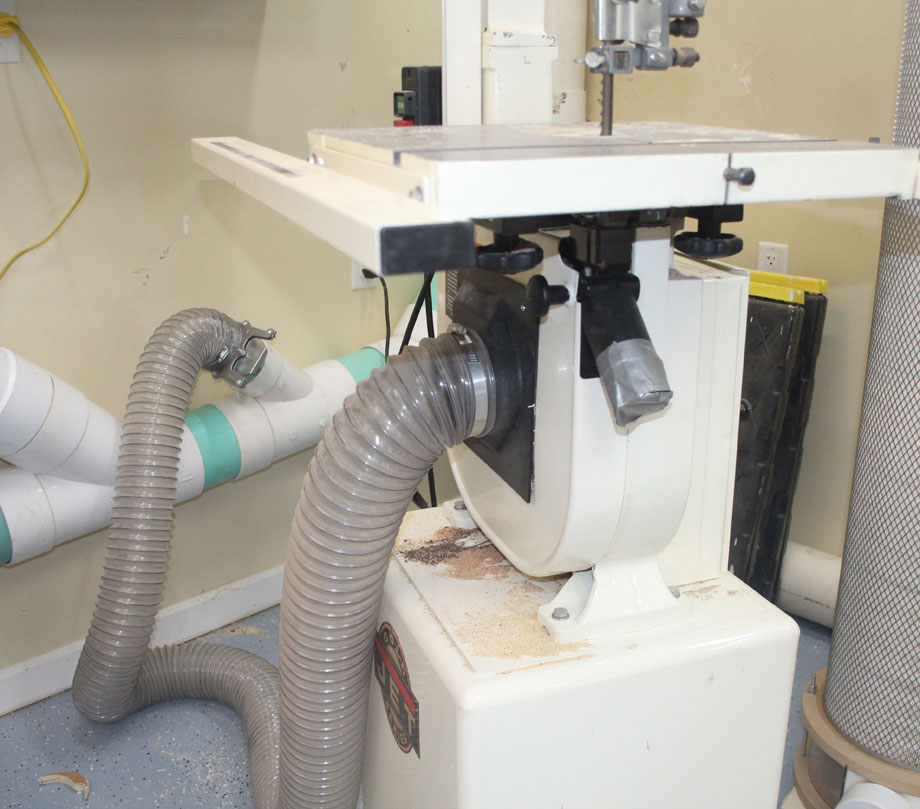
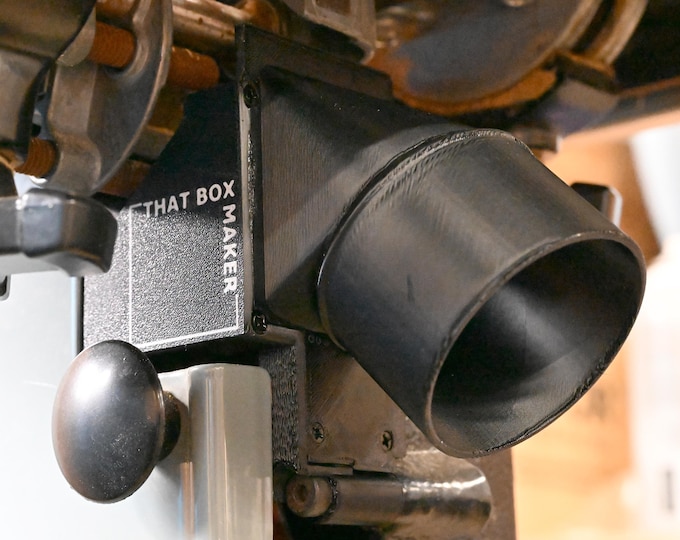
The most effective band saw dust collection captures dust close to the blade and below the table, uses a properly sized hose and collector, and limits leaks that allow dusty air to escape into the shop.
For woodworkers in the United States, effective band saw dust collection is more than attaching a hose to the factory port. A band saw sends much of the cutting debris downward through the throat opening and into the lower wheel area, while fine particles can escape around the blade and cabinet openings. The result can be a layer of sawdust inside the machine and airborne dust throughout a garage, basement, or dedicated woodworking shop.
The best setup depends on the saw, the location and size of its dust ports, the type of collector or shop vacuum, hose length, and the amount of resistance in the ductwork. A small benchtop saw may work well with a shop vacuum and a compact port, while a larger 14-inch or 17-inch saw used for frequent resawing can benefit from a higher-flow dust collector and collection closer to the blade. The goal is not simply maximum suction at the collector; it is useful airflow at the point where dust is produced.
Source: woodtalkonline.com
How Band Saw Dust Collection Works
A band saw produces dust primarily at the blade-to-workpiece contact point, but the dust does not remain there. The blade travels downward through the table, carrying chips and fine particles with it. Much of the debris passes through the throat opening and reaches the lower guide area or lower wheel housing.
That makes band saw dust collection different from simply placing a vacuum nozzle near the cutting line. The collector needs a path that captures debris before it spreads through the lower cabinet or becomes airborne. On many machines, the factory port is located below the table or on the lower wheel cabinet. That can work reasonably well, but the effectiveness depends heavily on the internal airflow path.
The basic system has four parts: a collection opening, a hose or duct, a dust collector or vacuum, and a filtration system. The opening captures the dusty air, the hose transports it, the collector creates airflow, and the filter keeps captured material from being discharged back into the workshop.
Source: images.ctfassets.net
Source capture
The collection opening should be positioned where dust actually travels rather than where it is merely convenient to install a fitting.
Airflow
The collector must move enough air through the complete system to overcome hose, duct, fitting, filter, and machine resistance.
Containment
Cabinet doors, unused ports, and other openings can allow air to bypass the dusty area, reducing effective capture.
Filtration
Collected material still needs to remain inside the collector. Fine dust can become an indoor-air problem if the filtration system is inadequate or poorly maintained.
Where Does Most Band Saw Dust Go?
For many woodworking bandsaws, the most useful collection point is below the table and close to the blade. Dust then enters the lower wheel housing, where the wheel can distribute it across the cabinet. This is why a factory port located farther down the cabinet may leave visible buildup even when the collector is running.
A practical inspection is simple: disconnect power, open the lower cabinet, and look at where dust accumulates after normal cutting. The location of the buildup provides useful evidence about where airflow needs improvement. If dust is concentrated around the lower guides or directly beneath the throat opening, a collection point closer to that area may help more than simply increasing collector power.
Under-table buildup
Consider a collection opening closer to the blade and lower guides if the factory port leaves significant dust around this area.
Lower-wheel buildup
A lower cabinet port can be useful when dust is being carried into the wheel housing before collection.
Choosing the Right Dust Collector for a Band Saw
Choose the collector according to the bandsaw’s port size and the airflow required at that port, not simply according to the horsepower printed on the collector. Manufacturer recommendations vary by machine, and a published collector CFM rating may represent unrestricted airflow rather than the airflow available after connecting hose and ductwork.
For a small benchtop bandsaw with a compact dust port, a shop vacuum can be a practical solution because it produces relatively high suction through a smaller hose. A larger floor-standing bandsaw with a 4-inch port generally calls for a higher-volume dust collector designed to move more air through a larger opening.
One manufacturer’s bandsaw documentation, for example, specifies 400 CFM at the dust port for certain 4-inch-port machines. That figure should not be treated as a universal requirement for every bandsaw. It illustrates why the measurement point matters: the collector’s advertised CFM and the airflow actually reaching the machine are not necessarily the same.
Source: images.finewoodworking.com
Small benchtop bandsaw
A shop vacuum with an appropriately sized hose can be suitable when the saw has a small collection port and the work produces a modest volume of chips.
Typical 14-inch woodworking bandsaw
A dedicated dust collector is often more appropriate when the saw uses a 4-inch port and is used regularly for ripping or resawing.
Large resaw bandsaw
Higher-volume collection may be necessary because wide, deep cuts can generate substantial amounts of sawdust and chips.
Two-port bandsaw
If the machine has separate collection points, follow the manufacturer’s instructions and consider whether a properly sized Y-connection or separate hose arrangement can maintain useful airflow at both openings.
Shop Vacuum vs. Dust Collector
A shop vacuum and a dust collector are designed around different airflow characteristics. A vacuum typically provides strong suction through a relatively small hose, while a woodworking dust collector is designed to move a larger volume of air through larger ports and ductwork. Neither is automatically better for every bandsaw.
If a saw has a 2-inch or similarly small port, reducing a large dust-collection hose down to a tiny opening can create unnecessary restriction. Conversely, connecting a small vacuum to a large 4-inch machine port may not provide enough airflow to capture dust effectively. The hose and port should form a sensible match with the collector.
Use a vacuum when
The saw has a small port, the hose run is short, and the machine’s dust output is appropriate for a vacuum-based system.
Use a dust collector when
The saw has a larger port, the machine produces substantial chips and dust, or the system needs to move high airflow through larger ductwork.
How to Set Up Band Saw Dust Collection
Start by inspecting the saw rather than buying fittings immediately. Disconnect the machine from power, open the cabinet, identify every dust port, and measure the actual port diameter. Check whether the table tilts and whether a hose or shroud would interfere with blade changes, guide adjustment, or normal operation.
Once the collection path is understood, connect the shortest practical hose with the fewest restrictive bends. Secure every connection so that the collector cannot pull air through an unintended gap. If the machine has multiple collection ports, determine whether the collector can supply sufficient airflow when both are open.
Source: images.ctfassets.net
Step 1: Inspect the machine
Locate the factory ports and identify where sawdust accumulates inside the cabinet and beneath the table.
Step 2: Measure the ports
Measure the actual inside and outside dimensions instead of assuming that a nominal 2-inch, 2-1/2-inch, 3-inch, or 4-inch label will fit your hose.
Step 3: Select the hose
Use a hose diameter appropriate for the port and collector. Keep the hose as short and direct as practical.
Step 4: Connect and secure
Use suitable adapters and clamps where required, then gently pull each connection to verify that it remains secure.
Step 5: Seal unnecessary leaks
Reduce large unintended cabinet openings that allow the collector to pull clean room air instead of drawing dusty air from the cutting area.
Step 6: Test the system
Run the collector before cutting and make a controlled test cut. Inspect the underside of the table, lower guides, wheel housing, and surrounding floor for escaped dust.
Adding an Under-Table Dust Shroud
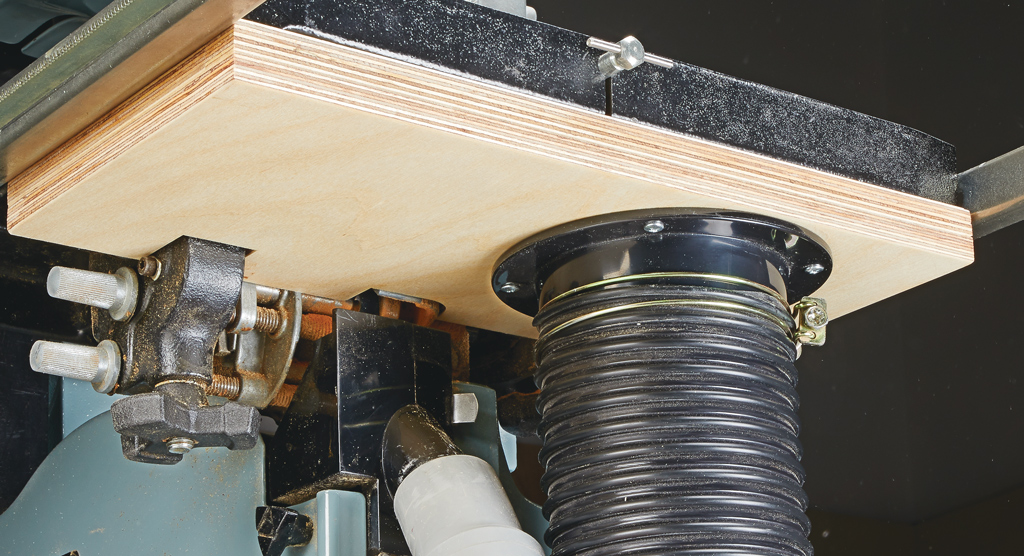
A poorly positioned factory port can sometimes be improved with a removable under-table shroud. The purpose is to create a controlled collection area around the underside of the table so that the collector draws dusty air from near the blade instead of primarily pulling air through distant openings.
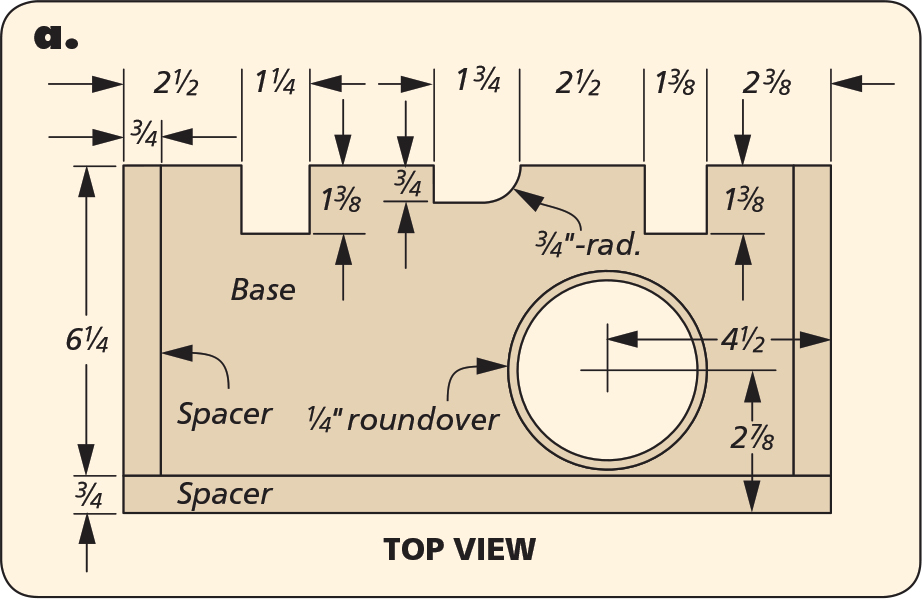
A shroud can be made from plywood, sheet material, or another suitable rigid material, depending on the machine. It should be shaped around the trunnions and other moving components without touching the blade or interfering with table movement. The collection fitting should be large enough for the intended hose, and the assembly should remain removable for blade changes and maintenance.
Do not place a homemade shroud so close to the blade that blade movement, vibration, or a broken blade could cause contact. After installation, rotate the wheels by hand with power disconnected and verify that the blade path and all moving parts have adequate clearance.
Keep it removable
A collection shroud should not make routine blade changes or machine maintenance unnecessarily difficult.
Protect moving parts
Maintain clearance around the blade, guides, trunnions, wheel, and any table-tilting mechanism.
Direct the airflow
The shroud should guide dusty air toward the collection port rather than creating a large enclosed cavity that blocks access or interferes with the machine.
Improve Airflow Through the Hose and Ductwork
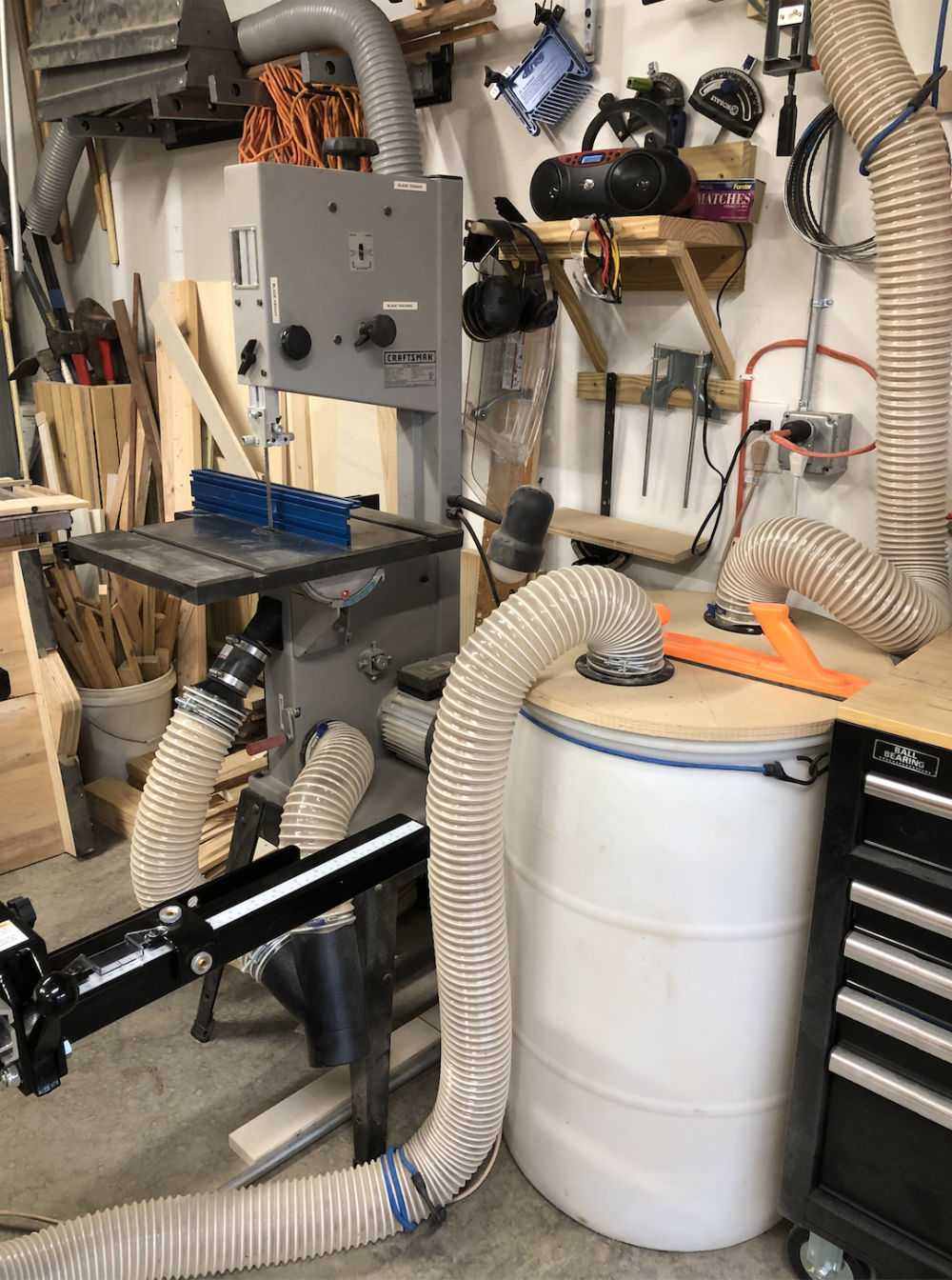
If a collector is running but dust remains around the bandsaw, inspect the airflow path before assuming the collector needs to be replaced. Every long hose, sharp bend, reducer, wye, partially closed blast gate, clogged filter, and unnecessary restriction can reduce airflow at the machine.
Smooth, appropriately sized ductwork generally creates less resistance than long runs of corrugated flexible hose. Flexible hose is useful for connecting a stationary machine to a fixed duct, but excessive lengths and tight bends can impose significant resistance.
Keep the collector filter clean according to the manufacturer’s maintenance instructions. A loaded filter can restrict airflow even when the motor is operating normally. The same principle applies to separators, collection bags, and bins: inspect the entire system when performance changes.
Source: recordpower.co.uk
Shorten flexible hose
Use only enough flexible hose to connect the machine to the fixed duct or collector.
Reduce sharp bends
Use gradual turns where practical because tight directional changes increase resistance.
Close unused branches
Blast gates or other suitable controls can prevent airflow from being unnecessarily divided among multiple open machine branches.
Maintain the filter
A dirty or overloaded filter can reduce airflow and cause a previously effective dust collection system to deteriorate.
Why a Bigger Hose Does Not Always Fix Dust Collection
Increasing hose diameter can reduce restriction in some systems, but a larger hose does not automatically create more useful airflow at the bandsaw. The collector, port, hose, fittings, and machine enclosure work together as one system.
For example, replacing a short 2-1/2-inch connection with a much larger hose does not solve a poorly positioned collection opening inside the machine. Likewise, a large hose connected to a collector that cannot maintain sufficient airflow under system resistance will not perform as expected. Fix the airflow path and capture location before simply increasing hose diameter.
Port location comes first
A correctly located collection opening can matter more than increasing the diameter of a poorly positioned port.
System resistance matters
The collector’s actual performance depends on the complete hose and duct arrangement, not just its maximum advertised airflow.
When Factory Dust Collection Is Not Enough
A factory dust port is a starting point, not a guarantee that all sawdust will be captured. If the machine consistently leaves dust beneath the table or inside the lower cabinet, first determine whether the collector is actually moving air and whether the port is connected to the area where dust accumulates.
Some bandsaws can be improved with a secondary collection point near the blade. Other designs benefit from a larger lower-cabinet port, a shroud beneath the table, or better sealing around the collection area. These modifications should be made only when they preserve safe operation and do not compromise the structural integrity of the machine.
Commercial dust deflectors and aftermarket ports can also provide a less permanent option for some machines. Compatibility should be verified against the exact bandsaw model rather than assumed from a similar-looking machine.
Source: woodnewsonline.com
Use the factory port first
Verify that the original system is correctly connected and maintained before modifying the saw.
Add collection closer to the source
A properly designed under-table or blade-area collection point can intercept dust before it spreads through the lower housing.
Consider a second port
Machines designed with two collection points may provide better source capture when both ports can be supplied with adequate airflow.
Avoid irreversible modifications unless necessary
Cutting a cabinet or drilling into a casting can affect fit, serviceability, and potentially the manufacturer’s support terms.
A Practical Two-Port Strategy
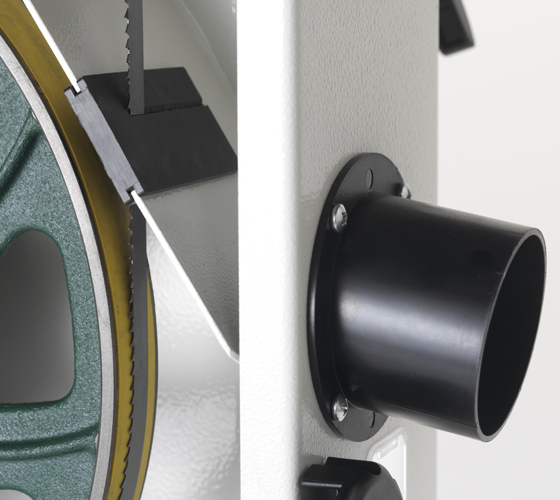
Some newer bandsaws provide both a collection point near the blade area and a larger port on the lower cabinet. When the machine and collector are designed to support this arrangement, connecting both can capture dust at different stages of its travel.
A Y-connector can combine two hoses into one line, but adding another branch also introduces resistance. The result depends on the collector and the rest of the system. If airflow becomes weak at either port, test the system with one port at a time to identify whether the collector has enough capacity for simultaneous collection.
Test each port separately
Compare dust capture with one port open at a time before deciding that both should remain connected.
Use the correct branch fitting
Choose a Y or wye fitting appropriate for the hose diameter rather than creating a severe restriction with an improvised connection.
Troubleshooting Poor Band Saw Dust Collection
When dust collection performs poorly, troubleshoot from the cutting area toward the collector. This approach helps identify whether the problem is capture location, airflow, blockage, leakage, or filtration instead of immediately replacing equipment.
Always disconnect the bandsaw from power before opening its cabinet, reaching near the blade, clearing a blockage inside the machine, or modifying the collection system. Never place a hand near a moving blade to inspect dust flow.
Source: wwgoa.com
Dust remains directly under the blade
The collection opening may be too far from the blade, too small, blocked, or poorly shaped. Inspect the area beneath the table and consider a properly designed closer collection point.
Dust fills the lower wheel housing
The factory port may not be receiving enough dusty airflow, or the collector may not have enough capacity for the machine and hose arrangement.
Dust escapes around cabinet doors
The collector may be pulling air through cabinet gaps instead of drawing enough air through the intended collection path. Inspect seals and unnecessary openings.
Collection became weaker over time
Check the filter, collection bag or bin, separator, hose, blast gates, and ports for loading or blockage.
Collector sounds normal but capture is poor
Normal motor sound does not prove adequate airflow at the machine. Inspect restrictions and test airflow at the bandsaw connection.
Dust is escaping despite strong suction
Strong suction at a small opening does not guarantee sufficient volume through the dusty area. Look for bypass airflow and poor port placement.
Signs That the Setup Is Working
A successful setup should noticeably reduce the amount of dust left beneath the table and inside the lower cabinet after a representative cut. The surrounding floor and work surface should also show less escaped dust. Some residue is normal, especially during aggressive resawing, curved cuts, or operations where the workpiece geometry directs debris away from the collection opening.
Do not judge performance from a single short cut. Test the system during the type of work that produces the most dust in your shop, such as long resaw cuts or repeated cutting of sheet goods. Inspect the machine after the test with the power disconnected.
Less cabinet buildup
The lower wheel area should accumulate less sawdust during comparable work.
Less floor dust
The area around the bandsaw should remain noticeably cleaner after normal cutting.
Stable airflow
Collection should remain effective during sustained operation rather than declining rapidly as the filter or collection container loads.
Band Saw Dust Collection Safety
Wood dust is not simply a housekeeping problem. Occupational and industrial hygiene guidance treats airborne wood dust as a potential health hazard, so source capture and suitable filtration are important parts of a woodworking setup. Dust collection should reduce exposure, but it should not be treated as a guarantee that no airborne particles remain.
Use the dust collection system whenever the bandsaw is operating. Keep the collector and filters maintained, and use suitable respiratory protection when the work or environment can still produce significant airborne dust. Follow the respiratory protection requirements and manufacturer’s instructions for the specific respirator rather than assuming that any face covering provides equivalent protection.
Do not use compressed air to routinely blow accumulated wood dust around the shop. That can redistribute settled material into the breathing zone. Vacuuming with suitable equipment is generally a better housekeeping approach.
Fine wood dust can also create combustible-dust concerns in certain industrial environments. Shop owners operating larger systems should follow applicable local requirements, equipment instructions, and professional dust-control guidance rather than treating a small hobby-shop setup as equivalent to an industrial installation.
Source: i.etsystatic.com
Disconnect power before servicing
Turn off and disconnect the bandsaw before opening cabinets, clearing internal blockages, adjusting a collection shroud, or working near the blade.
Maintain filtration
A collector that captures chips but releases fine particles back into the room is not providing complete dust control.
Protect your breathing zone
Use suitable respiratory protection when source capture alone cannot adequately control airborne dust.
Keep dust from spreading
Use vacuum-based cleanup and avoid practices that unnecessarily re-suspend settled dust.
Do Not Sacrifice Machine Safety for Dust Capture
A homemade dust port or shroud must never interfere with the blade, blade guides, table movement, wheel rotation, doors, or guards. The collection system is secondary to safe machine operation. If a modification requires cutting structural components, drilling into the machine, or changing a guard, understand the consequences before proceeding.
After any modification, disconnect power and manually inspect the blade path and moving components. Rotate the wheels by hand when appropriate and verify that the table can move through its required range without contacting the collection hardware.
Maintain blade clearance
No hose, shroud, fitting, fastener, or bracket should be capable of contacting the blade during normal operation or a foreseeable blade movement.
Preserve table movement
A dust collection modification should not prevent the table from tilting or locking as intended.
Common Band Saw Dust Collection Mistakes
Most poor results come from airflow problems rather than a complete lack of collection equipment. A few design and maintenance mistakes can make a powerful collector perform poorly at the machine.
Source: media.popularwoodworking.com
Relying only on advertised CFM
Free-air or maximum CFM does not describe the airflow available after hose, duct, fittings, filters, and machine resistance are added.
Assuming the factory port is perfectly positioned
A factory port may be convenient to manufacture but still be too far from the primary dust path.
Using too much flexible hose
Long corrugated hose runs can add substantial resistance and reduce useful airflow.
Ignoring the filter
A clogged or heavily loaded filter can reduce airflow enough to make a previously effective system perform poorly.
Using a reducer without checking the system
Reducing a large duct to a small port may be necessary, but the restriction should be minimized and the collector should be appropriate for the resulting system.
Leaving cabinet leaks unaddressed
Large unintended openings can let the collector draw relatively clean room air instead of pulling dusty air through the intended capture zone.
Adding collection hardware too close to the blade
A collection improvement is not worthwhile if it creates a blade-contact hazard or prevents normal machine adjustments.
A Simple Performance Check
Run the collector and inspect the hose for obvious collapse or blockage. With the bandsaw powered off, inspect the collection port and lower cabinet for packed dust. Check the filter and collection container, then verify that every intended branch is open and every unused branch is controlled.
After correcting obvious restrictions, make a representative cut and inspect the machine again after disconnecting power. If dust still accumulates heavily near the blade while the lower port remains relatively clean, the problem is likely the capture location or internal airflow path rather than simply insufficient collector power.
Start at the saw
The cutting area and internal dust path should be inspected before changing the collector.
Work outward
Check the port, hose, fittings, branches, separator, filter, and collector in sequence.
Frequently Asked Questions
Q
What size dust collector do I need for a band saw?
There is no single collector size that fits every bandsaw. Start with the manufacturer’s airflow recommendation for the specific model and consider the actual port size, hose length, fittings, and other open branches in the system. Some 4-inch-port bandsaws specify approximately 400 CFM at the machine, but that figure should not be applied universally to every model.
Q
Is a shop vac good enough for a band saw?
A shop vacuum can work well with a small bandsaw or a machine with a small dust port and a short hose. It may be less suitable for a large bandsaw with a 4-inch port because that setup needs substantially more airflow volume. Match the vacuum to the machine’s port and the manufacturer’s recommendations.
Q
Where should a band saw dust port be located?
The most useful location is generally close to the path where dust leaves the cutting area, often beneath the table near the lower blade guides or in the lower wheel housing. The exact position depends on the bandsaw’s internal design. Inspect where dust actually accumulates before deciding where to add or move a port.
Q
Why does my band saw still have dust even with a dust collector?
Common causes include a poorly positioned port, insufficient airflow at the machine, a clogged filter, excessive hose resistance, cabinet leaks, a blocked port, or a collection opening that is too small for the system. If dust is concentrated near the blade while the collection port remains relatively clean, investigate the capture location and internal airflow path first.
Q
Can I add a second dust port to my band saw?
A second port can improve capture when it is positioned near a significant dust source and the collector can maintain useful airflow through both connections. The modification must preserve blade clearance, table movement, guards, doors, and structural integrity. A removable under-table shroud is one possible approach on compatible machines.
Q
Should I use a 4-inch hose on a band saw?
Use a hose size that matches the machine’s port and collector design. Many full-size woodworking bandsaws use 4-inch ports, while smaller machines may use smaller connections. A 4-inch hose is not automatically better if the saw has a small port or the collector cannot provide adequate airflow through the complete system.
✦ Wrapping Up
Conclusion
Effective band saw dust collection starts at the blade, not at the dust collector. The collection point should intercept dust close to where it enters the lower portion of the machine, while the hose and ductwork should provide a reasonably direct, low-resistance path to a collector capable of maintaining useful airflow.
For a small bandsaw, that may mean a short shop-vac hose connected to a properly sized port. For a larger saw, particularly one used for frequent resawing, a dedicated dust collector, larger port, secondary collection point, or under-table shroud may provide better control. The correct solution depends on the specific machine and system rather than on a single universal CFM or hose-size rule.
If collection is poor, troubleshoot the system in order: inspect the capture location, check for blockages and leaks, verify hose and duct sizing, maintain the filter, and then evaluate whether the collector has enough capacity. Keep safety controls and blade clearance ahead of any dust-collection modification.
💡 Key Takeaway
Disconnect power, inspect where dust accumulates inside and below your bandsaw, measure the existing port, and trace the complete airflow path from the blade to the collector. Improve the capture point and remove unnecessary restrictions before buying a larger collector.