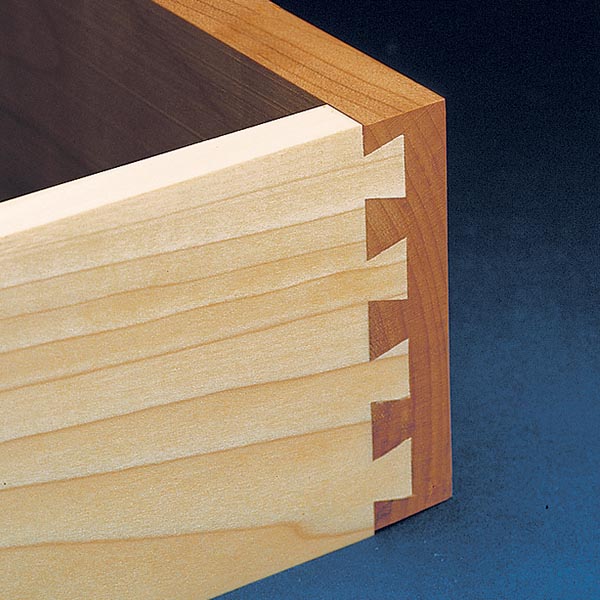
A dovetail joint is a woodworking connection made by fitting trapezoid-shaped tails on one board into matching pins on another board. Its angled geometry creates a strong mechanical lock that resists being pulled apart.
In the United States, dovetail joints are widely used by furniture makers, cabinetmakers, and hobby woodworkers for drawers, boxes, and fine furniture because they combine structural strength with visible craftsmanship. The joint works by transferring pulling forces through interlocking wood fibers rather than relying only on glue.
Understanding dovetail joint fundamentals starts with learning the relationship between pins, tails, layout, cutting accuracy, and wood movement. A properly made dovetail should assemble with controlled pressure, maintain square alignment, and provide enough surface area for a reliable glue bond.
Source: woodworkersjournal.com
What Is a Dovetail Joint and How Does It Work?
A dovetail joint connects two pieces of wood using wedge-shaped sections called tails and pins. The tails are cut into one board and the pins are cut into the mating board so the pieces slide together. The angled sides prevent the boards from separating when force is applied in the direction that would pull them apart.
The strength of a dovetail comes from its geometry. Glue improves the connection, but the interlocking shape provides the primary resistance against withdrawal. This makes dovetails especially useful for drawer corners, where repeated pulling forces occur.
Source: finewoodworking.com
Tail
The wider trapezoidal section that expands toward the end of the board and fits into a matching socket.
Pin
The narrower section between tails that locks into the tail spaces of the mating board.
Baseline
The marked depth line that controls how far the cuts extend into the wood.
Common Types of Dovetail Joints
Different dovetail styles are chosen based on appearance, strength requirements, and whether the joint should be visible. Furniture makers often select a joint style according to the location and function of the connection.
Source: ctfassets.net
Through dovetail
The pins and tails are visible on both faces of the joint, making it common for boxes and case construction.
Half-blind dovetail
The joint is visible from one side only, often used for drawer fronts where the exterior face should remain clean.
Sliding dovetail
A tapered tongue slides into a matching groove and is often used for shelves, dividers, and structural connections.
How to Make a Basic Dovetail Joint
Making a dovetail joint requires accurate preparation before cutting. Beginners usually get better results by focusing on layout and fit rather than trying to remove material quickly.
Before cutting, prepare straight, square boards with consistent thickness. A poor reference surface can create gaps even when the dovetail cuts appear accurate.
Source: techinsider.ru
1. Mark the layout
Choose tail spacing, mark the baseline, and transfer the tail positions clearly to the mating board.
2. Cut the tails
Use a dovetail saw or suitable cutting tool to follow the layout lines accurately.
3. Remove waste
Clear waste carefully with chisels while protecting the finished reference surfaces.
4. Transfer and cut pins
Use the completed tails as a guide for marking the matching pins.
5. Test the fit
Adjust small high spots gradually until the joint closes with firm hand pressure.
Signs of a Correctly Fitted Dovetail
A properly fitted dovetail should align squarely, require light pressure during assembly, and avoid large visible gaps. The joint should not require excessive force because overly tight fits can split the wood.
Even contact
The pins and tails make consistent contact along their angled faces.
Square assembly
The connected boards remain aligned without twisting or racking.
Tools, Materials, and Design Factors
The best dovetail approach depends on the project, available tools, and desired appearance. Hand-cut dovetails emphasize craftsmanship, while router-based systems can improve repeatability for multiple parts.
Hardwoods such as maple, cherry, walnut, and oak are commonly used for visible dovetail work because they provide durable edges, although many species can work when properly prepared.
Source: axminstertools.com
Hand tools
Typical tools include a dovetail saw, marking gauge, chisels, mallet, and layout tools.
Power tools
Router tables and dovetail jigs can help produce repeated drawer components with consistent dimensions.
Most dovetail problems come from inaccurate layout, poor reference surfaces, or forcing the joint together before correcting the fit. Small adjustments are usually safer than removing large amounts of material.
Source: pinimg.com
Loose joint
Possible causes include overcutting waste areas or removing too much material. Improve accuracy by making smaller fitting adjustments.
Joint too tight
High spots may need careful trimming. Avoid hammering an excessively tight joint because it can split the wood.
Uneven gaps
Check board preparation, layout accuracy, and saw control before changing the design.
Frequently Asked Questions
Q
Why are dovetail joints considered strong?
Dovetail joints are strong because their angled tails and pins mechanically resist being pulled apart. The shape transfers force through the wood instead of relying only on adhesive.
Q
Are dovetail joints difficult for beginners?
Dovetails require practice because accuracy matters at every stage. Beginners can learn successfully by starting with simple layouts, soft practice wood, and careful fitting.
Q
What angle should dovetail tails have?
There is no single required angle for all dovetails. Woodworkers choose angles based on wood species, appearance, and the strength requirements of the project.
Q
Can dovetail joints be made with machines?
Yes. Router jigs and specialized equipment can produce dovetails efficiently, especially when making multiple identical parts. Hand tools remain popular for custom work.
Q
Should dovetail joints be glued?
Many furniture dovetail joints are glued after a correct dry fit. The glue adds holding strength, while the mechanical shape provides the main structural connection.
✦ Wrapping Up
Conclusion
Dovetail joint fundamentals come down to understanding how pins, tails, layout, and accurate cutting work together. The joint is valued because it combines reliable mechanical strength with a distinctive woodworking appearance.
For anyone learning joinery in the United States, practicing on simple projects such as small boxes or drawer corners is a practical way to build the skills needed for larger furniture work.
💡 Key Takeaway
Start with straight, square stock, mark carefully, cut slowly, and adjust the fit gradually. Precision is the foundation of a successful dovetail joint.