
A Dowel Joint Guide helps woodworkers understand one of the most useful traditional joinery methods. A dowel joint is simple, clean, and strong when made with care. Many American woodworkers use dowels for furniture repairs, cabinet building, and home projects because the method does not require complex machines.
From my experience studying woodworking methods, the biggest difference between a weak dowel joint and a professional one comes from accuracy. A small drilling mistake can create gaps, while careful marking and proper tools can create a joint that lasts for decades.

What Is a Dowel Joint?
A dowel joint is a woodworking connection that uses small round wooden rods called dowels. The dowels fit into matching holes drilled into two pieces of wood. Glue is added inside the holes to lock the pieces together.
This joint creates both alignment and strength. Unlike a simple butt joint, a dowel joint gives extra support because the dowels act like internal connectors between the boards.
- ✦ Wooden connector
A dowel is a smooth wooden pin, often made from hardwood, that joins two pieces of wood.
- ✦ Hidden joinery
The dowels stay inside the wood, creating a clean surface without visible screws or hardware.
- ✦ Strong connection
The combination of dowels and wood glue creates a durable bond for many projects.
How Does a Dowel Joint Work?
A dowel joint works by transferring pressure between connected wood pieces. The dowel sits inside drilled holes and spreads force across the joint area.
When wood glue dries around the dowel, it creates a strong connection. The dowel also prevents the boards from sliding out of position during assembly.

- ✦ Drilled holes
Matching holes must be placed at the same position and depth on both wood pieces.
- ✦ Glue bonding
Wood glue fills small spaces and strengthens the connection between the dowel and wood.
Main Parts of a Dowel Joint
A basic dowel joint has three main parts: the dowel pin, the drilled holes, and the adhesive bond. Each part affects the final strength of the joint.
- ✦ Dowel pin
The solid wooden piece that locks the boards together.
- ✦ Dowel hole
The precisely drilled opening that holds the dowel.
Types of Dowel Joints Used in Woodworking
Different projects require different dowel joint designs. Woodworkers choose a style based on the direction of the wood, the required strength, and the final appearance.
A good Dowel Joint Guide should explain these common types because each one has a specific purpose.
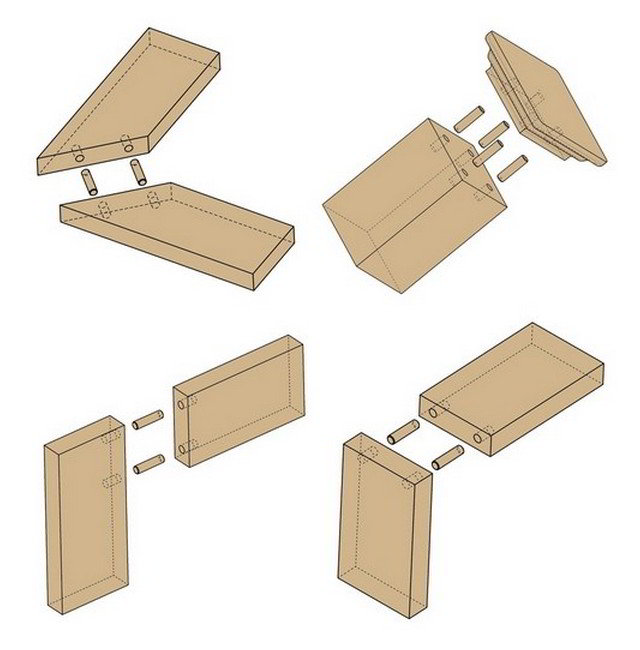
- ✦ Edge-to-edge dowel joint
Used to join boards side by side, such as making wider tabletops.
- ✦ Corner dowel joint
Used for boxes, frames, and cabinet corners.
- ✦ Face-to-edge dowel joint
Connects one board face with another board edge.
- ✦ End-to-end dowel joint
Joins two boards lengthwise when extra support is needed.
Tools Needed to Make a Dowel Joint
Making a reliable dowel joint does not require expensive equipment. Many hobby woodworkers can complete projects with basic tools and careful measurement.
Professional results come from using tools that improve drilling accuracy. A doweling jig is especially helpful because it keeps holes straight and evenly spaced.

- ✦ Drill
A drill creates the holes needed for the dowels.
- ✦ Doweling jig
A jig guides the drill bit and improves hole alignment.
- ✦ Wood glue
Glue creates a permanent bond between the dowel and wood.
- ✦ Measuring tools
A ruler, square, and pencil help create accurate marks.
Step-by-Step Process for Making a Dowel Joint
The process begins with careful planning. Measure the wood pieces and mark the exact locations where the dowels will go.
After drilling the holes, test the fit before adding glue. A dry fit helps you find alignment problems before the joint becomes permanent.

- ✦ Step 1: Mark locations
Create clear marks where each dowel hole will be drilled.
- ✦ Step 2: Drill holes
Use a guide to drill straight holes at the correct depth.
- ✦ Step 3: Add glue
Apply glue inside the holes and on the dowel surface.
- ✦ Step 4: Clamp the joint
Use clamps to hold the pieces together while the glue dries.
Common Mistakes to Avoid
Many beginners struggle with uneven holes or poor measurements. Taking extra time during preparation prevents most dowel joint failures.
- ✦ Wrong hole depth
Too shallow holes can prevent full dowel engagement.
- ✦ Poor alignment
Misaligned holes create uneven surfaces between boards.
Advantages and Limitations of Dowel Joints
A Dowel Joint Guide is incomplete without understanding both benefits and limits. Dowel joints are popular because they are affordable, hidden, and beginner-friendly.
However, accuracy matters. A poorly made dowel joint may fail because the holes do not match or the glue bond is weak.

- ✦ Advantages
Dowel joints provide clean appearance, strong alignment, and simple construction.
- ✦ Limitations
They require accurate drilling and may not handle extreme loads like some advanced joints.